Search This Blog

Wednesday, December 4, 2019

Hashtag Figureitout

It is rare that I write a lesson plan and stick to it. Lesson plans are written days in advance of my actual lessons, and by the time I go to teach my original intentions, the classroom climate is different or the kids have taken me in a different direction or school interruptions have occured or I have learned something new that makes me take an abrupt turn. That last one happened today.


The Birdville Independent School District in North Texas is putting on a professional development event called 12 Days of Innovation Summit (disclaimer: I work in this district). Each day, a video of a guest speaker is made available, and those participating are encouraged to share their learning.

The event began today with a conversation with George Couros, author of The Innovator's Mindset. Although I had many takeaways (my Twitter posts are proof), my big a-ha moment was this: we often do not give kids enough time to figure things out on their own. How often do we give a lecture or an explanation or a modeling, only to have our students turn around and ask us exactly what we just said? And how many of us give in and end up explaining ourselves again? And again. And again.

As I listened to the discussion during my drive to work, I made a last minute decision to change my well thought out lesson plans and make it a "Hashtag Figureitout Day." The second I got to my classroom, I typed up my daily instructions with a little help from my friend Liam Neeson. The first students who entered my classroom for the day immediately took notice of the meme. One even muttered an uh-oh.

Each of my morning classes sat talking for the first few minutes of their class periods, not noticing that I had not spoken. Slowly, I noticed my kids turning their attention to my post. Slowly, I noticed my kids start to get their needed materials for the day and get started on their tasks for the day.

Now, this was not a perfect and immediate transition from socializing to productive work. I stopped my students once they started to catch on to explain what we were doing and why. We discussed problem solving and asking classmates for help prior to coming to me for assistance. Some kids challenged me, checking to see if I was going to give in  - which I did not. Others complained that they still could not figure things out - which they did. When they were truly stuck, we discussed how they could figure out their issues - many of which simply required a dictionary.

By the afternoon (I see my students twice a day), the kids were asking if we were still doing the "figure it out thing." They got to work, and in all honesty, I saw kids being productive who usually beg and plead for help on every little thing while accomplishing nothing. I watched as they assisted and supported one another. It was honestly one of the best days I have had all year, all thanks to a slight shift in thinking.

My students also held me accountable to my own standards. Many of my kids are taking a high-school level engineering class, and they recently built cube puzzles. They needed to have adults and classmates attempt to solve these puzzles. I had already agreed to be a victim - I mean participant - in the challenge. This is a project I have participated in for many years, and not once have I solved any of the puzzles brought to me. That changed today when I had to practice what I was preaching and "Hashtag Figureitout."

Out of the five puzzles presented to me today, I managed to solve four. I struggled with each one. My students laughed a little and prompted me a little, but I encouraged them to let me battle my own brain. It was slightly embarrassing to have kids watch me spend six minutes to try to put a cube together, but as I tell my kids all the time, earning bragging rights feels good.

So now I challenge you. One, I challenge you to sign up for the summit and join along in the learning and sharing. Two, I challenge you to let your students figure it out. And three, I challenge you to let your students see you struggle. The payoff may be the greatest gift of all.

Saturday, November 30, 2019

Building seventh grade poets

I need to tell the truth, the whole truth, and nothing but the truth: I took the easy way out on an assignment. I needed my students to write poetry, and I was in a time crunch. Some of my students were finished with a previous writing assignment, and I needed to help others without holding my finishers up. I could not see how I was going to teach a poetry writing assignment like I wanted. So I didn't! And I have to admit that sometimes the laziest lesson planning creates the most amazing results.

"Miss, what's a syllable?"
In order to continue addressing the previous writing assignment, I resorted to creating two poetry writing assignments in Google classroom: a nonet and a Japanese lantern poem. Both poems have specific rules for lines and syllables. I assumed these would not require much explanation and/or support from me, allowing me to work with some students who needed more help.

Despite some initial struggles with syllable counting, some of my students produced the best writing I have had from them all year. I was blown away, and my shock at the work they produced led them to ask if I would share their work. I am working on building internal motivation in my students, and we are all about braggin' rights. So please allow me to brag on my kids.

Many students chose to write the nonet. I am providing the structure of the poem as well as some of my favorite examples.


Monday, November 25, 2019

Texas Association for Literacy Educators (TALE) - Literacy Awards

Texas teachers: I am a member of TALE and the advice at committee. We truly wish to recognize literacy leaders on our communities. We work hard, and recognitions like this honor that work. Please consider nominating someone for these awards and sharing this post for others. 🥇
*****
The TALE Advocacy Committee is looking for outstanding literacy leaders for the TALE Leadership in Literacy Awards! The first award recognizes an outstanding PK-12 literacy educator. The other award highlights the literacy leadership of someone who does not work in the PK-12 setting but advocates for literacy within their community. You may self-nominate or nominate someone else.

The deadline to submit all nominations is December 25, 2019!

Winners will be notified as soon as the results are decided and awards will be presented during our annual conference in Odessa in February 2020!

Find out more about our organization at http://www.texasreaders.org/

Monday, September 9, 2019

Growing pains of a middle school teacher

One word I do not often use to describe myself is spontaneous. I am a creature of habit and home. Last May, upon receiving a text asking if anyone was looking for a job in a neighboring school district, I spontaneously responded, "Why not me?" Not only did I shock my friend who sent the inquiry, but I shocked myself, as I never looked back. Within a week and a half, I had applied, interviewed, and resigned from my school home of 16 years.

The decision was definitely a good one, but I did not anticipate some of the issues I would encounter, issues related to my own thinking. Once I made the decision, I never looked back. I spent the summer getting to know new colleagues and learning about my new campus and kids. I was grateful to have an entire summer to cope with the excitement because by the first day of school, I felt ready and part of my new school family.

I forgot something, though. The kids! The kids didn't know me. Prior to this school, I only ever taught at one campus. For sixteen years. Longer than my current students have been alive. I taught siblings, cousins, nieces, nephews, aunts, uncles...and even a child of a first year student passed through. I have mentored student teaching interns who once sat in my classroom. I have been invited to weddings and baby showers. I have provided job and college references. I have supported and nutured a few thousand students. Aside from two years (we all have a couple, right?), I have maintained a relatively positive reputation.

It never crossed my mind that my new students would see me any differently. I expected them to see me as their social justice and equity champion from day one. Their nuturer. Their supporter. Their educator. Their teaching superhero! It never crossed my mind that in their eyes, I am new.

https://media.makeameme.org/created/you-taking-that.jpg

Last week, my third on the new campus, was one of the most painful I have ever experienced. That pain, however, has mostly been related to my ego. In one situation, I found myself angry with a student for a level of disprespect I haven't encountered in years, after a heart-to-heart had me thinking that the child and I had found some common ground. In another, I found myself feeling disappointed over something a student posted about me on social media, brought to me by two other students who were not willing to stand by and watch it happen. My head kept saying, "Don't you know who I am?" For a relatively brief moment, I experienced regret. Regret for leaving my previous campus, the comfort in the chaos that I was familiar with.

But then something happened that I am not sure I have ever experienced at the level with which it was provided: support. My administration nearly had me in tears with the understanding shown toward me and the discplinary measures taken to back me up. I swear my body was shaking for at least an hour, and I really expected to start bawling before my students came in. I went from feeling completely alone to feeling part of a community from one night to the next morning.

Things aren't perfect. I'm struggling with seeing students twice a day, with implementing new routines and procedures, including implementation of the workshop model. I'm battling lower motivation than I have seen in quite some time. I'm challenged by a new lesson plan format - one that is actually checked on a weekly basis. I'm facing lower success rates than I am used to working with.

Things aren't perfect. I no longer get to set the cruise control to 79 MPH in a 70 MPH speed zone. I am once again a student in my own classroom, learning about and from my students, learning new ways of teaching and meeting student needs. I am grateful for this change and this opportunity, for a chance to try new things and be more creative, and I am prepared to come home battling my own brain somedays. Maybe one day, when most of the days are all good, and I talk about the early days, the kids will say, "I don't even remember that, Miss."

Wednesday, August 28, 2019

Reading with Banksy

If you haven't seen Exit Through the Gift Shop, a documentary about Banksy's work as a street artist, I highly recommend it. This film was my introduction to his work. Bansky is phenomenal at what he does, how he sees a landscape and transforms it with creativity and insight, commentary and satire. The images he creates speak to me, each telling a story.

As an English teacher, I believe that I have a responsibility to teach kids to read all types of text, and that includes images. My current seventh grade students do not know a world without technology, without an influx of images. My concern is how these images are interpreted, especially when they are still learning the world. What information is being processed? What information is being missed or misunderstood? How does the information affect their thinking? If I do not take the time for my students to learn how to read images, who will?

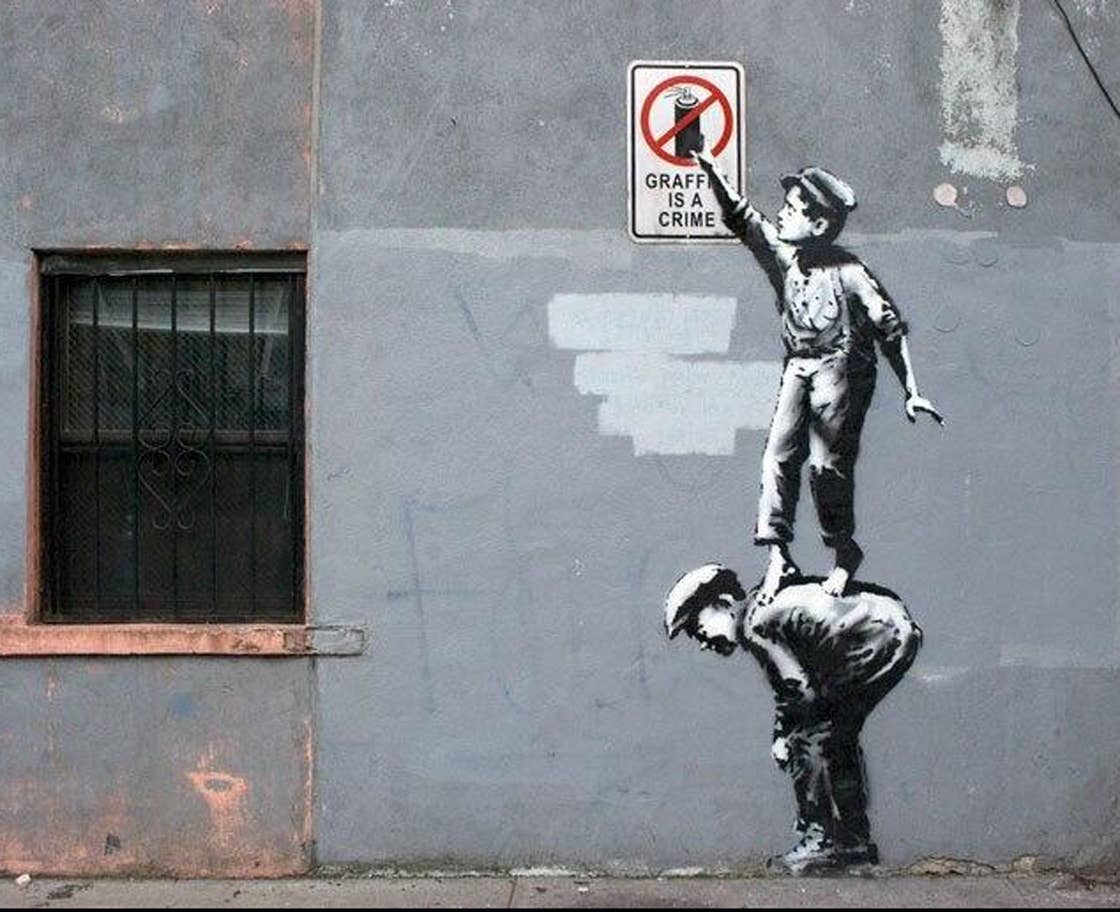
The following is one of my favorite images from Banksy and one I love to use in class for my first reading lesson:

https://static.independent.co.uk/s3fs-public/thumbnails/image/2013/10/02/14/Banksy-New-York-1.png?width=1368&height=912&fit=bounds&format=pjpg&auto=webp&quality=70
Banky's "The street is in play"

The lesson itself is simple: Make a list of everything you see in the picture. Then we share out one at a time. The conversation usually starts with observations about the window, the bars on the window, two boys, no shoes. The a-ha moment always seems to come when someone points out that the boy standing on the back of the other is either pointing at or grabbing the spray paint can from the sign.

In all of my classes this year, when this detail has been pointed out, there has been rustling as the students sit a little more upright, leaning forward to get a closer look. The classroom has filled with the sound of oh as the story unfolds before them. That moment of discovery fills my heart every time, and the exclamations shared afterward always make me smile.

In a few minutes, I am able to teach my students about the importance of details in text. It is their first lesson of the year about making inferences. It builds confidence in the ability to interpret and understand. I can now print this picture and hang it in the room as a reference point for the rest of the year, as the original mentor text.

My suggestion to you: Find an image that speaks to you, that will speak to your students. Provide them with time to discover. Then sit back and enjoy the ride.


Wednesday, November 21, 2018

My path to English language teacher

For the #Ellchat_bkclub, we have been reading The 6 principles for exemplary teaching of English learners. Chapter 4 mentions that English language teachers "come to the profession by many different pathways" (67), making me wonder how we all got here, contributing to this book club that has grown exponentially in the past year and a half since I joined. Evelyn is the reason I am here. Evelyn and a district decision back in 2010.

Evelyn was one of my seventh-grade English students. She and I bonded quickly. School was not the biggest priority for her, as it is not for many junior high students. Her Mexican family expectations were stereotypical - find a boy, have his babies. Finish school or don't. No big deal. At least that's how I remember it.

Aside from boys, Evelyn was always mixed up in drama. I once pushed my way through 200 students (I swear I am not exaggerating; I even earned the nickname Ninja Foti for how I worked my way through those kids) to get into the bathroom to break up a fight with her and another student. I ran in just in time to see her slam the other girl's head into a sink.

I wanted more for Evelyn, and I do believe part of her wanted more, too. We worked hard on her classes, more than just mine. Until the day she was removed from my class.

The district made a decision to place all ESL students together with an ESL certified teacher. Despite having a masters with an ESL focus, I really did not know much about how things worked with these students at that time, including any laws or regulations that may affect their class placement. The only thing I knew for sure was that Evelyn was taken from my class and placed with another teacher, one whom we both resented.

Things did not go well for Evelyn in the new class. She and the teacher did not get along. Evelyn's ability to see me, talk to me, and work with me became more and more limited. We would only have a couple of minutes here and there to talk, for me to keep tabs on her. And it was then that I decided that I would never allow a situation like that to happen again.

I became ESL certified within a year, and doors and opportunities opened up for me like crazy after that. Years later and I have earned a local ESL teacher of the year award and been named the best of the best presenters for my region at a state TESOL conference. The ESL kids on my campus, those I teach and those I do now, are my kiddos, whether they like it or not. I am territorial and want the best for them.

Evelyn is a grown woman. She has three kids now. I'm not sure if she finished school. The last I knew, she had not. In the middle of writing this, I stopped to send her a thank you on Facebook for transforming my life. Because she did.

So now I want to know about your story. How did you get here?

Tuesday, November 20, 2018

Making time for Makerspace

I was recently out of the classroom for two back-to-back conferences. My reading students had to survive without me for four days of school. Certainly not an easy feat for my seventh-grade students. So prior to leaving, we made a deal: if they could behave and complete the work I left with no more than one off day, we would take a break from class to visit the library and explore the new makerspace activities.

I teach struggling readers, and I truly believe students who struggle in any way need rewards to build motivation. Makerspace time may not have anything to do with reading in and of itself, but makerspace time allows for my students and I to engage in a number of other ways.

Students collaborated in small groups to problem solve. In doing so, they had an opportunity to talk to one another, building relationships in a way that does not always occur in the general classroom setting. I observed students who never talk to one another in class working together and discussing what they were creating.


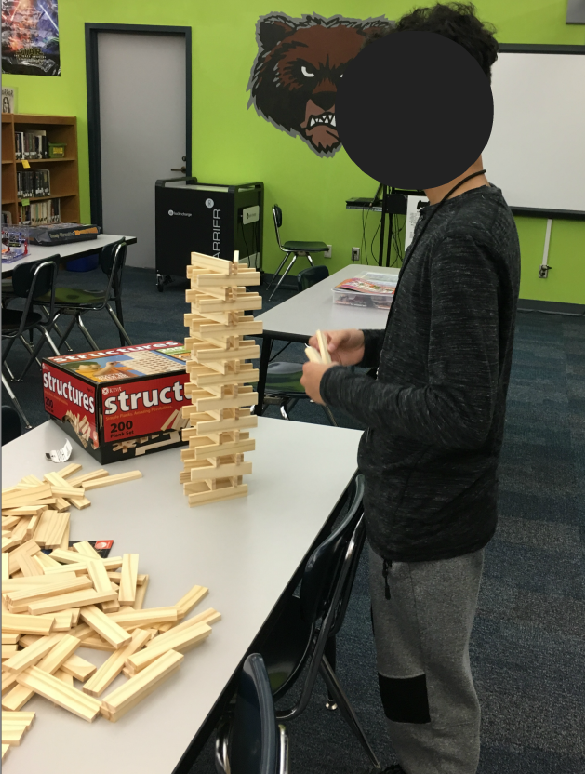
As students were working, I asked what professions they thought might use some of the same skills they were applying to their creations. The student below was building with blocks, when another student said an engineer would use those skills. The student actually doing the building said he felt that the process he was using might benefit an artist. Gotta love the kids who think differently!


One student exhibited some creativity that I had not seen in the classroom before then. When I asked what he was creating, he told he a portal - to take him home. I did ask if that same portal could take me to a tropical island, but I was denied.


In each class, I also played. I want my students to understand that "play" is not just for kids, no matter how much they criticize me for not acting my own age. They watched as I built a flower, only to have it collapse at the last second. Did they see me cry and yell and pout? Absolutely not. It was an excellent opportunity to model how to react when things do not always go our way.

I do believe that makerspace is underutilized on my campus. It is seen as play rather than being a tool for critical thinking and problem solving and so much more. And when did play become such a bad word? Are we so lost in a world of deadlines and testing that we have forgotten to give kids time to explore?

I am not simply doing my best to create better readers. I want to create writers and dancers and singers and artists, in addition to scientists and engineers and doctors and lawyers. And I hope our makerspace time ignites a spark that may not have been present before.

How are you using makerspace time with your students?

Sunday, September 9, 2018

The Independent Reading Files - Student Choice


This year, I am teaching seventh grade reading intervention classes. Not every student in my class is a developing reader (a.k.a., struggling). Some are developing test takers. Others are developing stay-awakers. Some knew they would be promoted regardless of the test outcome. Others experienced morning events that affected their performance. Regardless of the situation, we have a year to spend together, and my goal is to help these students find enjoyment in reading via independent reading.

Cullinan (2000) writes that independent reading comes in a variety of categories: voluntary, pleasure, leisure, recreational, spare time, and outside of school, for example. Within the four walls of my classroom, however, I cannot say that independent reading falls into any of these categories. These descriptors indicate a willingness and desire to read. In my classroom, silent reading time is mandated by me, thereby contradicting the very nature of voluntary reading. My hope, however, is that by participating in daily independent reading, my students will begin to want to read as a means of pleasure and leisure.

Independent reading also includes personal choice, writes Cullinan, and I am making that available to my students. Every day when my students come in to class, they are welcomed by hundreds of books.  I am fortunate to have received two grants in the past that allowed me to build a classroom library, and already this school year (we are three weeks in), I received a Scholastic library that another teacher decided she did not want. Her trash is my treasure because that library helps me provide my students with more reading options. 

It is my job to get the books into their hands by providing them with as much choice as possible. According to Skeeters et al. (2016), student choice empowers and values, leads to deep and meaningful conversations, deepens relationships, and leads to independence. I keep trade books that I have checked out from the public library in my classroom, refreshing them as they hit their due dates. I have novels of every genre. And I have informational texts and drawing books and brain teasers and graphic novels and comic books.

To date we completed fourteen days of daily independent reading, and although not all of the kids are completely on board yet, each day gets a little better. They are looking at and reading books. They are asking to keep reading once my timer goes off. They are starting to ask to borrow novels. They are starting to discover what they do and do not like about the books they are reading. This past week, a student called me over and said, "Miss, I don't find a lot of books I like, but I like this one" (in reference to Ghost by Jason Reynolds).


In addition, my English language arts teammates are starting to catch the bug. One seventh grade and one eighth grade teacher have now added a silent reading day to their weekly lessons. It may only be one day, but that provides more time that students may not read otherwise. And since my students are also in those classes, their reading time is expanding even more. The rest is yet to come.

References 

Cullinan, B. (2000). Independent reading and school achievement. School Library Media Research,3, 1-24. Retrieved September 1, 2018, from http://www.ala.org/aasl/sites/ala.org.aasl/files/content/aaslpubsandjournals/slr/vol3/SLMR_IndependentReading_V3.pdf

Skeeters, K., Campbell, B., Dubitsky, A., Faron, E., Geiselmann, K., George, D., . . . Wagner, E. (2016, February). The top five reasons we love giving students choice in reading. English Leadership Quarterly, 6-7. Retrieved September 1, 2018, from http://www.ncte.org/library/NCTEFiles/Resources/Journals/ELQ/0383-feb2016/ELQ0383Top.pdf


Wednesday, July 25, 2018

Nine Box Grid - Modified and Magnified

This week, I have returned to school to assist with our third annual incoming seventh-grade student orientation camp. I volunteer my services for this camp every year for numerous reasons: it gives me a chance to start building relationships with students I may or may not teach later on; the sample of students who participate usually reveal what we can expect from our new student population (so far, so great), and I get the opportunity to try out lessons on a smaller scale before the school year begins. 

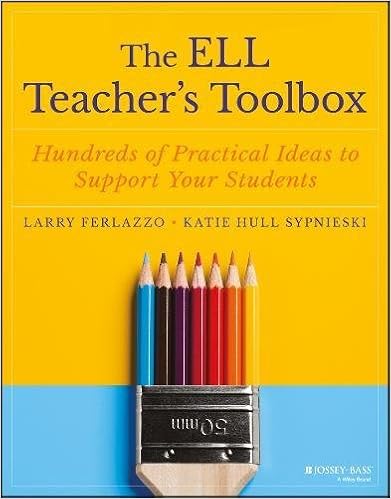
As part of the Twitter ELL book club, I  read The ELL Teacher's Toolbox by Larry Ferlazzo and Katie Hull Sypnieski. I love being part of this book club, as I have been exposed to strategies for working with ELLs - and ALL students - that I might not run across otherwise. The unfortunate part about this particular book was that we started reading it at the end of the school year, and I did not have time to implement all of these ideas that had my brain swimming in excitement. 

One activity I have been anxious to use in my classroom since last spring is Katie Toppel's Nine Box Grid. The authors acknowledge that they have modified this strategy, and I have to acknowledge that I, in turn, modified and magnified the strategy for my own needs based on the time constraints of the camp.

The Nine Box Grid involves creating a nine numbered boxes. A word is entered into each box, and they are used one at a time in a writing activity. During the school year, I am likely to use related words that we are learning in class, but due to limited time with my camp students, I chose to use a random word generator to come up with the nine words. These are readily available online. Some allow you to choose the words you want; others provide a set list. I used different types of generators for different groups of students to test out how I could make this activity work. My higher level classes received a specific set of words; my still-working-on-it groups were able to choose words from those provided to build our own list. 

I also turned the activity into a writing challenge by adding in rounds, For each round, the students received a topic (I also used an online generator for this). We started by writing about a topic with one word from the nine box grid. After completing a round, I changed the topic and increased the number of words. Most of the classes completed four rounds. 

_________________________________________________________________


  • Round 1
    • Run topic generator 
    • Pick a number on a card (the book says to use dice, but I don't even know where anything is in my classroom right now)
    • Write a sentence with the word in the box matching that number that connects to the topic
    • Share out 
  • Round two
    • Run topic generator
    • Pick two number cards
    • Write a sentence with both of the chosen words, connecting to the topic
    • Share out

    _________________________________________________________________

    My camp classes consist of English language learners (I have one student who has been here for two years, and she speaks eight languages), 504, special education, Pre-AP, and academic students. Within all of these groups, there was a great deal of groaning when I said we were going to write. I am happy to report that this was not the case by the end of the activity. The kids truly rose to the challenge. If we do not find ways to make writing fun for our kids, regardless of which student groups they fall into, those groans will never go away. We have a responsibility to light a fire within our students. 

    In addition, I have a special education co-teacher with me during one of my class sessions. She loved this activity, and her final class of the day joined mine in order to participate. She took lots of notes and said she is excited to use this with her kids once we return to school. When we model these activities for others, and they get to see how the kids respond, we spread the wealth. 

    Do not be afraid to take risks and try new things. Be contagious. Our kids deserve it. 


    Monday, March 19, 2018

    Visual Note Taking with Poetry

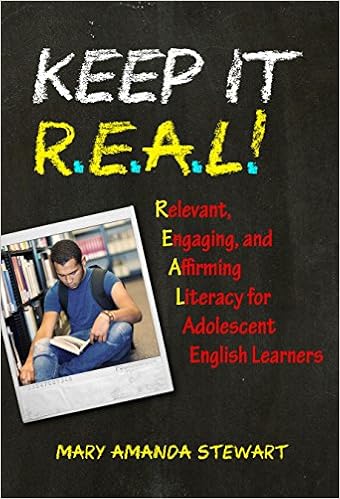
    Over spring break, I managed to read another chapter of Keep it R.E.A.L!: Relevant, engaging, and affirming literacy for adolescent English learners by Dr. Mary Amanda Stewart. Chapter 3, "Read in a literature-rich classroom," offers strategies that are applicable to the middle school classroom, and today I was able to teach poetry in my STAAR class, a supplemental reading class consisting of various types of language learners, including ESL students. And let me tell you, I hate teaching poetry as much as the kids hate learning how to read it. But today, we all enjoyed it. 

    Stewart writes, "Consider using poetry to develop students' listening skills...read the poem aloud without allowing students to see the words...Then, read the same poem while displaying the words for students and ask them if they now understood more" (54). I decided to combine this with a lesson on visual note taking (many of these students are also in my regular English classes, and I did not want to burden them with two class periods of standard note taking on our first day back from spring break). 

    Introduction to visual notetaking

    I began by showing my students a video from Youtube that addressed three components of visual note taking: decorative words, images, and connecting elements. Youtube is filled with videos about Sketchnotes and visual note taking. I chose the following video, as it is short enough to provide a general overview without overwhelming my students. 


    Multiple "readings" of the poem

    Because visual note taking was a new skill, I started with an easy poem, Jack Prelutsky's "Be glad your nose is on your face." One of my students recently informed me that I have a witch's nose, so I figured it was a good one to use in class. 

    I wanted to engage in the note taking process with my students, so rather than reading the poem aloud to them, I found an audio recording on Youtube that did not display the text of the poem, forcing my students - and me - to use their listening skills. 


    We listened to the poem multiple times, breaking our visual note taking into different rounds. While the students worked on their notes, I displayed my own paper via the document camera, modeling each step. For our first listen, we focused on words that caught our attention, adding them to our visual notes. We then listened again, drawing images that stood out to us. On the third, fourth, and fifth listens, we drew connectors between what we had drawn. 


    Displaying the poem

    The final layer of the visual note taking was the most complicated for my seventh graders, so I displayed the poem for them after we could no longer gather the information we needed by listening. The students and I referenced the text, adding more to our words, images, and connectors, adding more to their understanding of the poem. 


    Be Glad Your Nose Is on Your Face

    Be glad your nose is on your face,
    not pasted on some other place,
    you might dislike your nose a lot.
    for if it were where it is not, Imagine if your precious nose
    that clearly would not be a treat,
    were sandwiched in between your toes, for you’d be forced to smell your feet.
    it soon would drive you to despair,
    Your nose would be a source of dread were it attached atop your head, forever tickled by your hair.
    your brain would rattle from the breeze.
    Within your ear, your nose would be an absolute catastrophe, for when you were obliged to sneeze,
    be glad your nose is on your face!
    Your nose, instead, through thick and thin, remains between your eyes and chin,
    not pasted on some other place--
    The results
    For a first try, I was really impressed with my students. Not only did they enjoy the note taking strategy, they were actually invested in the poem, something that usually turns them off completely. I worked hard to remove the pressure of getting everything exactly right, focusing on building my students' ability to listen well. For ELLs with beginning and intermediate English skills, I think pairing them up with students with higher level skills might help connect the words and images together to convey meaning.
    Tomorrow I am going to give them a more difficult, grade-level poem to work with to determine if they can garner meaning through visual note taking with a bit less support from me. Again, we will begin by listening to the poem without seeing the words. I am hoping that in the long run, the kids will start to hear how poetry should sound within their own minds without relying on the voice of another.
    This one is mine. I think the kids did better. 

    Thursday, January 11, 2018

    Random Word Stories

    Winter break was a long 18 days, and I did not think about school one time, as I was in the process of selling one house and buying another. Fortunately, the AVID community on Facebook came to my rescue as I scrambled to figure out what I was going to teach the first day back to school with everyone suffering from back-to-school-itis. 

    Another AVID teacher posted that she uses random word generators to spark collaborative writing. Easy enough! I set up the lesson by explaining to my students that I would be providing them with six words from the generator. After discussing word meaning, I would provide them with six minutes to write a VERY short story with their table mates, using all of the provided words. We would then share out to practice listening and speaking skills. 

    Apparently, there are a significant number of random word generators online. I clicked on the first one. I generated a different list for each class period. For some of the classes, I had to click through a few times, as there were words that I did not even know popping up. Sure, I could have used those words as an opportunity to model my own learning, but I was tired

    The lesson went quite well. The time limit helped to keep students engaged. Many of the groups were amused with themselves for what they had created. Some wrote a couple of sentences, working in the words as quickly as possible. Others managed to write short novels in the time provided. If I had not been discussing new procedures for the second semester, I probably could have worked in a second round of this activity. I did have requests from many students to do this again, and I am pondering how to use this to inspire my seventh grade students for their STAAR writing test in a couple of months. 

    If you find yourself in need of a fifteen to twenty minute time filler (or you are having an off /I-can-barely-keep-my-eyes-open day and need to improvise), this requires little energy and planning on the part of the teacher. Give it a shot. 

    Sunday, November 19, 2017

    Keep it R.E.A.L. - Chapter 1 Response

    A few weeks ago, I received an unexpected message in my work email from a professor at Texas Woman's University. Dr. Mandy Stewart, a professor who I have not met, asked if she could share some of my work with potential graduate students. Fortunately, Dr. Stewart could not see me gushing and blushing behind my computer.

    As if that were not flattering enough, our conversation led to a book she recently wrote, Keep it R.E.A.L!: Relevant, engaging, and affirming literacy for adolescent English learners. Dr. Stewart asked me two questions: Would I mind if she sent me a copy to read? Would I mind providing my opinion on how the information can be more inclusive of middle school students?

    Me? Seriously? Two words: Jaw. Drop. What kind of expert am I? Fourteen plus years of experience teaching middle school, six of those as a certified ESL teacher, and I still do not see myself as an expert. But I do have opinions all the time, so why not! So here goes...something.

    Reader Response:

    Dr. Stewart shares how she used reader response instruction with newcomer students in a high school summer institute. Reader response might be the only theory I can comfortably discuss. I read Lois Tyson's book Critical theory today prior to entering the field of education. Even as I was studying this information as part of my English minor, reader response criticism resonated with me the most because it is how I read naturally. Once I entered the seventh grade classroom (and later on eighth), this became my go-to theory with my students.

    Reader response is all about interacting with the text to make meaning. It is about the experience of the reader. Not only do I consider this to be an ideal way for middle school students to develop a relationship with text, I also see this as beneficial for English language learners. Because we are asking our ELLs to engage with the text and develop connections, they cannot be wrong (unless they have completely misread, of course). The students are bringing their experiences to the table that allow them to engage in writing, listening, and speaking, in addition to the reading, all within the framework of a low affective filter.

    The Acronym:

    Just as we wish for students to connect with text, we need to connect with our students. Why not incorporate some slang into our teaching? I could easily say, "We are going to Keep it R.E.A.L. today," as part of a reading lesson. (That is far more comfortable for me than referring to myself as the G.O.A.T. or as Gucci.)

    Newcomers will need instruction in understanding slang American language. Pre-teens and young teens are on a journey of self-discovery, and as much as we may want them to be focused on long-term educational goals, their goal is simply to fit in with and be accepted by their peers. So I am all for keepin' it real. We can teach our newer ELLs an expression that will help them communicate socially, while also making new-language text more accessible.

    So here is my initial opinion regarding this content and students in grades 6-8: The foundation of this work is definitely an ideal fit for the middle school classroom. It allows for all students to connect to the learning, in particular our ELLs who may feel isolated and withdrawn. Reader response through Keep it R.E.A.L. provides for every student to be part of the learning community.

    Dr. Stewart discusses each element of R.E.A.L. in chapter one, and I would rather you read it than have me share all of my reader responses to the questions she proposes in regard to relevancy, engagement, affirmation, and literacy instruction, as we each bring different backgrounds and experiences from our teaching to these topics.


    Friday, October 20, 2017

    #TwoSentenceHorrorStory

    October 20, was the National Day on Writing. For weeks, I tried determine how to incorporate the day into my AVID class. We do write, but you see, it had been a long week for my students. They took the PSAT, and then they had to learn about the Pythagorean theory the same week! I had no desire to bog them down with a lengthy writing assignment. 

    Fortunately, I ran across a trending hashtag on Twitter: #TwoSentenceHorrorStory. I started reading some amazing short tales and realized that there was no way my students could complain about writing two sentences. 

    Being me, I presented the writing assignment to my classes as something dreadful. They groaned and complained about having to write until I said, "You only have to write two sentences." Boy, did their attitudes change quickly. After sharing some examples from the Twitter-verse, my students were excited to participate in the activity. I did clarify that scary is different for each person, sharing this example for them that I wrote:


    That is, by far, one of the most terrifying experiences for me. It was bad enough that there were only three yesterday. 

    I have to admit that the kids went above and beyond my expectations. I am not sure the nightmares have stopped yet. Here are some of my favorites:


    You might have to be an AVID teacher to appreciate this one. 


    I liked this lesson because it was short and sweet in addition to being highly engaging. It could be used as a time-filler or a warmup. The tone could be modified to anything one is trying to teach: humor, sadness, grief. I can see a great deal of potential.

    In addition, the limitation of two sentences kept the affective filter low for my ELLs and my struggling writers. And because we wrote on a Padlet board, we were all able to truly appreciate the madness of our minds. 


    Happy writing!

    Wednesday, September 20, 2017

    #bemoredog

    At our second annual Edcamp Arlington TX, we gave away George Couros' The Innovator's Mindset as one of many door prizes. I chose this one because it is one I want to read. It took me until yesterday to finally buy it, and it had immediate impact on me.

    While I was drying my hair this morning (hey, I work in ever minute I can to read), I was perusing the introduction to the book. Couros writes


    Well, I do happen to be a cat lover, so I stopped to watch the video.  


    We are five and a half weeks into school in my district, and I am not seeing as much effort as I would like from many of my students, particularly for a college preparation class. This commercial spoke to me. I want my students to be more dog! 

    So today I modified my lesson plan to address behaviors I am seeing on campus and in my classroom that I think need to be improved. Cat behaviors!  I was calling my students cats and making cat noises at them, speaking in complete metaphor about the cat behaviors. They were a bit confused until we watched the video. Then they were all about the dog behaviors!

    I asked my students to write three ways in which they could "be more dog" - aside from eating their homework.  There were some definite dog references - be more obedient, fetching work to turn it in on time, walking faster to get to class on time. But I also received some serious responses about being more enthusiastic and actively engaged in class. We always share out, accompanied by some sort of applause - double clap, snapping, a quick Woot! Today, we barked our approval. 

    I cannot say I have ever spent a dog hissing like a cat and barking like a dog in my classroom,  but this blog address does not start with crazyladyteacher for nothing. I am always willing to put my ego on the line and do something a bit ridiculous and adventurous in my classroom if it will benefit my students. 

    I went with a bit of crazy chihuahua today. What can you do to #bemoredog?


    Saturday, September 16, 2017

    Roving Paragraph Frames

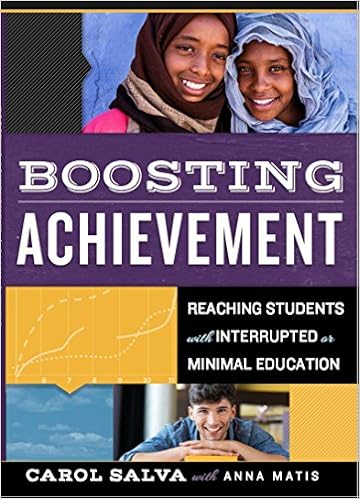
    This summer, I was introduced to a book chat on Twitter specifically focused on English language learners. The first book I read for #ELLChat_BkClub was Boosting Achievement: Reaching Students with Interrupted or Minimal Education by Carol Salva. Most of my students are long-term ELLs, but good strategies are good strategies, so I was not going to pass up the opportunity to dialogue with educators all over the country regarding this information.

    I do have some shorter-term ELL students in my classes this year, ranging from two to five years. Although we are four weeks into the school year, I do not know about their educational careers prior to immigrating. I do know that I want to provide them with the best possible education, and in Boosting Achievement, I discovered roving paragraph frames. As an AVID teacher, my students engage in writing, reading, collaboration, and reflection regularly. The roving paragraph frames strategy caught my attention because of its ability to meet my AVID expectations in addition to assisting my ELLs. I often use writing frames and templates in class, but the addition of movement and collaboration makes this a special strategy.

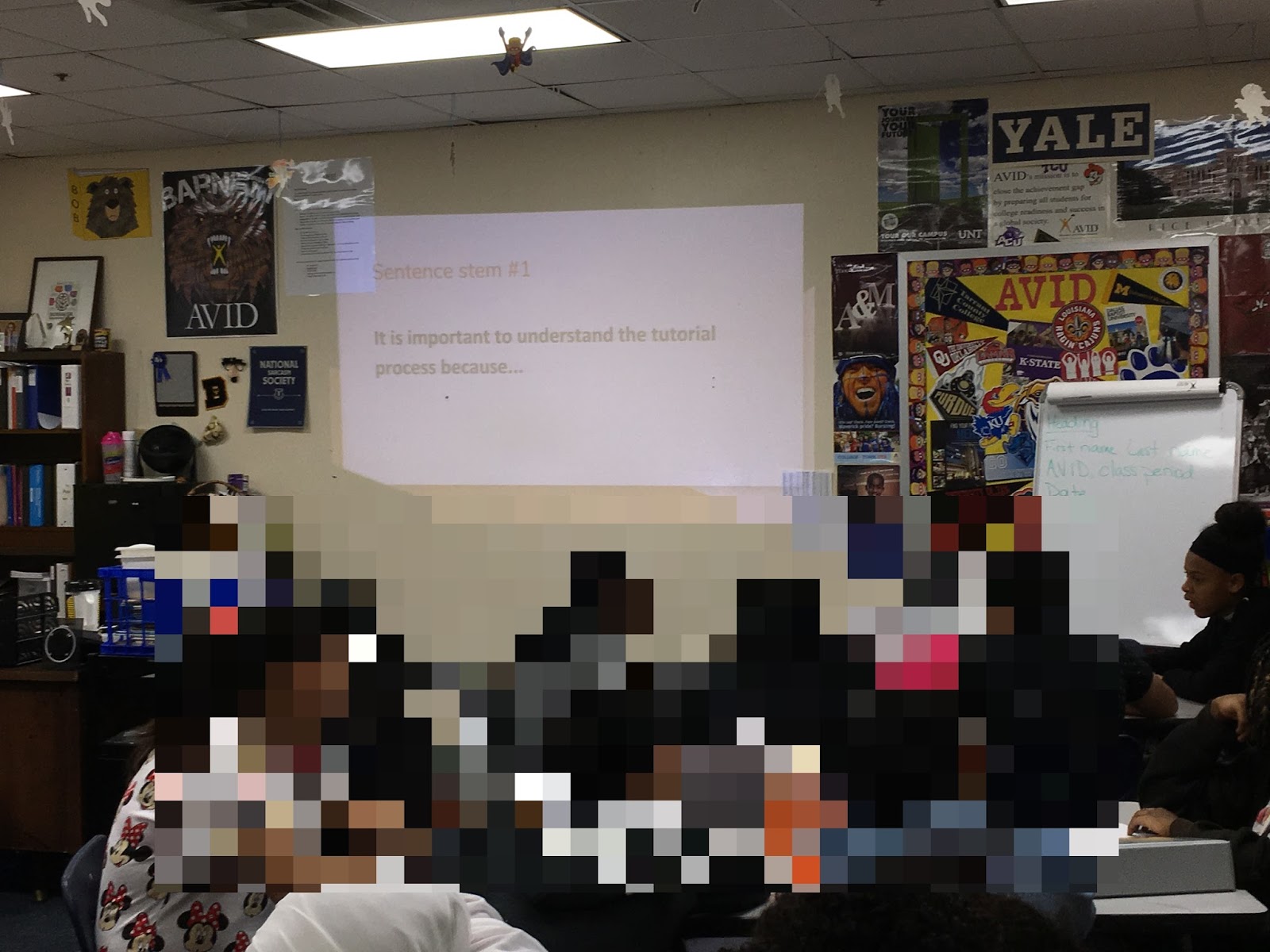
    After spending a week watching videos and taking notes over the AVID tutorial process, my students needed a day to get up and move. I used the roving paragraph frames strategy as a collaborative reflective writing assignment about our learning. Salva provides options for students who cannot yet write in English and for the newcomer classroom, as well as the following method that I used with my students:
    • Provide students with a sentence stem. They should complete the statement, creating a complete sentence. 
    "It is important to understand the tutorial process because..."
    •  Students signal when they have completed their writing and are ready for the next step. Salva suggests having students stand up in preparation to move. Because my classes are large, I simply had my students set their pencils down. 
    • Students next rove around the room to find a partner. I used the Kagan Hand up/Stand up/Pair up strategy. 
    • Once a partner is found, students read (speaking/listening) what they have written to one another.  
    • Provide another stem for students to add on to what they have written, creating another complete sentence. Students may write the information they received from their partners or write a brand new idea. 
    •  Students signal when they have completed their writing and are ready for the next step. Salva suggests having students stand back-to-back. I used this idea, but I would like to caution you in advance: we had some booty bumping taking place. 😀
    • Lather, rinse, repeat until your students have written what you wish for them to write. I kept this initial round to four sentences, as I was not sure how my students would react.
    After completing the activity, I had my students reflect on how we used listening, speaking, reading, writing, and collaboration with the strategy. It is important to me that they understand all aspects of communication skills as part of their college prep program.

    These three students are my newest to the United States and all wrote equally as well as their native Texan classmates: 

    Student from Mexico; in US 2 years


    Student from Vietnam; in US for 3 years

    Student from Vietnam; in US for 5 years

    If you have read my blog with any regularity, you know that I consider all students to be English language learners. Middle schoolers still have a lot to learn about writing fluently, and by using roving paragraph frames, my students have a foundation upon which to build.

    During my last class of the day, one boy asked if we were going to be doing this again. I told him that depended on whether or not the class enjoyed the activity. I was met with a chorus of resounding approval. I also have to tell you that my kids gave me a bit of a hard time. Apparently, I needed to increase the sophistication of the transition statements because they already know how to use the basics. Challenge accepted! Stay tuned.


    P.S. I will be presenting this information at the TexTESOL V conference in Plano in a few weeks. If you happen to try this before then, I would love your thoughts.

    P.P.S. Here is the presentation from the TexTESOLV conference. Thanks to all who attended and shared.