Search This Blog

Showing posts with label reading. Show all posts

Wednesday, August 28, 2019

Reading with Banksy

If you haven't seen Exit Through the Gift Shop, a documentary about Banksy's work as a street artist, I highly recommend it. This film was my introduction to his work. Bansky is phenomenal at what he does, how he sees a landscape and transforms it with creativity and insight, commentary and satire. The images he creates speak to me, each telling a story.

As an English teacher, I believe that I have a responsibility to teach kids to read all types of text, and that includes images. My current seventh grade students do not know a world without technology, without an influx of images. My concern is how these images are interpreted, especially when they are still learning the world. What information is being processed? What information is being missed or misunderstood? How does the information affect their thinking? If I do not take the time for my students to learn how to read images, who will?

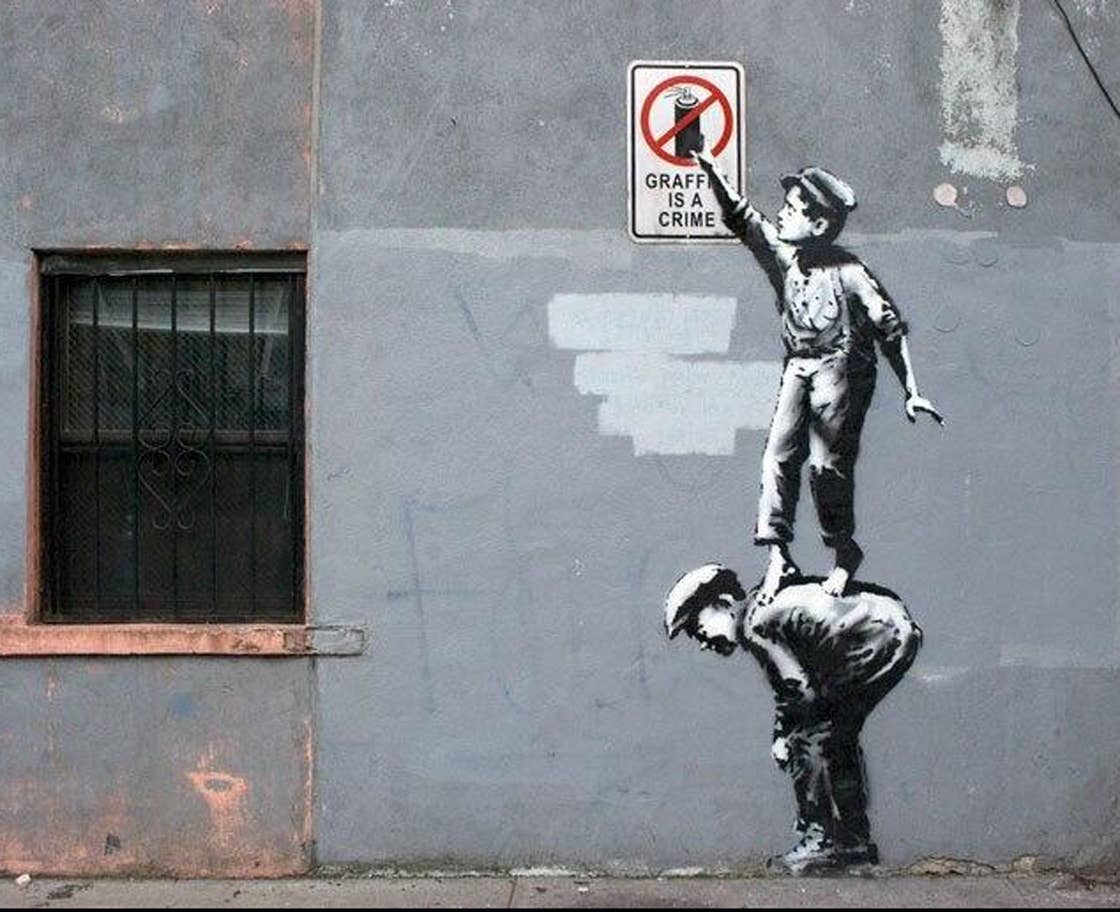
The following is one of my favorite images from Banksy and one I love to use in class for my first reading lesson:
https://static.independent.co.uk/s3fs-public/thumbnails/image/2013/10/02/14/Banksy-New-York-1.png?width=1368&height=912&fit=bounds&format=pjpg&auto=webp&quality=70
Banky's "The street is in play"

The lesson itself is simple: Make a list of everything you see in the picture. Then we share out one at a time. The conversation usually starts with observations about the window, the bars on the window, two boys, no shoes. The a-ha moment always seems to come when someone points out that the boy standing on the back of the other is either pointing at or grabbing the spray paint can from the sign.

In all of my classes this year, when this detail has been pointed out, there has been rustling as the students sit a little more upright, leaning forward to get a closer look. The classroom has filled with the sound of oh as the story unfolds before them. That moment of discovery fills my heart every time, and the exclamations shared afterward always make me smile.

In a few minutes, I am able to teach my students about the importance of details in text. It is their first lesson of the year about making inferences. It builds confidence in the ability to interpret and understand. I can now print this picture and hang it in the room as a reference point for the rest of the year, as the original mentor text.

My suggestion to you: Find an image that speaks to you, that will speak to your students. Provide them with time to discover. Then sit back and enjoy the ride.


Thursday, June 15, 2017

What I am learning about picture books

One of the classes I am enrolled in this summer is a library sciences children's and young adult literature course. In that class, I am reading Children's Literature in Action: A Librarian's Guide by Sylvia M. Vardell (and I just found out yesterday that until recently, she has been teaching the class), in addition to picture books and novels galore. This week's assignment was to read a chapter about picture books and read three picture books (choose from a particular list) for which we had to write reviews.

Even though I am a middle school teacher, I use picture/trade books in my classroom as often as I possibly can. In regard to these books, Vardell writes, "many are...not afraid to tackle challenging topics" (46). This past spring, my seventh and eighth grade AVID classes examined and analyzed controversial/banned children's books for an inquiry lesson. My students and I were able to engage in some difficult conversations involving gender, sexuality, and immigration, for example, all from picture books. I had never done this before and had no idea how young teenagers would react, but it turned out to be pretty remarkable.

As I was reading the chapter, I was checking off all of the picture books I have read, and I was pretty impressed that I have read a significant number, aside from alphabet books. Part of this is due to my participation in the #bookaday on Twitter, created by Donalyn Miller. Through this process, I discovered that many picture books are not really written for young children and that there is a lot that can be learned from these reads. I believe there are stereotypes about all picture books being elementary in nature, but many are rich in vocabulary, complex sentence structures, and information.

There were a few surprises for me within the reading:
  • One topic addressed in the chapter is awards for picture books. I had no idea that the Caldecott award had been around since the 1930s (39). The first book I shared with my students for the above mentioned lesson was Strega Nona, a Caldecott winner from 1976. I thought the award from 1976 was a long time ago - and I was alive at that time. I do not think I have ever really considered that children's books have been around for quite some time now.  
  • Vardell writes, "that no one artistic style is preferred by kids, and that judgment is rather individual" (40). This is simply something I have never thought about, but it struck me as funny. I started imagining a toddler running around the library, looking at books, grimacing, "No, not that one, Mother. The artistry is not to my liking."  
  • Most picture books are 32-pages in length (45). I was so intrigued by this that I tweeted about it and started counting the pages in some of the books I have sitting in my house right now. 32 pages, indeed! 
  • Children's picture books do not have to have a theme or lesson . Having taught middle school English for so long and theme being such a challenging TEK, this made me feel better about sharing picture books with my students for reasons other than an overall "moral of the story". The controversial books I used certainly have messages to convey, but like Vardell says, "Deeper meanings are gleaned subtly, implicitly, through understanding how the world words, how people behave, and how stories reveal those truths" (60). My students worked collaboratively to delve into those deeper meanings without my having to spoon-feed any information.
If you stop by the library or the bookstore, check out some of the children's books. There are treasures galore if you look. 


_____________________________________________


Some of my favorite picture books:

Sunday, June 4, 2017

NCTE Reads: Teaching Reading with YA Literature (chapter 1)

It's summer vacation, so I am sitting around doing absolutely nothing - said no teacher ever. I am tired just thinking about everything I am doing this summer - two graduate classes, two technology certifications, and an NCTE book study, to name a few.

For the book study, we are reading Teaching Reading with YA Literature: Complex Texts, Complex Lives by Jennifer Buehler. Now, I just finished up school yesterday (we had Saturday checkout), and our activities for the book study start today. Why no break? Because I am a teacher. And I strive to be the best possible teacher I can be. I don't need no stinkin' break! And of course, I will be sharing on my blog, as well.

_______________________________________________________________________


 _______________________________________________________________________

Week 1: MAKE

This week we’re going to create a curated list of YA novels with rationales for why they are complex texts. These lists may prove useful if you choose to use any of these novels in your class and are asked to justify your selection. Please share the title, author, and a few sentences explaining why a YA text of your choosing should be considered complex.

My response: The Hate U Give by Angie Thomas - Initially, I was not going to list this book, but I reconsidered. This book addresses topics and themes that are relevant to today’s youth. A young African American male is murdered by a police officer, an event witnessed by the story’s protagonist. The content invites natural discussion and real-world connections.
 _______________________________________________________________________

Week 1: TALK
 
How do you use YA literature in the classroom, and where does it fit in the larger context of all we’re meant to do in ELA?


My response: 

Due to a change in teaching assignments this past year, my focus on YA lit was put on the backburner. I moved from teaching eighth grade English to seventh and eighth grade AVID. Although AVID still incorporates reading and writing, I spent this year figuring out how to teach the class and bond with students who lost a beloved teacher to another position on another campus, some of whom resented me for coming in and leaving my classes and students behind. 

Personally, I did not discover young adult literature until sometime around 2007 or 2008. I know that most of the Twilight series had been published. I was teaching seventh grade at the time, and my girls were devouring the series. They wanted to talk to me about constantly, so I borrowed the set from a student to be able to reciprocate their discussions. 

I hate Twilight. Despise. Loathe. I found Belle to be a repugnant role model for young girls. To this day, I am quite vocal about my grievances with the series. It did, however, set me on a path of reading young adult literature in search of something worthy to share with my students. 

I abused my library card and read everything I could get my hands on. I recommended reads to my students, many of whom would go to the local library to find a book our school library did not carry. I started building a classroom library, thanks to a state literacy grant. 

I tend to showcase books in a display and talk about what I am reading, encouraging students to use my classroom library. This has been pretty successful, but I have not been able to reach every student in this manner.

During practice state testing situations, I will watch kids and try to determine what they might like to read. When they finish, I will bring them books from my shelves and see if I have hit on anything they might enjoy (I often do, which really surprises me).

Our middle school canon consists of young adult books. I have taught The Outsiders, The Westing Game, The Giver, Homecoming, Redwall, The Watsons Go to Birmingham, and A Wrinkle in Time. In reflection, my book and my mood probably had more to do with my students enjoying any of these books than my lessons did. For example, I dislike A Wrinkle in Time (a little less than I despite Twilight). I openly shared my frustration with my students regarding plot points, which may have been more entertaining for my kids than the story itself. 

For next year, I am considering having my AVID kids participate in independent reading activities with novels. As part of their college-readiness skills, I think they should know how to actively read novels in a particular time frame. I am in the early stages of this thinking and am not quite sure what to have my students do with those readings yet. I am hoping that throughout this book study and its discussions, I can create a meaningful reading environment for my students that carries over into their personal lives.


Saturday, February 11, 2017

Where are the diverse protagonists in young adult book series?

As many of you know, I am currently working with a master's cohort program through Texas Woman's University, and this semester, I am enrolled in Literacy and the Diverse Learner. At some point during our class last Wednesday, Dr. Claudia Haag made a comment regarding children's and young adult literature that made an impact on me: With all the book series out there that are inspiring children and teenagers to read, where are the non-white protagonists?

My mind started racing with all the book series I have read. Little House? Obviously not. Sweet Valley High? I don't think the 80s were so accepting. Harry Potter? Nope. Hunger Games? I don't think so. Eragon? Percy Jackson? Twilight? No, no, and no.  I searched book lists. None. I looked through my house. None. 


I consider myself to be pretty on top of things, but this one has passed right by me. I have worked hard to make sure that my classroom library reflects all of my students. I received a $1500 grant through First Book right after changing classes this year, and it was the perfect time to create a new classroom library. I ordered books about African American teens. I ordered books about Muslim teens. I ordered books about gay teens. I bought a few book series that I had never heard of before. But not a single one of those series has an African-American, Muslim, or gay main character. 

There is plenty of research out there that supports the need for young readers to see themselves reflected in what they read. Book series provide students with automaticity based upon familiarity with the author. Reading and fluency improve. With an achievement gap that continues to widen between racial groups, it is incredibly important to have students reading, not because we make them, but because we want them to enjoy the process. My student population consists predominantly of African-American, Hispanic, and Asian students, and I do not have a single book series in my classroom that reflects any of them in a starring role. 

I mentioned all of this to a group of African American girls in one of my classes, one of whom devours almost every book on my bookshelf. They honestly did not seem terribly concerned. Since most of the girls are not fans of reading, and I cannot help but wonder if that lack of interest does stem from not seeing enough of themselves in books. I think I am going to delve into this a bit deeper with all of my classes in a few weeks and have my students do some research. I have a few students who would like to be writers, and maybe they will be the ones who change the field in the future. 

As an insane reader of everything I can get my hands on, I am comfortable saying that things are definitely changing in the world of literature, but we still have a ways to go. Authors, we teachers are counting on you. 


References:

Camera, L. (2016, January 13). Achievement Gap Between White and Black Students Still Gaping. Retrieved February 11, 2017, from http://www.usnews.com/news/blogs/data-mine/2016/01/13/achievement-gap-between-white-and-black-students-still-gaping

Morrison, K. (2015, September 10). Part 4 - The Importance of Series Reading . Retrieved February 11, 2017, from http://www.inquirybydesign.com/part-4-the-importance-of-series-reading/

Popular series books. (n.d.). Retrieved February 11, 2017, from https://www.goodreads.com/shelf/show/series

Tuesday, September 6, 2016

Quote Analyses in Canvas Discussions

My Pre-AP students took a test over their summer reading today, and I needed an extension activity for those students who finished sooner rather than later. Since I administered the test in Canvas, I decided to create something else for my kids to do online, as that is usually what keeps them the quietest. 

This summer, I attended an AVID conference strand called AVID Academic Language and Literacy. One activity introduced was using a quote analysis (reading) to lead to academic discussion (for listening and speaking), as well as review and revision (writing). The process involves responding to a quote with a writing frame, then sharing and discussing with a partner using academic language scripts, leading to revision.

I needed a quiet classroom, however, so I moved this process to a discussion board within Canvas. The discussion board allows threaded replies and likes, similar to Facebook (but without all the cute cartoons). I am also able to join my two separate Pre-AP classes together for one cross-class conversation.


Although there were some initial struggles due to the lack of direct instruction with this instruction, the kids caught on quickly. For a first try, they didn't do too bad. Their responses included statements like "I agree with..." and "I like what you said about...". Then at some point, they became the grammar police, pointing out mistakes that needed to be corrected and directing classmates to use the entire writing frame for their responses. Talk about teaching made easy! 

This initial trial run has definitely given me incentive to pursue this further, adding depth and rigor as we move throughout the year. My student teacher did inform my kids that this is part of what she has to do in her college classes, so she may prove to be a valuable resource in this arena.