Search This Blog

Showing posts with label milkweed. Show all posts

Monday, December 8, 2014

Using Notice and Note with Dialectical Journals

I have discovered my favorite thing with Notice and Note: it goes with everything! I had been planning on teaching The Giver this year, as I have for the past few years. When I went to get copies of the book from our storage room, however, I discovered we did not have enough for me to provide each student with a copy. I did not want to work with a class set because I often have students who want to read ahead. I already had my Notice and Note lesson prepared, but since it works with everything, I did not have any issues with changing novels to work with. 
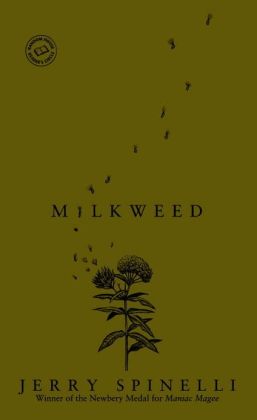
After much scrambling, I decided to teach Milkweed, a novel I used only with my Pre-AP students last year. My students will be studying World War II later this year, and after reading this book last year, I realized that even my knowledge was limited to a concentration camps (I still remember the paper I wrote in my eighth grade English class about Auschwitz). This easy-to-read novel gives my students a perspective that is not taught in most history classes. 

Coming back from Thanksgiving break last week, I had my students do nothing but copy my Notice and Note mini-posters. Ok, ok. I was really tired and did not want to have to work too hard the first day back, but...but... I am human, too! 

When I distributed student novels, I also gave them a Notice and Note bookmark. Aside from that, I have not mentioned one thing about the mini-posters until today (I actually had one kid try to talk to me about when we discussed the signposts earlier but we had not; I must be really good). 

Today I taught my students how to create a dialectical journal, using the signposts as a guide. We analyzed the text for signposts, using our bookmarks as a cheat-sheet. After identifying a signpost, we used the accompanying question from the bookmark and our posters to guide our class discussion and to write our responses. I never stopped to teach each the signposts individually. I simply jumped right in, and the kids reacted. This is what my classes came up with today for chapters one and two of the novel:


Tomorrow, the kids will start working in groups to identify signposts in the text. Some want more support before having to work on their own. Since dialectical journals are new to 76 of my 77 students, I do not have any problems with this. 

On a side note, many of my students are close to finishing the novel. Since I never even assigned a specific reading, this is a thrilling thing to see. 

Skills targeted:

  • ELPS - listening, speaking, reading, writing
  • using text evidence
  • monitoring comprehension
  • collaboration
  • inference
  • reader response


Sunday, December 8, 2013

Creating Analogies (Part 2): The Giver and Milkweed

From my analogy lesson with The Giver, I learned that I added a bit too much for my academic students to understand and left out a piece that is necessary for my understanding of student work. As I worked through my classes, I was having to modify the lesson. For my Pre-AP class analogy lesson with Milkweed, I have made some adjustments. 

The iceberg is gone in the Pre-AP lesson. My academic students were struggling enough with creating the analogies. Trying to make the animal analogies fit the iceberg was one step too much for them. With my co-teach class (academic and special education students), I never even introduced the iceberg. With another class, I had the students create the analogies, then determine where they would fit on the iceberg. Since we did the lesson as a workshop, I simply had them explain this element to me to see if they were grasping the idea. 

I have added an explanation piece to the Pre-AP lesson. As my academic students were showing me their analogies, I found myself repeatedly asking, "What do you mean by this? What is the connection?" Sometimes I forget that their thinking is not always going to be clear in their writing. I needed this extra step with them in order to not be guessing at their thinking. Every now and then they surprise me with a thought that I would never assume they had without the explanation of it. 

My academic classes only read the first five chapters of The Giver, while my Pre-AP students have read all of Milkweed. I am not sure that there was really enough information about Jonas in the first five chapters to get the analogy work that I wanted. For Pre-AP, however, they have a wealth of information to work with. Because of this, I have added two analogies that they must create: cockroach and milkweed. The cockroach image shows up repeatedly in the novel, and I want my students to put some thought into why. Milkweed is only mentioned a couple of times, but since it is the title of the novel, there must be a reason for it. I want to see what their thoughts about this are, as well. 

We will see how the revised lesson goes. Samples to come. 


Saturday, December 7, 2013

Milkweed: Found Poetry Samples

My Pre-AP students truly struggled with this lesson, but in the end, there was some fantastic work. 


I didn't even know this student was
working on the assignment. 

Completely unexpected product from
this student. 

I have shared from this student before. He is very introverted,
but he speaks volumes when he writes for me. 
This student struggles a bit, but I have
to admit that I am very pleased with her
final product. 

This student asked for permission to modify
the topic. She is a wonderful overachiever, so
she received special permission.


Sunday, December 1, 2013

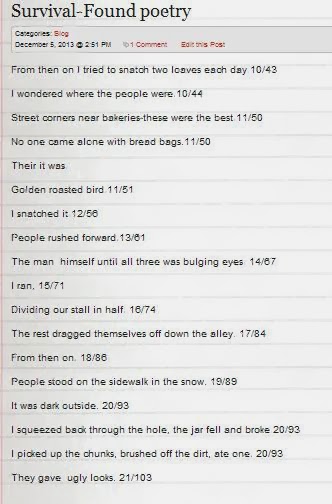
Milkweed Chapters 10-21: Found Poetry

I was so mad at my Pre-AP students for not reading their assigned chapters by the due dates that I assigned them holiday break reading. That is totally uncharacteristic of me, but they were messing up my teaching mojo. 

They have now completed two journal-entry blog assignments as the main character Stopthief. Before I bore them with monotony, I decided I needed to do something new for this holiday reading assignment. I was flipping through one of my AVID books and spotted a lesson on found poetry. I have used this strategy before but not for a few years now. I am trying to work in some different writing genres, however, so I am glad I ran across this when I did. 

Here is what they will be doing (for some reason, my spacing on Kidblog is not working this evening):


______________________________

For this assignment, you will be writing a found poem.
Due Date: Wednesday, December 4

What is a found poem?
A found poem is one composed of phrases from another text (Milkweed).

How do I write a found poem?

1. Choose one of the following topics (you must identify this at the beginning of your blog post).
              a. identity
              b. hope
              c. discrimination
              d. survival
              e. justice

2. Choose a minimum of one phrase from each of chapters 10 - 21 that relates to the topic you have chosen.

3. Create your poem.

             a. Your phrases do not have to be in the same order as the book.
             b. You may change punctuation as needed to make your poem work.
             c. You may add, delete, or revise words to make your poem work.
            d. Your poem must be a minimum of 11 lines (one phrase per chapter),
             a maximum of 22 lines (two phrases per chapter).
             e. You must include the chapter number and page number at the end of each phrase.
             f. Your poem must have an original title.

You may use this Word Mover once you have your phrases chosen. You can type them in and then rearrange them until you have the poem you want.

______________________________

Samples to come!

Saturday, November 23, 2013

Milkweed 1-4: Sample Blog Posts

At 2:30 PM Friday afternoon, I was cursing myself to giving this assignment: Create a blog as the character Stopthief in Milkweed. Create an entry that fits the character's life based on the parts we have read. This is not complicated, people!

My school mascot is a bear;
hence the angry bear. 
I went over the assignment Monday so my Pre-AP kids could start thinking about it. By Thursday, they were clueless about everything I discussed Monday. Because I had to reteach everything from Monday, I had to extend the due date for the assignment until the end of class Friday. By the end of class Friday, I had kids who still couldn't figure out what to do. Grrrr!

Between answering the same questions eight gazillion trillion uberillion times, I started looking at the posts from the kids who did understand the lesson. Right at that moment I had hit rock bottom, the sun started shining brilliantly. I am here to share some of that brilliance with you. These are my two favorites:

I love the approach this student took, and I feel like this entry captures
an eight-year-old voice.
This is from one of my quietest students. I was impressed to see his creativity.


Saturday, November 16, 2013

Milkweed, Chapters 1 - 4

My Pre-AP class is reading (or going to be) Milkweed to wrap up the first semester. I handed out the books Thursday and asked them to read chapters 1-4 by Monday. During an informal survey Friday, I learned that about a third of my students had already started reading the book, and many were well past chapter 4. All responded that they were finding the book very interesting. Since I have never taught this book (nor have I finished reading it), I am excited by their initial feedback. 

The biggest problem I have with novels is wanting to teach too much and not being able to finish. I think I have already  made too much work for the first few chapters, but better earlier than later. I would rather enjoy the end of the novel rather than cram too much in at the end. 

Our big assignment for the entire novel is going to be to create a blog for the main character Stopthief. Through this, I can reinforce a number of skills, including point of view and characterization. I have never done this before, but since I have started blogging, I figure I can handle it. I'm excited to see what happens with this. 

For their work, we are going to be using Kidblog. I have heard wonderful things about it and have been playing with it. The site is easy to use and understand, and all work is private. Once I see how things go with Pre-AP, I will decide whether or not to add my other classes to the site. 

For their first blog assignment, I modified a lesson I found on Read Write Think:


To make sure they have done the reading this weekend, I have a quick "higher level" assignment for them to complete on Edmodo. I believe this assignment will be a bit more challenging than a quick T/F or multiple choice did-you-read pop quiz. It should also show if they actually read. 


We will then return to chapter 1 to discuss the Memory Moment signpost from Notice and Note. This will be the third signpost added to our class discussions. I debated about whether or not to include this piece since the students are reading ahead, but I still think that it is important to cover. If the kids already know too much, they can discuss why the moment turns out to be important rather than predicting. 
I have then created an interactive lesson for chapters 1-4 using Nearpod. I made the basic presentation then added slides for my students to ask questions about the text. As we go through the questions they write, I am going to have them write down three that they want to discuss with their groups. They will take notes over this in their Google documents. This group discussion will be used to write their learning logs next week. 

After all this, I need to figure out how many days I actually have left to finish this novel before finals! 

Questions? Feedback? All is welcomed.