Search This Blog

Showing posts with label Texas Woman's University. Show all posts

Sunday, November 19, 2017

Keep it R.E.A.L. - Chapter 1 Response

A few weeks ago, I received an unexpected message in my work email from a professor at Texas Woman's University. Dr. Mandy Stewart, a professor who I have not met, asked if she could share some of my work with potential graduate students. Fortunately, Dr. Stewart could not see me gushing and blushing behind my computer.

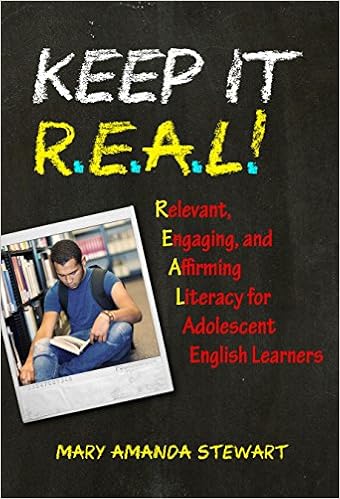
As if that were not flattering enough, our conversation led to a book she recently wrote, Keep it R.E.A.L!: Relevant, engaging, and affirming literacy for adolescent English learners. Dr. Stewart asked me two questions: Would I mind if she sent me a copy to read? Would I mind providing my opinion on how the information can be more inclusive of middle school students?

Me? Seriously? Two words: Jaw. Drop. What kind of expert am I? Fourteen plus years of experience teaching middle school, six of those as a certified ESL teacher, and I still do not see myself as an expert. But I do have opinions all the time, so why not! So here goes...something.

Reader Response:

Dr. Stewart shares how she used reader response instruction with newcomer students in a high school summer institute. Reader response might be the only theory I can comfortably discuss. I read Lois Tyson's book Critical theory today prior to entering the field of education. Even as I was studying this information as part of my English minor, reader response criticism resonated with me the most because it is how I read naturally. Once I entered the seventh grade classroom (and later on eighth), this became my go-to theory with my students.

Reader response is all about interacting with the text to make meaning. It is about the experience of the reader. Not only do I consider this to be an ideal way for middle school students to develop a relationship with text, I also see this as beneficial for English language learners. Because we are asking our ELLs to engage with the text and develop connections, they cannot be wrong (unless they have completely misread, of course). The students are bringing their experiences to the table that allow them to engage in writing, listening, and speaking, in addition to the reading, all within the framework of a low affective filter.

The Acronym:

Just as we wish for students to connect with text, we need to connect with our students. Why not incorporate some slang into our teaching? I could easily say, "We are going to Keep it R.E.A.L. today," as part of a reading lesson. (That is far more comfortable for me than referring to myself as the G.O.A.T. or as Gucci.)

Newcomers will need instruction in understanding slang American language. Pre-teens and young teens are on a journey of self-discovery, and as much as we may want them to be focused on long-term educational goals, their goal is simply to fit in with and be accepted by their peers. So I am all for keepin' it real. We can teach our newer ELLs an expression that will help them communicate socially, while also making new-language text more accessible.

So here is my initial opinion regarding this content and students in grades 6-8: The foundation of this work is definitely an ideal fit for the middle school classroom. It allows for all students to connect to the learning, in particular our ELLs who may feel isolated and withdrawn. Reader response through Keep it R.E.A.L. provides for every student to be part of the learning community.

Dr. Stewart discusses each element of R.E.A.L. in chapter one, and I would rather you read it than have me share all of my reader responses to the questions she proposes in regard to relevancy, engagement, affirmation, and literacy instruction, as we each bring different backgrounds and experiences from our teaching to these topics.


Sunday, March 5, 2017

My role as a student in blended learning

In addition to everything else I do, I decided to add yet another challenge: an online blended learning course. One of the first assignments was to read a chapter that explains blended learning. For being 43, I think my educational path has included more technology that most. 

When my daughter was born in 2001, I decided to get my masters degree. The University of Texas at Arlington was offering a degree plan that could be fully completed online. With a newborn, this was an ideal situation (except, in reflection, the horrific internet speeds of the time). My entire Masters of Education in Teaching (M.Ed.T) was earned based upon online discussions, assessments, and assignments. I had no face-to-face interaction with anyone, although I was having online interaction with a classmate in Japan. At the time, I thought this was one of the most amazing ways to learn, but now that I have engaged in blended learning, I have a different viewpoint.

I am currently enrolled in a masters cohort program through Texas Woman's University.  Two of the four classes I have taken have been blended learning courses, including the one in which I am currently enrolled. For my current class, we meet every two weeks (my summer class met every three to four) for face-to-face learning. During our off weeks, we have online discussions regarding our readings for class, allowing us to engage in much more than we can possibly cover in a three-hour class every two weeks. We also share real-life connections that we run across and respond to the work of one another.

There is a drawback to this class - for me. Considering how quickly my brain works, I have a lot to say. I am a heavy contributor to the discussion boards, and at times, I wish my classmates would add more. But I am realistic. We all have different lives and time available to us. It is not uncommon for me to be up reading and writing by 6 AM, but I certainly do not expect that of others.  

I am also currently participating in an online book study that is not blended learning. Here again, I wish there was more dialogue occurring. The administrator of this course set up expectations about how many posts and responses we need to add to the discussion. To some extent, I think that takes away from natural online dialogue, but I also see a need for it to ensure that those who signed up for this course contribute to it. 

I have had a chance to speak face-to-face to a few district colleagues who are enrolled in the book study course with me. There does seem to be some intimidation for those who are not as comfortable using technology, and for them, I think adding a face-to-face component would be beneficial. But as teachers, librarians, and instructional coaches, I know that trying to find time that works for everyone is not terribly easy. This particular course was designed to be "PD in your PJs." 

Having participated in fully face-to-face, fully online, and blended learning,  I find blended learning to be the most beneficial for my personal growth. I feel the added online component to the face-to-face class keeps me focused on the learning and challenges me to look at other viewpoints more frequently.

I am still trying to determine how to make this work with my own middle school students who see one another on a daily basis. For the next year, I am considering branching discussions across class periods to tie multiple classes and grade levels together. I need the downtime of summer vacation to plan this out.

For those of you out there using or engaging in blended learning, what are your thoughts about the positives and negatives? Have you been involved in anything that has brought about more success than you expected?

Sunday, February 26, 2017

Stop stopping the violence: boys and writing

One of my assignments for my current graduate diversity class is to conduct research regarding a topic I am interested in, become an "expert" in a few short weeks, and present what I have learned to my classmates. I have been thinking about this assignment at the same time I am conducting interviews for my AVID classes for next year and coping with the frustration of not being able to recruit and keep boys in this program. When the tornado of my brain whipped both of these into its vacuum, I found myself searching Google for information about literacy and achievement gaps between male and female students.


I ran across the article "Misreading masculinity: Speculations of the great gender gap in writing" by Thomas Newkirk, written in March 2000. Much of my early career teaching seventh grade English was spent teaching writing, and writing is a key component of AVID's WICOR. So I chose this as my first article to read. 

One of many topics discussed in this article is the prevalence of violence in boys' writing. If you had asked me few hours ago, I would have said, "Bad, bad, bad. Boys should not be writing about violent topics in school." But Newkirk has swayed me:


(p. 296)


Reading this sent me directly back to my first year of teaching. I assigned something for writing, although the exact assignment has long escaped my mind. The details of B.'s paper, however, are clear in my mind. He turned in his work on green paper, and I marked it up in red pen. B. had written about coming into the school with a sword and attacking his classmates. His story culminated with my head being chopped off. 

Since B. was already a student with whom I had disciplinary issues (he was a 12-year old boy), I treated the writing as a threat toward me. There was a referral. There was a parent conference. There was a suspension. 

If I could only rewind time! I made the mistake of automatically assuming that B.'s "use of violence in writing [was meant to be] vicious or sadistic" (p. 296).  According to Newkirk, I missed a great deal of the complexity that was included in B.'s writing:
  • A video culture - B. had actually written his passage based on a video game he had been playing. This information was revealed during our parent conference, but my new-teacher ego was offended at the time. The last time I spoke to B. a few years ago, he was trying to become a video game developer.
  • A friendship culture or social world - B. never intended to offend me with his story. He simply cast me as the villain and himself as the protagonist in a story set in our mutual environment. He expressed that he thought I would be complimented to be included in his story.
  • "A curriculum culture - ...In transforming largely visual narratives to written narrative, students negotiate popular culture and academic work" (p. 297). B. was simply taking an idea from his everyday life and adding it to my assignment.
I have come a long way in the past 13 1/2 years, and I continue to grow and learn every day.  I want to build a passion for writing, not kill it (pun intended). The next time I see any of my boys including violence in their writing, something I have discouraged over the years, I will engage in more dialogue. I know that in our current times, not every piece of expression can be treated equally, but I am now far less likely to apply the sentence before the trial. 


Saturday, February 11, 2017

Where are the diverse protagonists in young adult book series?

As many of you know, I am currently working with a master's cohort program through Texas Woman's University, and this semester, I am enrolled in Literacy and the Diverse Learner. At some point during our class last Wednesday, Dr. Claudia Haag made a comment regarding children's and young adult literature that made an impact on me: With all the book series out there that are inspiring children and teenagers to read, where are the non-white protagonists?

My mind started racing with all the book series I have read. Little House? Obviously not. Sweet Valley High? I don't think the 80s were so accepting. Harry Potter? Nope. Hunger Games? I don't think so. Eragon? Percy Jackson? Twilight? No, no, and no.  I searched book lists. None. I looked through my house. None. 


I consider myself to be pretty on top of things, but this one has passed right by me. I have worked hard to make sure that my classroom library reflects all of my students. I received a $1500 grant through First Book right after changing classes this year, and it was the perfect time to create a new classroom library. I ordered books about African American teens. I ordered books about Muslim teens. I ordered books about gay teens. I bought a few book series that I had never heard of before. But not a single one of those series has an African-American, Muslim, or gay main character. 

There is plenty of research out there that supports the need for young readers to see themselves reflected in what they read. Book series provide students with automaticity based upon familiarity with the author. Reading and fluency improve. With an achievement gap that continues to widen between racial groups, it is incredibly important to have students reading, not because we make them, but because we want them to enjoy the process. My student population consists predominantly of African-American, Hispanic, and Asian students, and I do not have a single book series in my classroom that reflects any of them in a starring role. 

I mentioned all of this to a group of African American girls in one of my classes, one of whom devours almost every book on my bookshelf. They honestly did not seem terribly concerned. Since most of the girls are not fans of reading, and I cannot help but wonder if that lack of interest does stem from not seeing enough of themselves in books. I think I am going to delve into this a bit deeper with all of my classes in a few weeks and have my students do some research. I have a few students who would like to be writers, and maybe they will be the ones who change the field in the future. 

As an insane reader of everything I can get my hands on, I am comfortable saying that things are definitely changing in the world of literature, but we still have a ways to go. Authors, we teachers are counting on you. 


References:

Camera, L. (2016, January 13). Achievement Gap Between White and Black Students Still Gaping. Retrieved February 11, 2017, from http://www.usnews.com/news/blogs/data-mine/2016/01/13/achievement-gap-between-white-and-black-students-still-gaping

Morrison, K. (2015, September 10). Part 4 - The Importance of Series Reading . Retrieved February 11, 2017, from http://www.inquirybydesign.com/part-4-the-importance-of-series-reading/

Popular series books. (n.d.). Retrieved February 11, 2017, from https://www.goodreads.com/shelf/show/series

Monday, September 5, 2016

Reading Intervals

This semester, I am taking a graduate class called Understanding, Valuing, and Teaching Struggling Readers. In my first class session last week, my classmates and I had to create a list of characteristics we associate with struggling readers. My partner and I included a lack of interest, stamina, and the ability to retain information, among many, many others. These, in particular, stood out to me as traits that I could immediately address. 
Image result for intervals 
The next day in the intervention classes that I teach, I established Reading Intervals to address these concerns. I explained how when we train as athletes, we often partake in interval training. So why not try it with reading and see if it helps us? 

  • Lack of interest
    • In the article "Taming the Wild Text," Allyn notes that students have may be reluctant or lack basic skills "because they haven't been exposed to materials suited to their interests, ability, and temperament" (19). To offer my students a wide range of materials, I stopped by the public library and picked up numerous kid books - books, award winners, graphic novels, comics. I left this out for class use, in addition to my classroom library. All students were allowed to choose whatever they wanted to read, regardless of the level of difficulty or ease.
  • Stamina/Ability to Retain Information
    • Instead of sitting down to read for a long period of time, we started with three minutes of reading. Once the timer went off, I had the kids make some notes about what they were reading in an attempt to help them retain information. They were then given the option to stand up and stretch and/or choose something different to read. 
    •  Before setting the timer for follow-up intervals, I asked the kids for their input on how long they wanted the next interval to be. Allyn states that, "For some reason, setting the timer to odd times...really helps!" (21).  I asked if they wanted to stick to three minutes or bump up to five. Every class choose five. One class got brave and asked me to set the timer for ten minutes so they could see how long they would last. The average was seven minutes before they found themselves losing focus.  
By the time we got through the entire class period, each student had completed at least fifteen minutes of independent reading. For many, this was an enormous accomplishment. 
 
There were also some unexpected surprises that came along with this impromptu lesson:
  • A few students asked if I could get more chapter books from the library for them. They wanted to see if something would catch their interest enough to get them to read an entire book.
  • Students were sharing their struggles during the note-taking intervals, allowing me glimpses into their thinking. One of our big focuses in class is metacognition, and this was definitely a moment when my kids were thinking about their thinking. 
  • Impromptu book talks were taking place. I had helped some of my boys find sports books to read, and every chance they had, those boys were comparing notes about story lines and arguing about who was going to check books out from me first. Can you say "Happy teacher"?
I am definitely going to continue on this adventure as I create reading athletes. I highly recommend checking out Allyn's article, as she discusses strategies to help struggling readers "become fierce, unafraid, and strong" (16).

References

Allyn, Pam. "Taming the Wild Text." Educational Leadership: Reading: The Core Skill:. ASCD,      Mar. 2012. Web. 05 Sept. 2016.

Monday, February 29, 2016

Where is poetry hidden in your life?

This weekend, I had the honor of being able to attend the Rose F. Spicola Forum in Reading at Texas Woman's University in Denton, Texas (the perks of being enrolled in a cohort program). The two keynote speakers were Georgia Heard and Naomi Shihab Nye. 


Google Search

Google Search

I have no shame in admitting that I am not a big poetry fan. Sure, I filled journals with teen angst-filled poems about boys and friends and loneliness when I was younger, but I have never considered myself a poet. Sure, I get a kick out of Shel Silverstein and "Sarah Cynthia Silvia Stout", but I do not consider myself a strong poetry teacher. But listening to Heard and Shihab Nye inspired me to find my poetic side. 

In Heard's speech, she discussed finding hidden poetry in our lives. She began by asking the audience to make a list of places where we might find hidden poetry:
  • my workouts
  • my classroom
  • my students
  • my pets
Heard then asked us to take one of our ideas and make a poem out of it. The assignment was not about writing at the level of a professional poet but of expressing ourselves through poetry. If I cannot write my own and be comfortable with whatever I can produce, how can I expect my students to do so? 


Both Heard and Shihab Nye suggested carrying around a small notebook in which to track observations about the world. After leaving the forum, I headed straight to Walmart to buy myself a little notebook and some cute new pens (may as well indulge). 


Being in a poetry mindset, I found myself aware and taking notice of the world around me - at Walmart. And there is so much to observe and write about at Walmart!


From this list, I heeded Shihab Nye's advice. I chose some of the items on my list and created a new poem. 


From here, I am already planning ahead in my brain, determining how to use this in my class this year and next year (I am always thinking ahead). I am not worried about my talent - or lack thereof. I want to be able to go through the process in order to be a better teacher. Maybe I can ignite a passion in a student and end up watching them become the keynote speaker at a future conference.