Search This Blog

Showing posts with label Bringing Words to Life. Show all posts

Sunday, January 11, 2015

Wizards, Wizards, Everywhere! (Updated 8/29/2016)

Word Wizard is an unexpected success! The first day back from winter break, I presented the idea. By the second day, I was in shock. 

When presenting the idea of being on the lookout for our vocabulary words in the world outside of my classroom, I was not met with the greatest enthusiasm. In every class period, I had students ask if they had to do it. I insisted that this is a truly optional assignment, and many seemed quite pleased. 

In the two following days, student after student approached my class tutor and me about having heard, read, or used (I will explain there creative approach to earning points in a second) our vocabulary words. I honestly was not even expecting them to remember the words we covered for the first semester, especially after two and a half weeks off. 

The really surprising part? The students who came to us with the words have been predominantly male and predominantly the goofballs. And I think that it is important to make a big note of this. Sometimes we think those goofballs are not paying attention because they are screwing around. Challenge them. I bet you, too, will discover that they are more in tune to your class than you may realize. 

So where are they finding words? These are just a few examples. 

  • "Family Guy" - The night I presented the lesson, many of the kids went home and watched this show. In a bar scene, one character called another a runt.


  • Song lyrics - One student sent me a screenshot for the lyrics of the song "Pompeii." He heard the word rubble


  • Conversations - A student came to us at the end of the day, stating she had heard some other students talking, and one had used the word preposterous
  • Text messages - This is where my boys got a little creative. They are having text messages conversations, using our class vocabulary words. I look at it this way: they are using the words! 

  • Books - I have some students double-blocked for my English class and my READ 180 intervention class. In READ 180, we were working on independent reading. A double-blocked student found two of our English class words in his book. 
On my word wall, I have created a Word Wizard chart. Every time a word is submitted, we put a star next to it. If the kids continue at the pace they started last week, I am going to have to come up with a much larger chart. 


Side note: During my team meeting time on Thursday, my math colleague noticed and asked about the chart. He thought it was a really good idea. Now if I could just get him to use it in his class, too...

______________________________ 

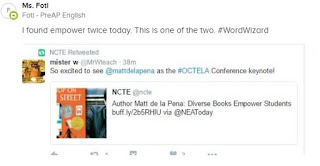
I am now on year three of my Word Wizard adventures, and my students continue to impress me tremendously. I taught the word empower on the first day of school. By the second day, two students came to me with a life-outside-of-class encounter. A week in, and we are up to eight encounters, plus two from me. Today I found the word empowering on a catalog and empower in a Twitter post:

 And of course, I sent out it to my students using Remind. The school day may end, but empowering my students to continue learning in every environment does not.

Friday, December 26, 2014

#wordwizard

In my ongoing battle for students to absorb vocabulary, I have found a technique that I have very slowly begun mentioning to my students: Word Wizard. This technique, focused on extending vocabulary beyond the classroom, comes from Bringing Words to Life.

As we have discussed different words throughout the year, I have tried to point out to my students when I have heard and/or read our words outside of class, whether it be on a television show, in a book, in a magazine, in a conversation. On occasion, I have had students come back and tell me that they are also encountering our words in life outside of school (vex seems to be a very popular word). 

This is the premise of Word Wizard. In Bringing Words to Life, the authors set up a Word Wizard system in which students earned extra-credit points based on vocabulary evidence by sight, sound, or use outside of the classroom lesson. I am not a big fan of extra credit assignments, but I do like the idea of giving extra credit points for being a Word Wizard (celebrate the nerdiness). 

So here is what I have done so far:

  • I have encouraged my students to be on the lookout for our words because they might be rewarded in the future. Because I came across the Word Wizard idea in the middle of a marking period/end of semester, I decided to hold onto it until our second semester. 
  • I have started using a Word Wizard hashtag on Instragram (search #wordwizard and/or @kirstenfoti). Whenever I run across one of words, I post it. Sometimes I take a screenshot of my Nook book. Sometimes I type out a quote from a TV show. Sometimes I take a picture from a book. Anything I can do to put our words out there. One of my students actually filmed a segment from the TV cartoon Lilo & Stitch, pointing out that there was rubble (one of our words) on the screen. He then told me that he really think that episode helped him understand the word even better.
  • I have started inviting my students to be Word Wizards. Yes, they let me know that I am dorky, but I know that I can sucker them into this. 
My next step is to introduce the Word Wizard system to my students when we return to school in January. I am going to create a classroom poster (link added 12/17/14) that contains the words we have covered so far this year. As we learn more words, I will add to it. When the kids bring me evidence (link added 12/17/14of a word encounter, I will put a stamp next to the word (may as well work in some math graphing skills), and the student will receive a coupon (link added 12/17/14for five extra credit points on any assignment. 

I am definitely seeing successes with vocabulary in my classroom. We are moving beyond rote memorization and moving on to fluent usage. I am going to share this idea outside of my content area and see if we can create a new culture within the school. It is a grand idea, but if we expect our kids to dream big, we must also dream big. 


_______

As I finished typing this post and clicked Publish, one of our classroom words (fancy = to imagine) was used by Lena Dunham on a repeat episode of Ellen from last October. I am getting ready to post it on Instragram!

Tuesday, October 21, 2014

Deepening Vocabulary Understanding

This year, I am getting much better about reusing lessons that work, rather than reinventing the wheel for everything I do. For the past two days, my students have been working on our vocabulary for "The Tell-Tale Heart." This has included a Texas Literacy Initiative vocabulary routine and a sketch-to-stretch assignment. 

Today I had a follow-up vocabulary booster training to last year's vocabulary routine training. Although I have been using the routine, I realized that I have not been moving through the entire process. I introduce the words, but I have not been working to deepen understanding as much as I should. I put the words on a word wall and often refer to them, but I have not really had my students doing much with them. 

So guess what's happening now.  With some guidance from Bringing Words to Life, I am creating daily review lessons for the rest of this week to deepen understanding of our vocabulary words. 

Deepening Understanding Lesson #1: Find the Missing Word 

This strategy is essentially a fill-in-the-blank. Since I have been out for a day and a half, this will help show me how much my students have learned without my presence. In order to ensure feedback from all students, I am creating the review as a Kahoot lesson. Kahoot creates high engagement, and my students often ask if we are ever going to use it in class. This will be the first time in my class this year. 

Deepening Understanding Lesson #2: Making Choices 

For this strategy, students will be given examples and non-examples for each word. If the information given is correct example, the students will say the word. If it is not, they will not say anything at all. 

For example: If I say something you think is truly hideous (and not just your personal opinion), say hideous. If you do not think it is hideous, do not say anything at all. 

  • Adam Levine
  • Freddy Krueger
  • a puppy dog
  • maggots on rotting food

Deepening Understanding Lesson #3: Putting the Words to Use

On Friday, I am going to have my students complete a timed writing with the words. In an effort to get them to apply our vocabulary words to other disciplines, they will have to write about what they are doing in another class, using at least four of the nine words. This week I introduced Seven-Up Sentences, writing with a minimum of seven words per sentence, to make their writing more powerful. They will need to incorporate this into their work (to the best of their ability under timed writing circumstances). 

I am looking forward to seeing how things go this week. The district goal is to focus on 4-5 words per week. I have more for this week because I am using a district-created lesson. Once I see how things go for the next week days, I will determine if I continue using this set for another week, and if not, I have to figure out what to next. 

Stay tuned.