Search This Blog

Showing posts with label vocabulary. Show all posts

Wednesday, July 25, 2018

Nine Box Grid - Modified and Magnified

This week, I have returned to school to assist with our third annual incoming seventh-grade student orientation camp. I volunteer my services for this camp every year for numerous reasons: it gives me a chance to start building relationships with students I may or may not teach later on; the sample of students who participate usually reveal what we can expect from our new student population (so far, so great), and I get the opportunity to try out lessons on a smaller scale before the school year begins. 

As part of the Twitter ELL book club, I  read The ELL Teacher's Toolbox by Larry Ferlazzo and Katie Hull Sypnieski. I love being part of this book club, as I have been exposed to strategies for working with ELLs - and ALL students - that I might not run across otherwise. The unfortunate part about this particular book was that we started reading it at the end of the school year, and I did not have time to implement all of these ideas that had my brain swimming in excitement. 

One activity I have been anxious to use in my classroom since last spring is Katie Toppel's Nine Box Grid. The authors acknowledge that they have modified this strategy, and I have to acknowledge that I, in turn, modified and magnified the strategy for my own needs based on the time constraints of the camp.

The Nine Box Grid involves creating a nine numbered boxes. A word is entered into each box, and they are used one at a time in a writing activity. During the school year, I am likely to use related words that we are learning in class, but due to limited time with my camp students, I chose to use a random word generator to come up with the nine words. These are readily available online. Some allow you to choose the words you want; others provide a set list. I used different types of generators for different groups of students to test out how I could make this activity work. My higher level classes received a specific set of words; my still-working-on-it groups were able to choose words from those provided to build our own list. 

I also turned the activity into a writing challenge by adding in rounds, For each round, the students received a topic (I also used an online generator for this). We started by writing about a topic with one word from the nine box grid. After completing a round, I changed the topic and increased the number of words. Most of the classes completed four rounds. 

_________________________________________________________________


  • Round 1
    • Run topic generator 
    • Pick a number on a card (the book says to use dice, but I don't even know where anything is in my classroom right now)
    • Write a sentence with the word in the box matching that number that connects to the topic
    • Share out 
  • Round two
    • Run topic generator
    • Pick two number cards
    • Write a sentence with both of the chosen words, connecting to the topic
    • Share out

    _________________________________________________________________

    My camp classes consist of English language learners (I have one student who has been here for two years, and she speaks eight languages), 504, special education, Pre-AP, and academic students. Within all of these groups, there was a great deal of groaning when I said we were going to write. I am happy to report that this was not the case by the end of the activity. The kids truly rose to the challenge. If we do not find ways to make writing fun for our kids, regardless of which student groups they fall into, those groans will never go away. We have a responsibility to light a fire within our students. 

    In addition, I have a special education co-teacher with me during one of my class sessions. She loved this activity, and her final class of the day joined mine in order to participate. She took lots of notes and said she is excited to use this with her kids once we return to school. When we model these activities for others, and they get to see how the kids respond, we spread the wealth. 

    Do not be afraid to take risks and try new things. Be contagious. Our kids deserve it. 


    Monday, January 12, 2015

    Smashing Vocabulary

    Today one of my district technology representatives came to my campus to teach my students (and me) how to 


    It turns out that most of us are already doing this every day, but I actually learned some things. 

    We started by using Pic Collage to create a collage relating to one of our vocabulary words from last week (innovative, amicable, and inquisitive). The kids were able to use text, web images, classroom photos, and app stickers to show the meaning of the assigned word. 

    We then imported the collages into Thinglink. This app and website is completely new to me. Thinglink allows you to create interactive pictures. The user can add hover-over icons that contain text, links, pictures, and videos. My students were adding everything from definitions to captions to videos. 

    When I asked how the kids felt about this activity versus our usual hand-made creations, most stated that they liked this better. This is definitely one to add to my repertoire, and I can see numerous possibilities already with Thinglink. I definitely have to find some play time for myself. 

    Class examples:

    Sunday, January 11, 2015

    Wizards, Wizards, Everywhere! (Updated 8/29/2016)

    Word Wizard is an unexpected success! The first day back from winter break, I presented the idea. By the second day, I was in shock. 

    When presenting the idea of being on the lookout for our vocabulary words in the world outside of my classroom, I was not met with the greatest enthusiasm. In every class period, I had students ask if they had to do it. I insisted that this is a truly optional assignment, and many seemed quite pleased. 

    In the two following days, student after student approached my class tutor and me about having heard, read, or used (I will explain there creative approach to earning points in a second) our vocabulary words. I honestly was not even expecting them to remember the words we covered for the first semester, especially after two and a half weeks off. 

    The really surprising part? The students who came to us with the words have been predominantly male and predominantly the goofballs. And I think that it is important to make a big note of this. Sometimes we think those goofballs are not paying attention because they are screwing around. Challenge them. I bet you, too, will discover that they are more in tune to your class than you may realize. 

    So where are they finding words? These are just a few examples. 

    • "Family Guy" - The night I presented the lesson, many of the kids went home and watched this show. In a bar scene, one character called another a runt.


    • Song lyrics - One student sent me a screenshot for the lyrics of the song "Pompeii." He heard the word rubble


    • Conversations - A student came to us at the end of the day, stating she had heard some other students talking, and one had used the word preposterous
    • Text messages - This is where my boys got a little creative. They are having text messages conversations, using our class vocabulary words. I look at it this way: they are using the words! 

    • Books - I have some students double-blocked for my English class and my READ 180 intervention class. In READ 180, we were working on independent reading. A double-blocked student found two of our English class words in his book. 
    On my word wall, I have created a Word Wizard chart. Every time a word is submitted, we put a star next to it. If the kids continue at the pace they started last week, I am going to have to come up with a much larger chart. 


    Side note: During my team meeting time on Thursday, my math colleague noticed and asked about the chart. He thought it was a really good idea. Now if I could just get him to use it in his class, too...


    ______________________________ 

    I am now on year three of my Word Wizard adventures, and my students continue to impress me tremendously. I taught the word empower on the first day of school. By the second day, two students came to me with a life-outside-of-class encounter. A week in, and we are up to eight encounters, plus two from me. Today I found the word empowering on a catalog and empower in a Twitter post:

     And of course, I sent out it to my students using Remind. The school day may end, but empowering my students to continue learning in every environment does not.

    Friday, December 26, 2014

    #wordwizard

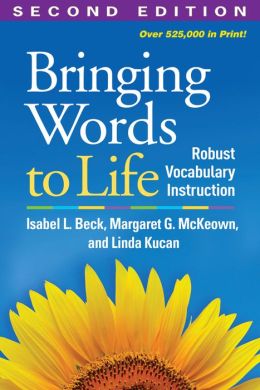
    In my ongoing battle for students to absorb vocabulary, I have found a technique that I have very slowly begun mentioning to my students: Word Wizard. This technique, focused on extending vocabulary beyond the classroom, comes from Bringing Words to Life.

    As we have discussed different words throughout the year, I have tried to point out to my students when I have heard and/or read our words outside of class, whether it be on a television show, in a book, in a magazine, in a conversation. On occasion, I have had students come back and tell me that they are also encountering our words in life outside of school (vex seems to be a very popular word). 

    This is the premise of Word Wizard. In Bringing Words to Life, the authors set up a Word Wizard system in which students earned extra-credit points based on vocabulary evidence by sight, sound, or use outside of the classroom lesson. I am not a big fan of extra credit assignments, but I do like the idea of giving extra credit points for being a Word Wizard (celebrate the nerdiness). 

    So here is what I have done so far:

    • I have encouraged my students to be on the lookout for our words because they might be rewarded in the future. Because I came across the Word Wizard idea in the middle of a marking period/end of semester, I decided to hold onto it until our second semester. 
    • I have started using a Word Wizard hashtag on Instragram (search #wordwizard and/or @kirstenfoti). Whenever I run across one of words, I post it. Sometimes I take a screenshot of my Nook book. Sometimes I type out a quote from a TV show. Sometimes I take a picture from a book. Anything I can do to put our words out there. One of my students actually filmed a segment from the TV cartoon Lilo & Stitch, pointing out that there was rubble (one of our words) on the screen. He then told me that he really think that episode helped him understand the word even better.
    • I have started inviting my students to be Word Wizards. Yes, they let me know that I am dorky, but I know that I can sucker them into this. 
    My next step is to introduce the Word Wizard system to my students when we return to school in January. I am going to create a classroom poster (link added 12/17/14) that contains the words we have covered so far this year. As we learn more words, I will add to it. When the kids bring me evidence (link added 12/17/14of a word encounter, I will put a stamp next to the word (may as well work in some math graphing skills), and the student will receive a coupon (link added 12/17/14for five extra credit points on any assignment. 

    I am definitely seeing successes with vocabulary in my classroom. We are moving beyond rote memorization and moving on to fluent usage. I am going to share this idea outside of my content area and see if we can create a new culture within the school. It is a grand idea, but if we expect our kids to dream big, we must also dream big. 


    _______

    As I finished typing this post and clicked Publish, one of our classroom words (fancy = to imagine) was used by Lena Dunham on a repeat episode of Ellen from last October. I am getting ready to post it on Instragram!

    Friday, November 21, 2014

    Plausibly Preposterous: Mixing Vocabulary and Grammar (Part I)


    Before I left for my trip to San Marcos last week, my students were reading an article about the Loch Ness monster in Scope magazine. In our reading, we ran across the words preposterous and plausible, and I decided to do some more work with them because the kids seemed to enjoy speaking with them. 

    Monday, we started with a modified vocabulary routine. I put both words together since we discussed them a bit last week. I gave them pictures to identify as preposterous or plausible, including pictures of a much younger me (sometimes you just have to go there to keep them engaged). 

    Now that my classes are comfortable with the Texas Literacy Initiative vocabulary routine, and because I am an ESL teacher, it was time to add another component: writing. Our school theory is that all students are English language learners, and as such, they need to listen, speak, read, and write every day. The kids have been doing a great job using the words in social conversations both in and out of my classroom, but I wanted to make sure they could use preposterous and plausible academically

    Last weekend, I was in San Marcos for the TexTESOL conference. I learned some incredible things in my day and a half (I was also presenting, so I did not get to attend as many sessions as I wanted). One of the presenters, Colin Ward, introduced me to the website Just the Word. The site allows you to type in a word, and it returns common uses of the word. This is a benefit for students who are encountering new words that they may not be familiar enough with to use correctly in their writing. Providing students will phrases instead of single vocabulary words helps them use the words more effectively. 

    Preposterous did not return any common phrases, so I gave my students two of my own: "That's preposterous", and "That idea is preposterous." Plausible returned six phrases, four of which I gave to my students for their use. Even though I provided my classes with these options, only a few students used them in their assignments. Most were able to effectively use the words on their own. 

    I also had the honor of seeing Gretchen Bernabei at the conference last weekend. Bernabei presented information from her upcoming book due out in January. I took one many of her ideas and added to the writing lesson I was putting together for this week.  

    The first idea I incorporated into my writing lesson was a simple trick (at least I think they are) to use with their, there, and they're. I chose to start with there:


    Bernabei talked about having the kids prove that they are using the correct form of there/their/they're. I am constantly on my students about providing text evidence (proof) with our reading assignments, so adding this component to their writing was a natural fit. 

    For there, the students use (here) as the proof piece. I initially gave this instruction but after a day, I realized that my kids were not actually checking anything. I added a piece to make sure that they were actually thinking through the method. In addition to (here), my students had to define the here (Bernabei asked us to play with her methods and see what works for us, so I do not feel guilty for the modification). For example:
    • There they are. 
    • Where are they?
    • Here. 
    • Here where?
    • Here in the school/cafeteria/classroom/etc. 

    Bernabei also said that if her students used the word correctly one time, they earn one grade. If they use it five times, they earn two grades. I decided to follow her lead, and I have to say it was a fantastic idea. I do not give extra credit, so most kids took advantage of this "easy" option for earning an extra 100. 

    Here is what the some of the first drafts ended up looking like:


    We followed all of this up with an editing/revising activity. Stay tuned for Plausibly Preposterous: Mixing Vocabulary and Grammar (Part II). 

    Wednesday, November 12, 2014

    Vocabulary Enhancement

    As we continue our journey of vocabulary development, I am taking some time in class to have kids review the vocabulary we have focused on for the first half of the semester. 
    We are using a vocabulary enhancement technique presented by my district ELL representative. She presents this activity all over the state and has seen teachers have much success with it. My students keep asking what this activity is called, but I do not have a specific name for it. We simply call it a vocabulary enhancer

    Students worked in pairs. Each pair received a word that we have covered explicitly so far this year. Their job was to turn the word itself into a picture that represents its meaning. I showed them (at a student's insight) how the word google is turned into pictures for the Google logo. I did have to clarify that what they are doing is a bit different: we are not creating theme pictures like the logo does, but the conversation itself did help my students understand what I was expecting from them. 

    I began by showing them my own creation for the word setting and having them analyze how I had incorporated time and setting into the word itself:


    Then I handed each group an index card with one of our words on it. Despite the whining and complaining, I would not allow them to trade their words. I wanted them to think. They were allowed to use technology to help come up with meanings and picture ideas. 

    The following video contains the finished products, and I will be sharing this at the TexTESOL conference in San Marcos this weekend:


    Tuesday, October 21, 2014

    Deepening Vocabulary Understanding

    This year, I am getting much better about reusing lessons that work, rather than reinventing the wheel for everything I do. For the past two days, my students have been working on our vocabulary for "The Tell-Tale Heart." This has included a Texas Literacy Initiative vocabulary routine and a sketch-to-stretch assignment. 

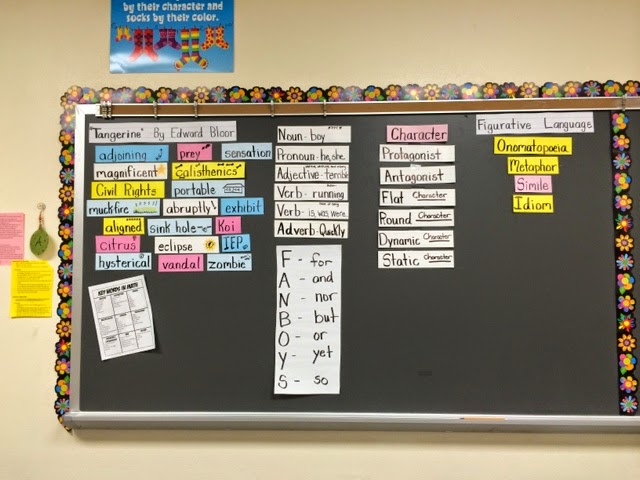
    Today I had a follow-up vocabulary booster training to last year's vocabulary routine training. Although I have been using the routine, I realized that I have not been moving through the entire process. I introduce the words, but I have not been working to deepen understanding as much as I should. I put the words on a word wall and often refer to them, but I have not really had my students doing much with them. 

    So guess what's happening now.  With some guidance from Bringing Words to Life, I am creating daily review lessons for the rest of this week to deepen understanding of our vocabulary words. 

    Deepening Understanding Lesson #1: Find the Missing Word 

    This strategy is essentially a fill-in-the-blank. Since I have been out for a day and a half, this will help show me how much my students have learned without my presence. In order to ensure feedback from all students, I am creating the review as a Kahoot lesson. Kahoot creates high engagement, and my students often ask if we are ever going to use it in class. This will be the first time in my class this year. 

    Deepening Understanding Lesson #2: Making Choices 

    For this strategy, students will be given examples and non-examples for each word. If the information given is correct example, the students will say the word. If it is not, they will not say anything at all. 

    For example: If I say something you think is truly hideous (and not just your personal opinion), say hideous. If you do not think it is hideous, do not say anything at all. 

    • Adam Levine
    • Freddy Krueger
    • a puppy dog
    • maggots on rotting food

    Deepening Understanding Lesson #3: Putting the Words to Use

    On Friday, I am going to have my students complete a timed writing with the words. In an effort to get them to apply our vocabulary words to other disciplines, they will have to write about what they are doing in another class, using at least four of the nine words. This week I introduced Seven-Up Sentences, writing with a minimum of seven words per sentence, to make their writing more powerful. They will need to incorporate this into their work (to the best of their ability under timed writing circumstances). 

    I am looking forward to seeing how things go this week. The district goal is to focus on 4-5 words per week. I have more for this week because I am using a district-created lesson. Once I see how things go for the next week days, I will determine if I continue using this set for another week, and if not, I have to figure out what to next. 

    Stay tuned. 

    Monday, April 14, 2014

    Preparing for a visit from TLI

    This Thursday, representatives from the Texas Literacy Initiative in Austin and within the district are coming to observe classes to see vocabulary use in action. I am the contact person for this program at our school. Last week, a colleague stopped me to show all that she has done to prepare for the visit. I am so impressed that I have to share. 


    Monday, March 3, 2014

    My first vocabulary collection assignment


    It is very frustrating to get excited about a lesson that does not turn out as planned. I spent two days explicitly teaching the vocabulary collection assignment. We went over step-by-step instructions. I provided examples of my own, and we went through a gradual release of responsibility set of examples together. 

    For starters, only about half of my students turned the first student assignment in. I understand that this is because I gave it as homework, and homework is a disaster in today's classroom. Secondly, out of those who did turn the work in, most did not follow the instructions. Labels were missing. Similes were analogies. Haiku had too many syllables. Rhyming poems did not. Thirdly, some work was so sloppy (meaning it was done the class period before) I could not even read it. And this is with two days, tutoring time, and instant messenger access to me. 

    I do have some gems like the following, but these are few and far between:


    So what to do? I am not ready to give up on this assignment, but there are clearly issues with understanding. And using it for homework is not going to work.

    We are missing today due to weather, and Tuesday and Wednesday, we are in district testing shutdowns. That means I will not even see my students for class until Thursday and Friday, and then we go on spring break. Doing the assignment this week will not work. 

    After spring break, I am out of my class for three days for state ESL testing. I will only be in the classroom on Monday and Friday, leaving me with these thoughts: Every Friday, we have enrichment day. That means shortened classes to add an extra period to the day. After spring break, I am going to try this assignment on Fridays in class where I can monitor the work and students can ask questions. We are very close to testing season, and once exams start passing by, kids think school is over. I want to continue focusing on academic vocabulary to help them understand we are still doing academic work. 

    Right now, I need to grade what is left without feeling beat down (sigh). 

    Thursday, February 20, 2014

    Vocabulary Collectors: Explicit Teaching - Day 1

    Due to a Monday holiday, a day-long meeting Tuesday, and my son getting in an accident with a hit-and-run driver Tuesday afternoon (he's fine), today was my first day back at school since Friday. And it was my day to introduce our new vocabulary collection routine. In years past, I probably would have handed the assignment out, gone over the examples, and left them to it. Now, I am much better at explicit teaching, and I think I did a pretty good job today.

    I went through the presentation slowly - too slowly for some classes. I wanted the kids to have an opportunity to take notes and ask questions over my product requirements. Some kids wrote everything; others wrote nothing. We are going to finish our practice round tomorrow, so I will be curious to see what information the non-notetakers need again. 

    Initially, the kids seemed to be turned off by the idea of coming up with their own words. My perception is that they lacked confidence in their own learning. To combat this, I picked a random subject and asked what they were learning about this week. The kids surprised themselves with the number of vocabulary words they were able to come up with - global warming, conduction, nullification, presidency, dividend, probability, factoring. The words spilled forth. They even realized that they were using the word conflict in both history and English. 

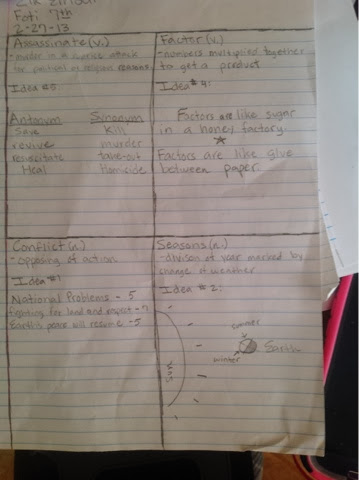
    Once we chose a word, we went through the entire process step-by-step. We tried to determine parts of speech and meaning based on word parts before resorting to the dictionary.We worked to put definitions into student friendly terms. I had students pulling out spirals from other classes and helping provide information. Then I had them each choose their own product to create (most chose the symbolic representation, but I had some pretty great rhyming poetry for dividend). 

    After completing the products, we did a gallery walk (some of them knew what that was without my even using the term), looking for what worked and what did not. This also gave my strugglers and opportunity to see what their classmates were creating to help give them ideas. There was a great deal of conversation about the words and the products without much direction from me.

    The best word of the day was unorthodox. The history sub, a former student of mine, used the word in class this morning (he said it could not have happened because he does not know big words). I had allowed my students to use their phones to help get ideas to draw. 

    One of my lower students brought her phone with this picture:


    My response: Um...uh...see, what had happened was... 

    I am a liberal living in conservative Texas and working in a conservative school district. Mine is an all-loving and accepting classroom. But, I did not know how to address this one. I handed it off to my co-teacher. With a bit of prompting, the student actually figured it out on her own. 

    Today I saw cross-curricular connections, and more importantly, actual learning. I cannot wait to see what tomorrow brings. 


    Monday, February 17, 2014

    Vocabulary Collectors

    Once again, Corbett Harrison has inspired me. This time, he suckered me in with his Vocabulary Collectors ideas and examples

    I have modified this for the needs of my students. My school is working hard on promoting academic vocabulary, so I have designed my lesson to include words from the four core classes. I have also focused on products that should be review activities for my students. 

    In my presentation, I have used a variation of our last vocabulary routine word, regress. I also created an example of each of the products that I will post on our student webpage for their access. I am looking forward to having their work to use as examples in the future. 

    Testing season is creeping up. I am hoping that this activity might help them digest some needed vocabulary over the next couple of months. I will need to display these, and I am going to try out some activities (TBD from my recent word wall training) using the words that are posted. 

    Here ya go:

    Thursday, December 26, 2013

    "Stolen Ideas" - Definitions and Photography

    I have mentioned before that my school is part of a state grant, the Texas Literacy Initiative, and the focus this year is on vocabulary. I stumbled upon this in my Twitter feed today, and my brain has been twitching with ideas ever since. I said I would wait until Saturday before I started doing anything school related, but my brain does not agree with that decision after 6 /2 days of little educational stimulation. 

    Today's Daily Create (@ds106dc) assignment: Using Dictionary.com's word of the day, take and share a photographic representation of the meaning. 

    How easy and wonderful is that. Not only can I use this with a word of the day to expose my students to more vocabulary, I can also assign words from our readings for them to do this with. We are a Bring Your Own Technology school, and most of my students have some sort of camera. For those who do not, they can always draw something. They can also use photo editing apps to add some creativity. 

    Of course, what is a great idea without some practice? 

    Today's Dictionary.com word:  


    As a former daytime soap opera addict (I am only a nighttime soap opera addict now), I know this meaning. The second definition, however, caught me off guard. I decided to go with that one because it is new to me and because I cooked a turkey Christmas Eve. 

    So without further ado, here is my photographic representation of schmaltz:

    Yum!

    Now I need someone to teach me how to use Flickr because I have not logged into the site in years. 

    Sunday, December 1, 2013

    Vocabulary Routine for Milkweed: Ghetto

    Now that turkey break is coming to a close, it is time to get back to the daily grind. That means Sunday lesson planning! 

    My Pre-AP class is reading Milkweed. This is not a difficult read, and I have not pulled out any vocabulary so far. But we are now traveling to the ghetto in the story, and this is definitely a word I feel needs to be taught explicitly. 

    I admit it. I'm guilty of using this as a slang term, then turning around with my old lady voice and saying,"Do you have any idea what that word really means?"

    Although some of my Pre-AP students will understand the word in context, some will not. I am sure some have been doing their reading over the break with an image such as this in mind:

    My apologies if this is a picture of
    any of my readers and/or family/friends/
    acquaintances of my readers.
    Blame Google Images. 

    I have worked at the same school for 10 1/2 years now. I know my students. This kind of image, or one similar, is going to come to mind when reading the World War II story as soon as they see the word ghetto

    So, I have put together their vocabulary routine lesson, complete with various images from 1940s Warsaw, to ensure that they never forget what ghetto really means. I did add an end piece asking them to briefly write about how they think the 1940s definition used in the book has turned into the slang definition we use today. I am curious to see what they come up with. 

    Thursday, October 24, 2013

    TLI Vocabulary Routine: Round 2 (Reflection)

    I love this strategy. I love love love love love this strategy. Did I mention that I love this strategy? I do. I love it. I loved it the first time. I loved it this second time

    The Texas Literacy Initiative vocabulary strategy engages students. The kids are actively involved in learning the material. 

    1. They repeat the word. I have them do this in different ways for my own enjoyment - say the word, say it like a cat, say it like a dog, say it like a boss. I definitely see some future actors and actresses coming from my classroom. 

    2. They are analyzing usage and providing informal assessment information with a thumbs up/thumbs down response. I can scan the room and visually see who is understanding within a matter of seconds. Both times I have conducted the routine, when a student provides an incorrect answer, he/she will go back to the sentence and process again until he/she figures it out. Watching a student take the initiative to actually correct himself is pretty impressive. 

    3. I learn a great deal about my students through my examples and non-examples. Case in point: Today, one of my sentences said that parents are vexed when kids take the initiative to wash dishes on their own. One boy told me that he is not allowed to wash dishes because his parents think he is does not clean them well enough. I think this is one smart child!

    4. The kids are speaking to one another in complete sentences with the Seven-Up Sentences. I did not complete this part of the activity last time. This time, I added it, and the practice was magical. I am one of two eighth-grade ELA ESL teachers, and getting my ELLs to speak in front of others can be a struggle sometimes. This was a no pressure partner conversation, and everyone was talking, in addition to working with the given word. 

    5. They are learning. It has been a few weeks since we went through our first vocabulary routine. When I referred back to our gripes lesson, I was immediately barraged with a chorus of "to complain." Sure, a few kids forgot, but after a few seconds, the first lesson seemed to pop right back into their brains. 

    6. They made connections between two lessons and were able to write about it using the words

    I have not yet taught this strategy to my campus colleagues, but the training is coming up soon. I cannot wait to share and model how this works with them. 

    Vocabulary Strategy: Sketch to Stretch is a hit!

    A few days, I posted my vocabulary lesson  for "The Tell-Tale Heart." I truly felt I had something good, but as always, the children have surpassed my expectations. 


    You know it's a good strategy when the kids start drawing you for the assignment. Of course, this student thought he was the first and only child to ever come up with an idea like this.

    I used this as my example for the rest of the day, telling them I have never lied about being a model. This is the proof! The lips are too big, however. No Botox for me, thank you very much. 

    Here are some other examples:


    This was fun and engaging for the students and for me. 


    Sunday, October 20, 2013

    Vocabulary Strategies for "The Tell-Tale Heart"

    I will begin teaching "The Tell-Tale Heart" later this week. I am working on two vocabulary strategies for this lesson to mix things up: the Texas Literacy Initiative vocabulary routine and another strategy called Sketch to Stretch. 

    I will start the vocabulary work with the vocabulary routine for the word vex. I chose this word because it ties in well with our last vocabulary routine for the word gripe. I want my students to be able to view words in connection to one another, rather than isolated pieces from different readings. I have heard my students using the word gripe - correctly - in conversation with one another, so I will be curious to see if they pick up on vex the same way. 

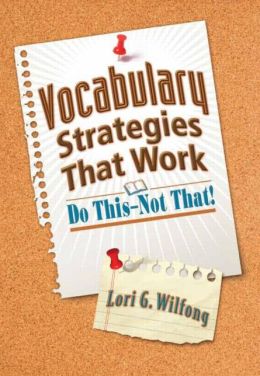
    The second strategy, Sketch to Stretch, comes from Vocabulary Strategies that Work, a book provided by the Texas Literacy Initiative as part of our vocabulary focus. Sketch to Stretch was originally created as a reading comprehension strategy for visualization (I am going to use that as a connection piece at the end of the reading). In this process, students read a section of text, then create a reaction drawing. By the end of the reading, they have a series of drawings to help them recall information. [If you search this strategy online, you will find a great deal of information.]

    Wilfong has adapted this strategy for vocabulary study. Students read a chunk of text, then they choose a word from that section that they feel is vital to the meaning of the selection. They then draw what they think the word means in the given context. 

    Since this is the first time I will be using this strategy, and because "TTH" tends to be complicated enough for my students to understand, I have modified Wilfong's strategy to suit my own needs. Rather than use Poe's text, I am giving my students modern-language sentences with selected words from the story. They will create their drawings and definitions based on this information to help them apply it to "TTH".

    Follow-up to come after I teach this Thursday or Friday. Stay tuned.

    Saturday, October 5, 2013

    Texas Literacy Initiative: Vocabulary Routine

    This year, my school has become part of the Texas Literacy Initiative. This is a grant that helps support literacy efforts from ages 0 -18. The focus for 2013-2014 is vocabulary instruction. Our at-risk students come to school with a significantly lower vocabulary knowledge-base than students from other family backgrounds. If we want out students to make it to college (or simply get by in a future workplace), it is imperative that we find effective ways to provide vocabulary instruction. 

    I am serving as a pseudo-instructional coach for my school regarding this grant. I have already had the opportunity to attend professional development with state representatives that I am bringing back to my campus for my students and colleagues.

    This week, I incorporated the TLI vocabulary routine into my classroom instruction. In the professional development sessions, the routine seemed extremely time-consuming and very dorky. Boy, was I wrong on both counts. The entire routine took no more than ten minutes, and it only lasted that long because the students were so engrossed in what we were doing. 

    I conducted the vocabulary routine with the word gripes to accompany a news article. The first group I completed the lesson with was my Pre-AP students. I thought for sure that my group of 29 was going to hate this activity. Wrong! By the time we finished, one of my girls called me over and said, "Are we going to do more words this way? This was fun!" Out of all my students, she was one of the last I expected to hear this from. 

    My favorite experience was with my co-teach class, a combination of special education and academic students. My co-teacher and I struggled to pull in the reigns with this group. Not only were they fully engaged with the routine, but they managed to turn it into a song. My classroom was full of singing, dancing, and clapping. How is that for vocabulary instruction?

    I honestly thought most kids would know this word, but a quick show of hands throughout all my classes showed the contradictory. I think it is incredibly important to point that out because we often assume that our students know more than they actually do. I am working hard to break that mindset, and this vocabulary routine has provided me with an entertaining avenue to break through to my students.