Search This Blog

Showing posts with label narrative. Show all posts

Saturday, October 19, 2013

Teaching in Metaphor: Writing Sentences with Coordinating and Subordinating Conjunctions

Sentence variety. Aaaah. As much as I love understanding how sentences are constructed, for some reason (cough-cough) my students simply do not find it terribly exciting. But with my unique teaching style, I am comfortable totally nerding out over sentence construction. This year, I managed to take it farther than ever before. 

For starters, I use Jeff Anderson's Mechanically Inclined and Everyday Editing  to teach many writing skills. The man is a genius, and his books have been some of my best investments. And he has already done so much of the work that I really only have to put my presentations together. 

This past week, we worked on writing with coordinating and subordinating conjunctions for their sentence revisions. I had the kids copy the mini-poster slides and examples in their resource journals while I explained the basic structures of the sentences. So far, so not-very-exciting. Then I pulled out the metaphor!

I have used this for years now, and it works. At first, I get the you-are-such-a-nerd look (to which I respond with my own duh-I-have-a-poster-of-Darth-Vader-on-the-wall look). It doesn't take long, however, for the kids to become pretty impressed with my genius on this one - or maybe it is just what I am showing them and connecting to sentence building. 

What is this magical metaphor, you ask? Let me leave you in suspense no longer. The magic is in the Lego. I teach my students that sentences are simply Legos in word form. Different pieces are different types of Lego blocks, and we can put those blocks together in multiple ways to create unbelievable creations and works of art. You will see in my presentation that there are even boxes around different elements, and when the kids write for me, they draw these "blocks" to show how they build their sentences. 
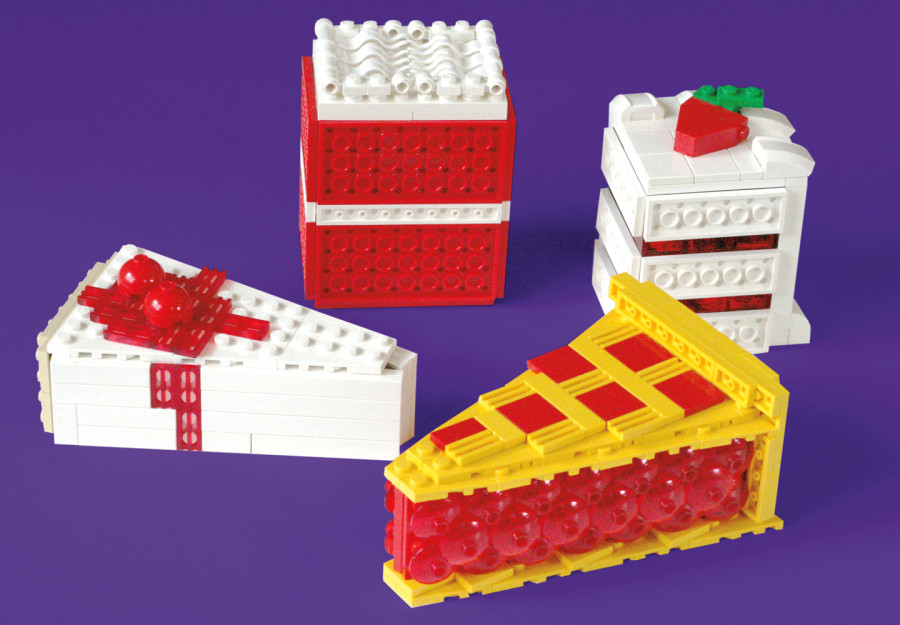
Now, explanation alone is not good enough for the kids to get this. This is a true "a picture speaks a thousand words" moment.  This year, I showed a recent article from The Huffington Post that I ran across just a couple of days before I taught this lesson (you can also find a gazillion amazing Lego creations with an image search). I compared the different levels of design to the different levels of sentences that one can write. I explained that some students would write dessert-level creation sentences and some would write castle-level creation sentences. Either way, both would be fantastic. The group I have this year is highly competitive, and they were not about to settle for dessert-level writing. I have to admit that I was shocked by how some of their eyes lit up when I read their work and responded with, "You wrote a castle!"

Don't be afraid to get your nerdy on. It is all about the passion you express. Let it be contagious. 

Wednesday, October 16, 2013

Blind Rewrites

As we continue our writing journey with the personal narrative, I added another new element that I got from Jeff Anderson's 10 Things Every Writer Needs to Know: blind rewrites. 

After the power writing, speed drafts, and a peer questioning activity, I gave my students four minutes to thoroughly read over what they had written. Their objective was to focus on the important details, particularly what their classmates felt they should add to their work. Once the four minutes were up, I collected their original papers. 

When I presented the next step, I was blatantly accused of torture, to which I replied, "Torture for you; entertainment for me." The uproar continued, but I smiled my way through it. 

Their concern? I told my lovelies that they had to rewrite their entire paper in seven minutes. Without looking. 

Sure, I heard a lot of "but I can't remember." But they did. Within that seven minutes, almost every student in class had at least a half page written, and a few were quick to point out that they only remembered the important parts. Ding-ding-ding! We have a winner!

Tomorrow, we will be contrasting the first draft with the second draft. I want them to determine if they included the information that was truly important to the meaning. If they left anything out that they deem necessary to the rewrite, they can add it back in. 

After that, sentence revisions. Oh, how I love complex sentences!

Tuesday, October 15, 2013

Speed Drafts

Before I move on to today's topic, let me follow-up on my Power Writing post:

  • This was a continued success with my academic students. The best response I heard all day was a whispered, "This is aaaaaawesome." In addition, I heard requests for more rounds. 
  • One of my science colleagues (anonymous shoutout) used Power Writing with her students today as a review of academic terms. We are both part of our Texas Literacy Initiative Campus Based Leadership Team, and we are working on reading and writing skills in all classrooms. The teacher provided this feedback: "They LOVE this. I was afraid they wouldn't buy in to writing in science but they did and then some!! Thank you" 

The power rounds were used in anticipation of a personal narrative writing assignment. Traditionally, in assigning a personal narrative, I would model brainstorming and Thinking Maps planning before approaching a rough draft. This time I decided to try something different based on informal observations. The  biggest issue the kids have is getting started, and the more time they are given, the more time they will take. Well, I am not into wasting time (at least not too much; we all need our moments). 

Extending on my Power Writing lesson, today I added Speed Drafts. After presenting the topic and giving the kids a few minutes to discuss their ideas with one another, I provided them with a very limited amount of time to write as much as they could about their topic - 5 minutes for Pre-AP; 7 minutes for academic. By no means did I expect them to have a completed draft. Working with a time limit, however, ensured that they had something written with which we can work on skills such as elaboration, clarification, complex sentences, and basic editing. 

I did expect some grumbling, but what I did hear was about hand cramps. I have never seen my students write so much in one day, nor have I seen them exhibit such pride in accomplishing a small feat for the day. One student came up to me with a huge smile and said, "Miss. I wrote 260 words. Can you believe it?"

I would not have believed any of it had I not seen it with my own eyes. I set a personal goal to challenge my students more this year, and this small victory ensures me that I am doing the right thing for them and for me. 

Tomorrow, rewriting without looking!

Monday, October 14, 2013

Power Writing

Last year, one of my curriculum instruction specialists included a writing activity called Power Rounds from Jeff Anderson's 10 Things Every Writer Needs to Know in a professional development session. I was hooked from the first second, even though I was unsure how my students would react to the lesson. 

Here is the gist:


  • Students are shown two words. 
  • From the two words, each student chooses one. 
  • Students write for one minute about the word without stopping. 
  • Once the round is completed, students count how many words they have written.
  • Two more rounds are completed. 
I love this activity because it can be used in so many ways - an introduction, a review, a brainstorm, a time-filler. 

After learning about this strategy, I invited my curriculum instruction specialist to campus to see the lesson in action. I used it as an introduction to The Hobbit with my Pre-AP students. I made it like a boxing match, with matches and rounds and using a boxing bell for my timer, and not only did my students love it, I received positive reviews from my curriculum instructional specialist. 

Knowing how well this strategy worked last year, I have been anxious to try it again this year. My students are starting a personal narrative, and I managed to work Power Writing into the lesson as a brainstorming piece. Last Friday, my Pre-AP class completed their Power Writing. I am by no means modest about my prowess as a teacher, but I have to admit that I was blown away but how much this class loved the assignment. 

After the first round, we did a tally on how many words each student had written. The range was from zero to 28. Once that tally was complete, something happened in their crazy little minds. This extreme competitiveness came out of I-don't-know-where, and it was GAME ON for round two. They were actually trying to steal one another's papers in order to get more words written. When the timer beeped after sixty seconds, I was having to yell for them to stop writing because they wanted to continue. Most importantly, for me at least, they all wrote considerably more the second time than they had the first. 

By the third round, students were running around the room trying to hide from one another in order to protect their work. Each was determined to write more than anyone else. Again, I was begging them to stop writing, and they were begging to continue - so much so that they asked me for a bonus round. Is this really happening? I kept thinking. They want to write more? Getting students to write is usually like pulling teeth. 

I know to many of you that this may seem like pure chaos, and more often that not, my classroom looks like a disaster to the outsider. But I teach in a world where edu-tainment is a real term, and if the students are not entertained, we are very likely to lose them. I am far from an old-school teacher. The full engagement of 29 students is a dream come true. I am excited to complete this lesson with my academic classes in the next few days, and with this much success, this strategy will play a role in my classroom for years to come.