Search This Blog

Showing posts with label Keep it R.E.A.L!: Relevant. Show all posts

Monday, March 19, 2018

Visual Note Taking with Poetry

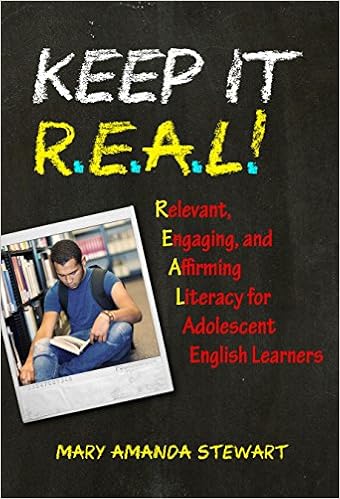
Over spring break, I managed to read another chapter of Keep it R.E.A.L!: Relevant, engaging, and affirming literacy for adolescent English learners by Dr. Mary Amanda Stewart. Chapter 3, "Read in a literature-rich classroom," offers strategies that are applicable to the middle school classroom, and today I was able to teach poetry in my STAAR class, a supplemental reading class consisting of various types of language learners, including ESL students. And let me tell you, I hate teaching poetry as much as the kids hate learning how to read it. But today, we all enjoyed it. 

Stewart writes, "Consider using poetry to develop students' listening skills...read the poem aloud without allowing students to see the words...Then, read the same poem while displaying the words for students and ask them if they now understood more" (54). I decided to combine this with a lesson on visual note taking (many of these students are also in my regular English classes, and I did not want to burden them with two class periods of standard note taking on our first day back from spring break). 

Introduction to visual notetaking

I began by showing my students a video from Youtube that addressed three components of visual note taking: decorative words, images, and connecting elements. Youtube is filled with videos about Sketchnotes and visual note taking. I chose the following video, as it is short enough to provide a general overview without overwhelming my students. 


Multiple "readings" of the poem

Because visual note taking was a new skill, I started with an easy poem, Jack Prelutsky's "Be glad your nose is on your face." One of my students recently informed me that I have a witch's nose, so I figured it was a good one to use in class. 

I wanted to engage in the note taking process with my students, so rather than reading the poem aloud to them, I found an audio recording on Youtube that did not display the text of the poem, forcing my students - and me - to use their listening skills. 


We listened to the poem multiple times, breaking our visual note taking into different rounds. While the students worked on their notes, I displayed my own paper via the document camera, modeling each step. For our first listen, we focused on words that caught our attention, adding them to our visual notes. We then listened again, drawing images that stood out to us. On the third, fourth, and fifth listens, we drew connectors between what we had drawn. 


Displaying the poem

The final layer of the visual note taking was the most complicated for my seventh graders, so I displayed the poem for them after we could no longer gather the information we needed by listening. The students and I referenced the text, adding more to our words, images, and connectors, adding more to their understanding of the poem. 


Be Glad Your Nose Is on Your Face

Be glad your nose is on your face,
not pasted on some other place,
you might dislike your nose a lot.
for if it were where it is not, Imagine if your precious nose
that clearly would not be a treat,
were sandwiched in between your toes, for you’d be forced to smell your feet.
it soon would drive you to despair,
Your nose would be a source of dread were it attached atop your head, forever tickled by your hair.
your brain would rattle from the breeze.
Within your ear, your nose would be an absolute catastrophe, for when you were obliged to sneeze,
be glad your nose is on your face!
Your nose, instead, through thick and thin, remains between your eyes and chin,
not pasted on some other place--
The results
For a first try, I was really impressed with my students. Not only did they enjoy the note taking strategy, they were actually invested in the poem, something that usually turns them off completely. I worked hard to remove the pressure of getting everything exactly right, focusing on building my students' ability to listen well. For ELLs with beginning and intermediate English skills, I think pairing them up with students with higher level skills might help connect the words and images together to convey meaning.
Tomorrow I am going to give them a more difficult, grade-level poem to work with to determine if they can garner meaning through visual note taking with a bit less support from me. Again, we will begin by listening to the poem without seeing the words. I am hoping that in the long run, the kids will start to hear how poetry should sound within their own minds without relying on the voice of another.
This one is mine. I think the kids did better. 

Sunday, November 19, 2017

Keep it R.E.A.L. - Chapter 1 Response

A few weeks ago, I received an unexpected message in my work email from a professor at Texas Woman's University. Dr. Mandy Stewart, a professor who I have not met, asked if she could share some of my work with potential graduate students. Fortunately, Dr. Stewart could not see me gushing and blushing behind my computer.

As if that were not flattering enough, our conversation led to a book she recently wrote, Keep it R.E.A.L!: Relevant, engaging, and affirming literacy for adolescent English learners. Dr. Stewart asked me two questions: Would I mind if she sent me a copy to read? Would I mind providing my opinion on how the information can be more inclusive of middle school students?

Me? Seriously? Two words: Jaw. Drop. What kind of expert am I? Fourteen plus years of experience teaching middle school, six of those as a certified ESL teacher, and I still do not see myself as an expert. But I do have opinions all the time, so why not! So here goes...something.

Reader Response:

Dr. Stewart shares how she used reader response instruction with newcomer students in a high school summer institute. Reader response might be the only theory I can comfortably discuss. I read Lois Tyson's book Critical theory today prior to entering the field of education. Even as I was studying this information as part of my English minor, reader response criticism resonated with me the most because it is how I read naturally. Once I entered the seventh grade classroom (and later on eighth), this became my go-to theory with my students.

Reader response is all about interacting with the text to make meaning. It is about the experience of the reader. Not only do I consider this to be an ideal way for middle school students to develop a relationship with text, I also see this as beneficial for English language learners. Because we are asking our ELLs to engage with the text and develop connections, they cannot be wrong (unless they have completely misread, of course). The students are bringing their experiences to the table that allow them to engage in writing, listening, and speaking, in addition to the reading, all within the framework of a low affective filter.

The Acronym:

Just as we wish for students to connect with text, we need to connect with our students. Why not incorporate some slang into our teaching? I could easily say, "We are going to Keep it R.E.A.L. today," as part of a reading lesson. (That is far more comfortable for me than referring to myself as the G.O.A.T. or as Gucci.)

Newcomers will need instruction in understanding slang American language. Pre-teens and young teens are on a journey of self-discovery, and as much as we may want them to be focused on long-term educational goals, their goal is simply to fit in with and be accepted by their peers. So I am all for keepin' it real. We can teach our newer ELLs an expression that will help them communicate socially, while also making new-language text more accessible.

So here is my initial opinion regarding this content and students in grades 6-8: The foundation of this work is definitely an ideal fit for the middle school classroom. It allows for all students to connect to the learning, in particular our ELLs who may feel isolated and withdrawn. Reader response through Keep it R.E.A.L. provides for every student to be part of the learning community.

Dr. Stewart discusses each element of R.E.A.L. in chapter one, and I would rather you read it than have me share all of my reader responses to the questions she proposes in regard to relevancy, engagement, affirmation, and literacy instruction, as we each bring different backgrounds and experiences from our teaching to these topics.