Search This Blog

Showing posts with label Flowers for Algernon. Show all posts

Sunday, February 2, 2014

Deconstructing Content Standards: Take 2

Tuesday, I got my feet wet with deconstructing a content standard after a presentation over the information. Today, I am studying this section of Classroom Assessment for Student Learning, and I quickly learned that although I was on the right path the other day, I was not quite where I needed to be. So now am I teaching myself how to do this the correct way. 


To begin with, I am using Kentucky's Deconstructing Standards Flowchart to guide my thinking. 
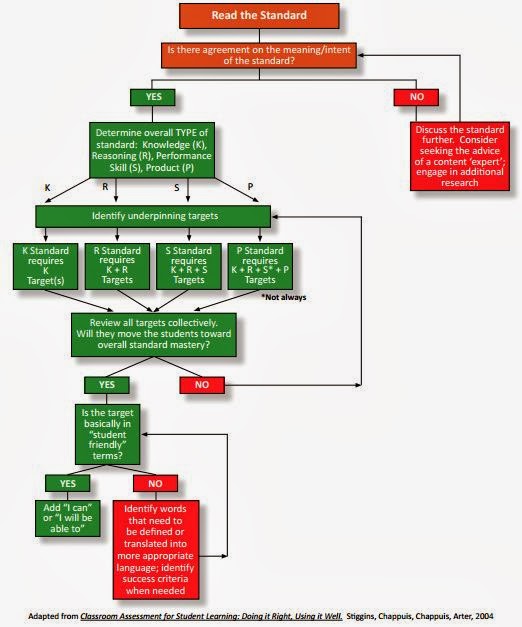

This week, I am going to be working on the following standard to wrap up "Flowers for Algernon":
  • TEK 8.6 B analyze how the central characters’ qualities influence the theme of a fictional work and resolution of the central conflict 
When I played with this process a few days ago, I had not used one of the TEKS but had instead focused on my classroom objective regarding a TEK. That is not what the deconstruction process is for. It is designed to help break down the complexity of the standard itself. 

With my analysis of 8.6B, I realized that there are only two targets: knowledge and reasoning. 

  • Knowledge Targets: What does a student need to know and understand to attain mastery of this standard? (p 61)
    • I have broken this down into as many pieces as possible. To attain mastery, each student needs to have a basic knowledge of analysis, central characters, character traits, the elements of plot, theme, and the meaning of influence.

  • Reasoning Targets: What patterns of reasoning, if any, are required to attain mastery of this standard?
    • With all of those knowledge pieces, each student needs to be able to us thought processes to:
      • infer character traits
      • create a theme
      • figure out how the character traits connect to that theme
      • identity both the conflict and the resolution
      • make a connection between the conflict and resolution
      • determine how that information connects to the theme
      • put it all together
For one standard, that's a lot of understanding and thinking!

Now I need to synthesize all of this to figure out how to put everything into student friendly terms.
  • I can explain how Charlie's characteristics influenced how the story ended. 
  • I can explain the message of the story. 
What do I do with this after the breakdown? Prior to this deconstruction, I would have gone through a series of questions and then told my kids to write a response. At least that is how I was putting everything together a few days ago. Now, I am going to start with a formative pre-assessment to make sure my students actually know the knowledge pieces. I have created a presentation that I am uploading into Nearpod. This will allow me to instantly see who knows what and determine if I need to go into more detail with any of the knowledge components. 

Example of Nearpod poll

Once we have gone through this process and discussed/reviewed any information that kids need, we will move on to the reasoning stage. I have a set of prepared questions (I did not make this) that guide them from point A to B based on the TEK. I think I will have the kids working on these in small groups to bring back to a large group discussion. 
In the end, I want them to put together a paragraph that synthesizes all of this information. But, I am now realizing that assigning this is not teaching it, and if I am not teaching it, I should not be using it as a summative assessment. Instead, I think we may end up writing the paragraph together. 
So if I do all of this formative assessment, how do I do a summative assessment? My curriculum instruction specialist put together a list of extension questions based on some of our TEKS. I believe if I use the following question, my students should be able to go back through the analysis process and create a unique writing product. At least I hope so!


I am about to test my own teaching and my patience. Let the games begin!


Monday, January 27, 2014

"Flowers for Algernon" - Double-Bubble Thinking Map

My class is up to the last progress report in "Flowers for Algernon." Before we move on to Charlie's downfall, we are stopping to compare and contrast his character pre- and post-surgery using a Double Bubble Thinking Map (a glorified Venn diagram for those of you unfamiliar with these). 


Today, the kids are working in groups on planning. I counted off to put them in groups, something I rarely do. I decided they needed some mixing up. For the most part, it has worked. I have only had one group so far that did not want to get anything done. 

The single bubbles are for the categories: pre-surgery and post-surgery. This is the foundation of the work the kids are doing. 

The box is called a Frame of Reference. Within the F.O.R., the kids must include the title of the story and the page numbers as a manner of citation. They also have to include two quotes that describe Charlie - one prior to the surgery and one after. Regardless of how many times we cover over what a quote is and the proper punctuation, they do not get it. Guaranteed, I will get final copies with mistakes. 

The bubbles in the middle, D, E, and F, are for similarities: What about Charlie stays the same before and after the surgery? I am getting questions like, "Is it okay to say Charlie is a boy before and after?" Nothing like deep thinking on a Monday morning. 

The outside bubbles are for the contrasts. Unlike a Venn diagram, the contrasts must connect together. For example, for 1a, I can say that Charlie had an IQ of 68. For 1b, I would then say that Charlie's IQ was above 200. This pairing doesn't always work with a story, but for "Flowers," it does. 

My model is color-coded and labeled to help my ELLs(and probably the rest of them) understand the pieces that fit together. When my students make their final poster board copies, they are required to color-code theirs as well. 

The secret agenda: Open House. At this level, I rarely have much to show, especially since we do so much on the computer. I am going to hang these up for parents to view. It's always nice to have something to show. 

Examples to come. 


Sunday, January 12, 2014

Flowers for Algernon: Part 2 - Characterizing with acrostics

We started "Flowers for Algernon" last Friday. We went through the first two progress reports slowly, discussing direct and indirect characterization. It wasn't a tough lesson, and the kids grasped the ideas quickly. I did note that we still need more work with supporting our ideas with text evidence, but that will be addressed shortly through dialectical journaling. 

I am a very hands-on reading teacher, and I am nowhere near being ready to turn my students loose with this story. BUT, I have the awesome pleasure of getting to hear Jeff Anderson speak tomorrow afternoon, and an honor like that takes precedent over the lesson. So I have put together the kind of lesson of which I am not a fan, reminding myself that one day of lower-than-standard lessons is not going to hurt anyone in the long run. 

My students are going to read the next three entries on their own. I struggle with independent reading in the classroom. Student reading levels range from third grade to collegiate, and we usually do guided reading to manage pacing. They all need to know how to read on their own, however, and they need to build their reading stamina. Maybe this is not such a bad idea after all. 

Once they finish reading, I am going to have them write a characterization acrostic using Charlie's name. Their assignment is to come up with phrases that describe what we have learned about Charlie through either direct or indirect characterization prior to the surgery. And here again, they may end up surprising me. I am going to keep my fingers crossed. 

Next up...irony. Now would be the perfect time for some other guest speakers. 

Thursday, January 2, 2014

Flowers for Algernon - Part I

This is my third year teaching eighth grade (after eight years teaching every possible reading/writing variation of seventh grade we have had). When I left seventh grade, I was teaching writing, and eighth grade is predominantly focused upon reading. One of the biggest issues I have had has been pacing. After two years of trying to manage every listed reading assignment in our curriculum, I threw it all out the window and decided to simply teach - and it is paying off. Unfortunately, there are still requirements. 

One of the eighth grade required readings for eighth graders is the short story "Flowers for Algernon." When I say requirement, I mean requirement. Oops. Missed this for the first two years! Year three, I got this...I think. So here goes. 

Progress report for March 5

  • Although my students should pick up on the indirect characterization right away, I am going to start with direct characterization. This will be a short and sweet review to introduce us to Charlie. 
  • We will be working on computer annotation skills (Google Drive), starting with some basic underlining/highlighting skills. I am trying to get them away from highlighting everything on the paper. I have been teaching annotation all year, but that has not cut down on the highlighter abuse. 
  • Since we will be using Google Drive, we will also work on adding comments to take notes. I have created a sentence stem (slide 3) to guide their reflection of the direct characterization. 
  • I am also going to have the kids rewrite the first entry in proper English. Well, as proper as they can make it, I suppose. I haven't quite figured out how to grade this. It might simply be a participation grade for them, but I want them to get some editing practice. 
  • For the second entry, we are switching gears to indirect characterization. I want my students to start putting together what we are learning about Charlie through his writing. 
  • Since we have been working on Notice & Note signposts throughout the year, I am going to review Again & Again. With our Again & Again lenses (I am combining the N&N signpost with a text evidence strategy from Falling in Love with Close Reading), we will be looking for patterns in Charlie's thinking that help us understand his traits. 
  • Click for larger copy
  • The hard part here is getting them to focus on the text evidence. For example, what does the "rabits foot in my pockit because when I was a kid I always faled tests in school" tell us about  Charlie? (It was really hard to type all of that incorrectly.) Using a modified version of the frame provided in FILWCR, I am going to have the kids write a character traits statement about Charlie.

This is as far as I have gotten so far. Now I have to figure out where to chunk the rest of the text so it doesn't take me until the end of May to teach the entire story. 

________________________________________________________

Resources: