___________________________________________________________________________
Poetry. Yuck! That’s
my first reaction when I think about poetry, but I honestly do not know where
that comes from. As I was reading this chapter, I was a bit flabbergasted by
how much of a role poetry has played in my life and my teaching.
As I was reading about Mother Goose, something clicked in my
brain. I have a closet in my house that is used solely for book storage (it’s
one of many places). I had to stop reading the chapter about poetr and go
hunting to find something I thought was there:

These three books are all from my childhood (I’m almost 44,
so they have been around a long time). All were read more times than I can
remember. All are attached to some very positive memories of my mother and
maternal grandparents, and just finding them and seeing my grandmother’s
handwriting brought me to tears, so much so that I had to stop reading about
poetry and contact my mother and sister. That
is the power of literature right there.
When I did get back to the
chapter, as I read J. Patrick Lewis’ interview, I remembered that my fifth
grade writing project was all poetry. I can recall sitting in class, writing limericks
and haikus, editing and revising over and over again in an attempt to create
the best possible work. There were two other girls in class who were also
writers, and we were very competitive. For as long as I can remember, it was my
intention to be the best writer.
I continued to write a great
deal of poetry throughout my childhood. I have literary magazines from high
school in which my poetry is published. I also filled personal journals with
teen angst-filled poetry.

I have never simply shared poetry with my classes. In
teaching STAAR-tested poetry, the goal has always been to make sure students
understand it enough to answer questions to be able to pass the test and move
on to ninth grade. Now that I am not in a STAAR-tested class, I do have the
ability to actually share poetry.
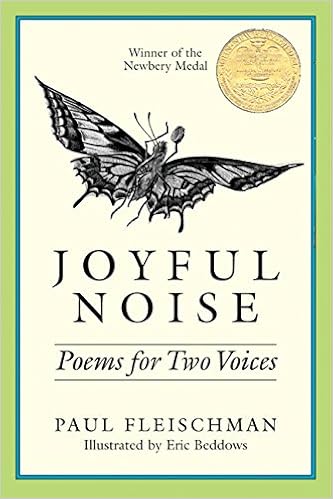
I don’t like to teach poetry for reading,
but I like to teach writing poetry. When I was at the AVID conference last
week, one of the writing strategies presented was a two-voice poem (page 139).
This is not new information to me. I have taught this format before, but I have
not used it in quite some time. I have already added it to my list of beginning
lessons for August. My eighth grade classes will be a half-and-half mix of
students I taught last year in seventh grade and students who are new to AVID
for eighth grade. I am going to use the two-voice poem as a get-to-know you
activity between my former students and my new students.
I have also taught other
types of poems in my class, such as diamante and acrostic, but one of my
favorite poems to teach is a “Where
I’m From” poem that I first learned about through AVID. The poem is based
on a piece by George Ella Lyon. In the classroom, it provides an opportunity
for students to explore their family backgrounds. I have also used the “I
Am” poem that I first learned about through AVID.
 Ironically, despite thinking
I do not like poetry at all, I have been a big proponent of spoken-word poetry.
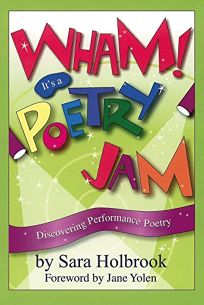
I purchased Wham! It’s a Poetry Jam in
an attempt to try to build a poetry slam on my campus, but it never found it’s
footing. I used a few of the poems with my students, but I was discouraged and
gave up. It might be time to pull that book back out.
Ironically, despite thinking
I do not like poetry at all, I have been a big proponent of spoken-word poetry.
I purchased Wham! It’s a Poetry Jam in
an attempt to try to build a poetry slam on my campus, but it never found it’s
footing. I used a few of the poems with my students, but I was discouraged and
gave up. It might be time to pull that book back out.
This chapter also made me wonder what poetry is available in
my school library. Silverstein and Prelutsky are staples, and I know exactly
where they are on the bookshelf. I pulled up our online library catalog to see
what other poets we have available for checkout. There are 228 titles
categorized under poetry, including The
Poetry Friday Anthology by Sylvia Vardell (I have debated about buying that
book for years; I had no idea we had a copy at school). We also have titles
from Paul Janeczko, Lee Bennett Hopkins (I didn’t know he was a big deal until
reading this chapter), Carl Sandburg, and Pat Moon, to name a few. I honestly
do not think I have ever seen a student walking around with a book of poems,
however, unless it has been a requirement for an English class project.
Based on my very informal analysis of titles, it does not
look like our collection addressed the diversity of our school campus. Many of
the books are about holidays or are compilations of silly poems. My campus has
a new librarian coming in this year, and this is probably something I can
discuss with her.
This class continues to surprise me as I continue to
discover how different genres of literature have shaped me. When I say I cannot
remember not reading, I really know why. When you look back on the role of
literature in your own life, what role did/does poetry play?


