Search This Blog

Showing posts with label reflection. Show all posts

Sunday, June 22, 2014

Why I Dislike Zumba (and what it has to do with teaching)

Although the world is full of many Zumba fanatics, I am not one of them. Despite what most people realize, Beto actually released a failed home version of Zumba in 2002. I know. I asked for the videos for a birthday as an alternative to my Tae Bo workouts. (And yes, I still have them AND a VCR.) My review: cheesy, cheesy, cheesy. Not Kraft mac and cheesy. Velveeta mac & cheesy. And every time I pull these old videos out, I cannot help but see Beto as a pervert. 


Since 2002, my love affair with fitness blossomed first with The Firm, then with Beach Body and Chalene Johnson and Shaun T. and Tony Horton. (Take a peek at my Instagram page for verfication.) I love the intensity and the insanity and the sweat and the pain. Unfortunately, as I get older, my body is not willing to keep up with my brain on my desire for constant beast mode. My knees ache (I already had surgery on both when I was 23), my lower back hurts, and I am developing tennis elbow. 

A few weeks ago, I invested in some of the newer Zumba videos because I got offered a really good deal, and I was already looking for something lower impact. The newer workouts are much more intense then the 2002 versions. My abs and hips hurt for days (but that probably stems from my inability to dance more than doing anything correctly). I still find them a bit cheesy, but at least Beto does not seem so pervy to me anymore. 

But I still dislike them. 

Even with the guided workouts (those with actual instructions), I often have no idea what I am supposed to be doing. I stop the DVD. I pause. I rewind. And sometimes I just modify (walk in place) because I cannot figure out what is happening. With one of the workouts, I keep skipping a whole section simply because I have no idea what is going on. The instructors' feet move so fast at times that I am not even sure what I am looking at. Getting through a Zumba workout is like sitting through a class with no clear instruction that moves too quickly and does not leave a great deal of room for questions.

So, being a teacher, I wondered how often my classroom is like this:
  • Even when I model, am I going too quickly?
  • Am I scaffolding enough for my students to pick up on the pieces one part at a time?
  • Am I allowing students an opportunity to review what my expectations are for their success?
  • Do I let them ask enough questions to figure it what they are not understanding?
  • Are they skipping parts of assignments simply because they have no idea what is going on? 
  • Am I expecting them to catch on to things simply because I am good at them?
  • Am I causing physical pain and mental anguish for some kids?

As teachers, I think sometimes we forget what it is like to learn something that causes us frustration. Sure, we do professional development things that bring us new ideas, but they usually involve ideas for which we already have background knowledge. How often do we branch out to learn things that are brand new to us, that cause us frustration? 

I am not willing to give up on Zumba. It has only been a few weeks, and I know with practice, I can and will get better. Do our students have that same mentality, or are they shutting down once that frustration kicks in? What do we need to do to keep them from giving up? What do I need to do?

Monday, March 3, 2014

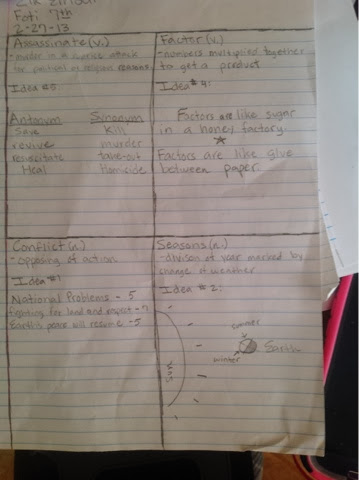
My first vocabulary collection assignment


It is very frustrating to get excited about a lesson that does not turn out as planned. I spent two days explicitly teaching the vocabulary collection assignment. We went over step-by-step instructions. I provided examples of my own, and we went through a gradual release of responsibility set of examples together. 

For starters, only about half of my students turned the first student assignment in. I understand that this is because I gave it as homework, and homework is a disaster in today's classroom. Secondly, out of those who did turn the work in, most did not follow the instructions. Labels were missing. Similes were analogies. Haiku had too many syllables. Rhyming poems did not. Thirdly, some work was so sloppy (meaning it was done the class period before) I could not even read it. And this is with two days, tutoring time, and instant messenger access to me. 

I do have some gems like the following, but these are few and far between:


So what to do? I am not ready to give up on this assignment, but there are clearly issues with understanding. And using it for homework is not going to work.

We are missing today due to weather, and Tuesday and Wednesday, we are in district testing shutdowns. That means I will not even see my students for class until Thursday and Friday, and then we go on spring break. Doing the assignment this week will not work. 

After spring break, I am out of my class for three days for state ESL testing. I will only be in the classroom on Monday and Friday, leaving me with these thoughts: Every Friday, we have enrichment day. That means shortened classes to add an extra period to the day. After spring break, I am going to try this assignment on Fridays in class where I can monitor the work and students can ask questions. We are very close to testing season, and once exams start passing by, kids think school is over. I want to continue focusing on academic vocabulary to help them understand we are still doing academic work. 

Right now, I need to grade what is left without feeling beat down (sigh). 

Friday, January 31, 2014

Applying the Instructional Model: Part 3

Assessment. In my mind, always synonymous with test. Multiple-choice test. Icky, yucky, waste of time test. But my mind has been changed. This week, I truly learned the difference between formative and summative assessments in the simplest of ways: 

  • formative = for learning
  • summative = of learning
Because I have often held the viewpoint that summative assessments are standardized, I can honestly say that I did not realize how much summative assessment I have been using in my class when I thought I was using more formative assessment. And I am a more than a bit disappointed in myself because I thought I was a better teacher than that. 

My first lesson of the marking period was winter break haikus. I did not share the art of haiku with my students. I did not show them examples of wonderful poems. I showed them the format, then told them to write. Yes, I helped them along the way - if they made it to me before the bell rang. So some students got immediate feedback. Others, however, got no feedback. Bad, Ms. Foti! 

Then I had them write an acrostic to fill up a day when I was going to be out. No formative assessment for understanding. Just an assignment to turn in, thereby becoming a summative assessment of the method. Bad, Ms. Foti!

Rewriting a passage from "Flowers for Algernon"... three homework writing assignments... compound sentences... a reading passage reflection... a thinking map... All summative. None of these assignments have been for the learning. They have been of the learning. I am disappointed in me. I am sure I am doing some informal formative assessing, but based on what I have learned this week, I am far from where I need to be. 

This week, I read that we, as teachers, have spent a great deal of time focusing on the craft of teaching in recent years, and I know that I definitely have, but we, as teachers, have not spent as much time focusing on the students' learning. Time to shift thinking once and for all. Good, Ms. Foti. 

Tuesday, January 28, 2014

Can YOU draw a penny without looking?

Today was day one of my Instructional Model Pilot Program training. We are using Classroom Assessment for Student Learning from the Pearson Assessment Training Institute as a guide (sorry for the Amazon link; it's not posted with detail on Barnes & Noble). 

Although I will share more as we go along with this process, I want to reflect on one activity I participated in. Ken Mattingly, our facilitator for today's journey, instructed us to draw the face of a penny without looking at one. Simple enough. I'm forty years old. I know what a penny looks like...?

I got the circle part. But then I couldn't remember which president was on the penny, nor could I remember which way he faced. I knew there were some words but drew a blank about what they were. I had to look at my friend's sketch to even remember that there is a year on all coins (my students taught me that TEACHING and CHEATING have the same letters, so my actions were completely acceptable). How did I not know what a penny looked like?

Now, I'm no artist, but it is really that bad? (cough-cough, wink-wink)


Despite my belief that this lesson was designed to humiliate the non-artistic in the room, there actually was a bigger purpose: without preparation and a clear target and purpose, learners are often left stumped and confused. (more on this in the future)

For now, I am taking away a bigger lesson. Tomorrow, I will be making fun of my students using this activity. I can't wait!