Search This Blog

Showing posts with label trade books. Show all posts

Wednesday, May 3, 2017

Critical literacy: Examining controversial and banned children's literature.

I was reading about controversial children's literature in an article or a book (I read so much that I cannot always remember), and being the ever rebellious teacher that I am decided that I needed to bring these books into my classroom. Including something controversial in my lessons is no big deal on my end, as I am always willing to push boundaries. I have used trade books in class previously, and the response was positive, so I decided to engage my students in a critical literacy/inquiry lesson involving the analysis of controversial and/or banned children's trade books.

The Books

The following books were chosen from different lists I found online while researching this topic. Every selection was available at my local public library:

  • Strega Nona by Tomie dePaola (witchcraft)
  • In the Night Kitchen by Maurice Sendak (nudity, phallic representation)
  • The Stupids Have a Ball by Harry Allard and James Marshall (intelligence)
  • White Socks Only by Evelyn Coleman (segregation, violence)
  •  Smoky Night by Eve Bunting (riots, violence, differences)
  • Friends from the Other Side/Amigos de otro lado by Gloria Anzaldua (illegal immigration)
  • The Amazing Bone by William Steig (witchcraft, robbery, violence, kidnapping)
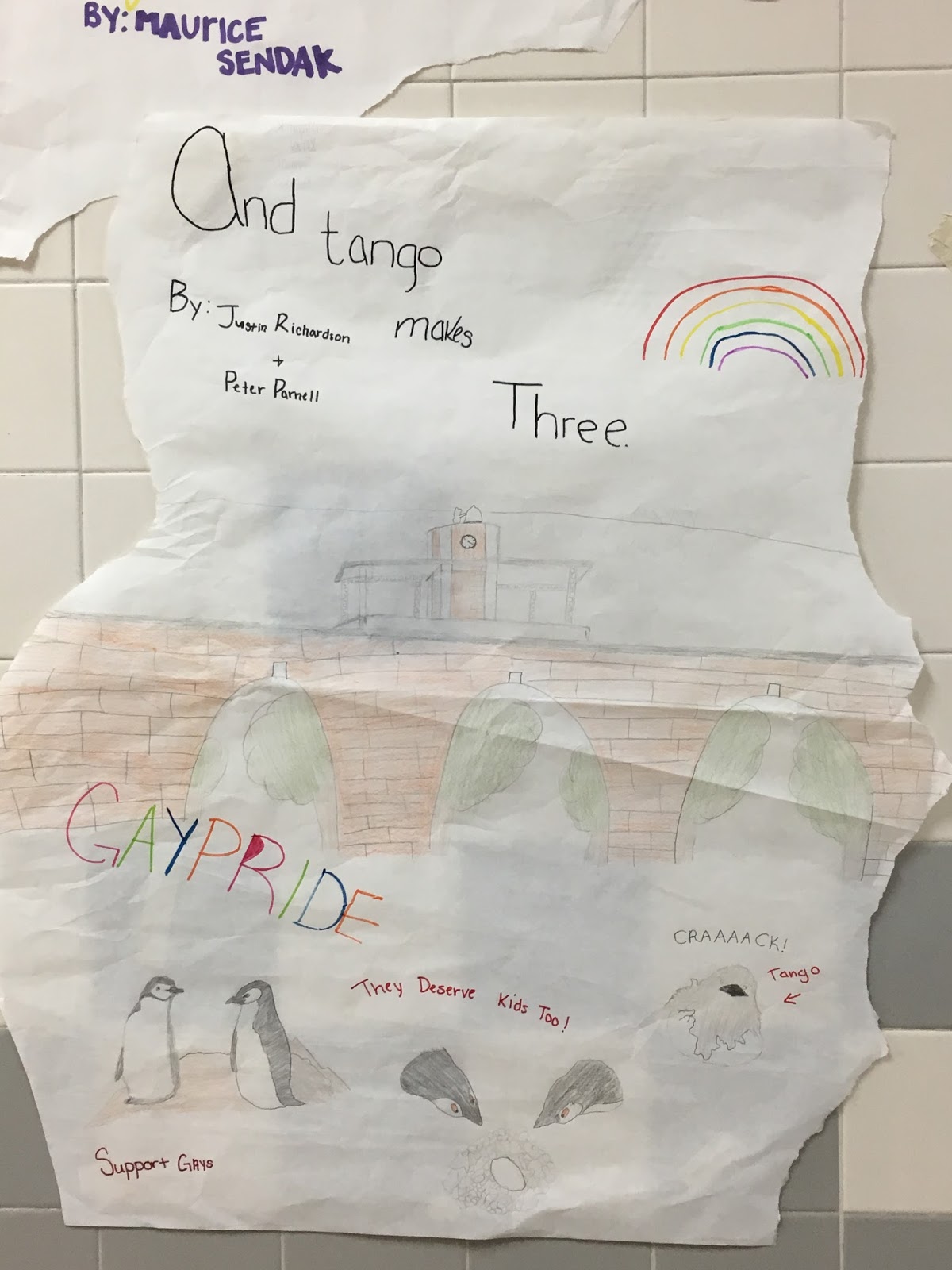
  • and Tango makes three by Justin Richardson and Peter Parnell (gay couples, gay parenting)
  • I am Jazz by Jessica Herthel and Jazz Jennings (transgender issues)
  • In Our Mother's House by Patricia Polacco (lesbian couples, lesbian parenting, discrimination)
  • Flabby Cat and Slobby Dog by Jeanne Willis and Tony Ross (fat-shaming)
Planning for the lesson

I read each of these books before bringing them into my classroom. After reading, I knew I would have students who were uncomfortable with some of the topics, but I did not want to censor the readings in my classroom. The book topics are all real-life issues, and I felt that my students must learn to critically analyze information regardless of personal beliefs as part of becoming informed citizens. I wanted them to think about why some of these books would be complained about to the point of being banned in addition to how they felt about the topics personally. 

Mentor Text

I began the lesson with my students using Strega Nona as our mentor text. I explained that the story was considered controversial. [Side note: It took me two class periods to realize that my students did not understand the meaning of controversial. This will be addressed first in future presentations of this lesson.]

We listened to a Tomie dePaola audio recording of the story, during which I directed my students to actively listen for and determine what might be controversial about the story. Many thought that priests and nuns in a children's book might offend people. Others thought Big Anthony was being treated like a slave. Only a few were able to determine that there are people in our society who find witchcraft to be offensive.


[Side note: We also discussed what the Caldecott Award is and why a book that wins awards can still be controversial.]

Grouping

I sorted my classes into diverse groups. I know my students pretty well and am comfortable saying I know what most of them believe about a lot of topics. I created groups that reflected a wide range of thinking in order to create some discussion among the students.

Book Selection
 
Initially, I planned on assigning specific books to my groups based on what I thought they would be comfortable with. I quickly changed my mind. I wanted the kids to be slightly unsettled and uncomfortable in order to get them thinking about the topic being presented. To randomize the process, I had one member of each group blindly draw a book from a basket. I kept the spine-side down to prevent any peeking.

Critical Literacy Questions

After reading the selected text, each group conducted a critical analysis. I provided my students with a list of questions (see below) I found online and left them to it. I told them I would answer and assist as needed, but I wanted to see what they could come up with on their own.

The biggest issues turned out to be with the power and interest questions. In one-on-one conversations, my students completely understood the questions and were able to present responses. They had never considered these to be power issues, however. This was quite eye opening to many.

____________________________________

Textual Purposes

  • What is this text about? How do we know?

  • Who would be most likely to read this text and why?

  • Why are we reading this text?

  • What does the author of this text want us to know?

Textual Structures and Features

  • What do the images suggest?

  • What do the words suggest?

Power and Interest

  • In whose interest is this text?

  • Who benefits from this text?

  • What knowledge does the reader need to bring to this text in order to understand it?

  • Which positions, voices, and interests are at play in this text?

  • How does the text depict age, gender, cultural groups?

Gaps and Silences

  • What views of the world is the text presenting?

Interrogating the Author

  • What kind of person, and with what interests and values, authored the text?

  • What view of the world and values does the author assume the reader holds? How do we know?

Multiple Meanings

  • What different interpretations of the text are possible? Who would support this text? Who would argue against this text?

Adapted from: http://wwwfp.education.tas.gov.au/english/critlit.htm

____________________________________

Graffiti Walls

The culminating piece to our analysis was to create graffiti walls. This is a connection response activity from Kathy Short:

 
This was a little too much freedom for my students. With most creative assignments, I hear, "Do we have to color? Does it have to be neat?" With this assignment, I said, "Be as messy as you want. You do not have to color. It does not have to be neat. You can make a great big mess." I even ripped pieces of butcher paper in odd shapes to help exemplify that the work could be messy. My kids could not handle it. They asked if they could cut the paper. They asked if they could color. They asked for more time. I got some of the neatest and most creative work ever. The silly part of me wanted to tell the kids I was taking off points for not being messy, but I was afraid of scaring my kids for life.


 Student Examples


Reflection

This is one of my favorite lessons of the year. From an AVID perspective, all elements of WICOR were included - writing, inquiry, collaboration, organization, and reading. From a proud teacher perspective, I heard some amazing conversations taking place in my classroom, and those conversations included understanding, tolerance, and acceptance, regardless of personal beliefs.  There was some disagreement about who should be reading the books and at what age, but my seventh and eighth grade students were incredibly mature in all aspects of the lesson.


Friday, March 17, 2017

My exploration of banned and controversial books: The Amazing Bone by William Steig

Although I found it easy to defend In the Night Kitchen from those who see it as a threat to young children, I cannot find good reasons to defend The Amazing Bone by William Steig - and this one has won awards: " a 1976 New York Times Book Review Notable Children's Book of the Year and Outstanding Book of the Year, a 1977 Caldecott Honor Book, and a 1977 Boston Globe - Horn Book Awards Honor Book for Picture Books" (Barnes & Noble website).

This book is filled with a number of things that bothered me:


  1. Peal, the antagonist, finds a bone. I can get past that, but based on the rest of the book, it is a bit disturbing that this young pig shows no concern for a bone she finds in the woods. Where did it come from? Dead body? Maybe I am putting too much focus on this, as last week, a junior high student found a pile of bones from a dead body while walking to school. 
  2. Pearl gets robbed by masked bandits carrying both knives and guns. In on illustration, a gun is actually placed to Pearl's temple. That is disturbing for a young children's book. 
  3. Pearl is kidnapped by a fox who plans to take her home, cook her, and eat her. Again, this is nothing new in stories (Little Red Riding Hood, Hansel and Gretel), but combined with the other elements of the story, this feels like far too much.


    I honestly do not know what to make of this story as a whole. I am 100% against banning books, but I would be cautious about this one with very young children. I will share this with my middle schoolers are part of a critical literacy lesson, but I cannot see reading it to a young child. Without the pictures, the story is still pretty harsh; with the images, I think it becomes gratuitous.


Wednesday, March 15, 2017

My exploration of banned and controversial books: In the Night Kitchen by Maurice Sendak

While I was conducting some online research about children's books that address social issues, I ran across a few lists of banned children's books. That's was an immediate invitation for me to start reading each and every single one of them, and I was surprised to discover that I have already read a few that show up on many lists, including In the Night Kitchen by Maurice Sendak. 


My first reaction: Maurice Sendak has a banned book? The Little Bear author? My now 22-year-old son and I used to read those books and watch the television series on Nickelodeon. Where the Wild Things Are Maurice Sendak? Oh, that one has controversy around it too.

I did not recall anything controversial about In the Night Kitchen, so I ran straight to my public library to check it out (and there are many copies available, not banned). According to many websites, I had missed the nudity of 3-year old Mickey (buttocks and genitals, the sexual innuendo of a free-flowing milk, and the phallic appearance of a large milk bottle. Well if that isn't an advertisement to go back and read it again, I don't know what is! 

So here is an example of Mickey's nudity:


This is a children's book, for goodness sake, and little kids like to be naked. If you have a little one who is not nude or half-nude right now, you have probably forced that child into clothes. I remember my son stripping down in our foyer every day immediately after arriving home from daycare. Every. Day. He also used to take his little naked body and watch himself dance in front of a full length mirror. It was funny. This is funny. Kids get to giggle because there is a naked boy in a book, and parents get to giggle because we recognize the inside joke. And as Americans, we really need to get over this prudish fear of nudity (my most humble opinion).

My guess is that Sendak recognized that kids enjoy being naked and created a character to which they could relate - particularly little boys. I am fighting a never ending battle of getting boys to read in middle school. Maybe if they had all read this book, they would still be reading now. Maybe if I share it with my seventh and eighth grade students, they might pick up another book.

Here are examples of the milk controversies:


Oh, people...if you are seeing something in that picture that is not there, that is completely on you. That's your mind. And that is disturbing! Like Where the Wild Things Are, this is the story of a little boy's adventures via his dreams. Into the kitchen. Where people make cake. And maybe he really likes cake. I know I do. 

If you have an issue with the nudity, do not read the book. That does not mean, however, that you are able to speak for others who wish to encourage creativity and imagination and curiosity and adventure in our children. And that, as always, is my most humble opinion. 

P.S. If you truly want to be rebellious, you can purchase the coloring book version for your kids. 


Sunday, January 19, 2014

My first ever trade book read-a-thon

This past week was our school's first day for our enrichment program. Every Friday, we are going to be on a shortened bell schedule that allows for an extra class period at the end of the day. During this time, students will be involved in an enrichment program - clubs, organizations, etc. Our full-length classes are 47 minutes. The enrichment program takes about seven minutes off each class. So what to do with a 40 minute class period? This week, because we were also at a stopping point with our lesson, I decided to do a trade book read-a-thon. 

For my entire 10 1/2 years of teaching seventh and eighth grade, I have heard, "But I don't like to read. There aren't any pictures in these books." Well, let me fix that! 

Since participating in #bookaday, I have discovered that many children's books are fantastic. There is much more out there than the easy reader: wonderful stories, rich vocabulary, beautiful paintings. If I was missing out on this for so long, my students are certainly missing out. 

I went to the public library and picked up 35 trade books (I made sure they were ones heavy with words). I placed the books all over my classroom, letting the kids know that they did not have to choose from the stack at their group. I was pleased to see that most of my students moved about the classroom and searched for books they found appealing. This was more than the usually do when we go to our school library. 


I did, of course, have to have some educational focus for the day. We would never want the kids thinking we were reading for enjoyment (cough-cough). Having shared my plan at an ESL meeting the night before, I decided upon this:


"That's all we have to do?"

Yep, kids, that's all we have to do. 

They read. They were quiet! And most importantly, they actually enjoyed reading. 

When I asked, "Did you find a book you really liked?", I heard yeses throughout the room.

When I asked, "Do you want to do this again?", I heard, "Not every week but maybe every three weeks." Nothing like specifics. 

I did have one student try to cheat. He was reading a couple of pages of each book, writing down the information I had requested. When he had ten titles written down within the first few minutes, I knew something was up. His classmates ridiculed him plenty for cheating on reading kid books. 

Now that I have done this once, I am excited to try it again and see what I can do with it. It's been awhile since I have attempted Donalyn Miller's forty-book challenge, but now I am seeing new possibilities.