If you haven't seen Exit Through the Gift Shop, a documentary about Banksy's work as a street artist, I highly recommend it. This film was my introduction to his work. Bansky is phenomenal at what he does, how he sees a landscape and transforms it with creativity and insight, commentary and satire. The images he creates speak to me, each telling a story.
As an English teacher, I believe that I have a responsibility to teach kids to read all types of text, and that includes images. My current seventh grade students do not know a world without technology, without an influx of images. My concern is how these images are interpreted, especially when they are still learning the world. What information is being processed? What information is being missed or misunderstood? How does the information affect their thinking? If I do not take the time for my students to learn how to read images, who will?
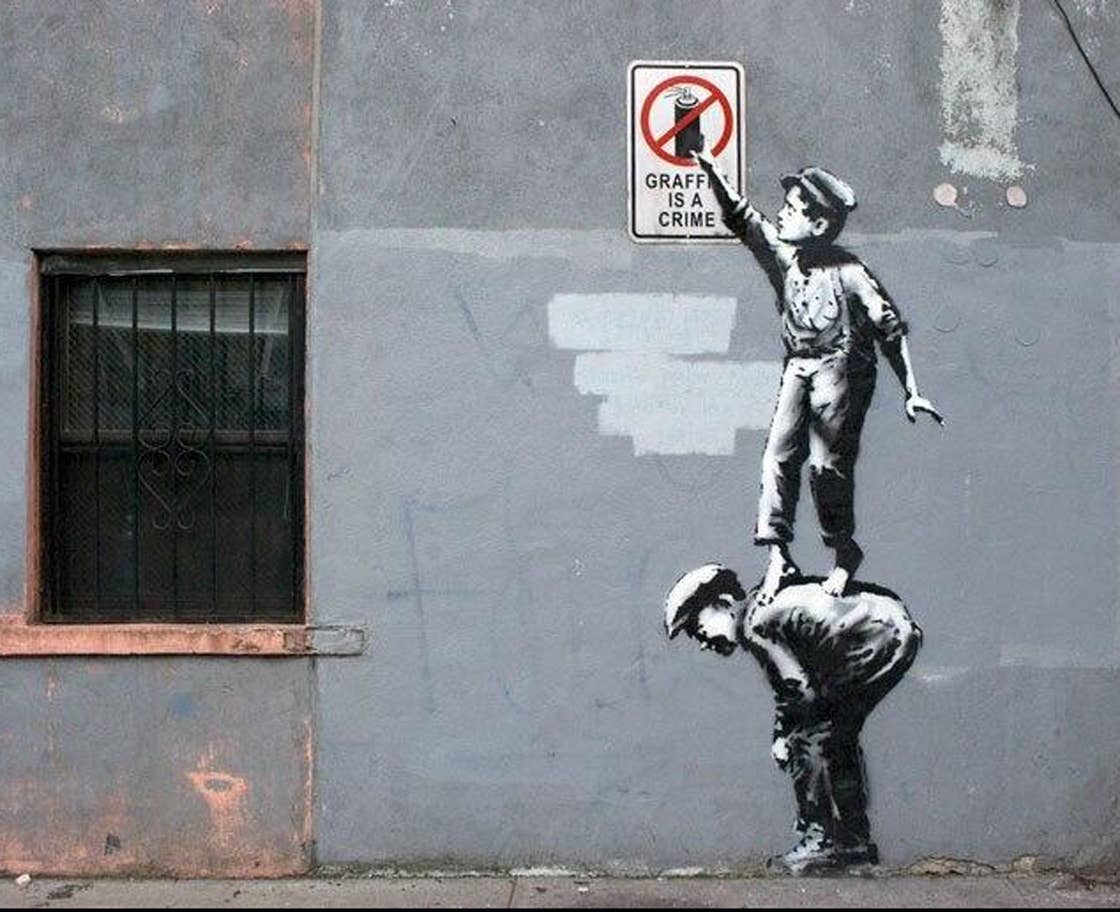
The following is one of my favorite images from Banksy and one I love to use in class for my first reading lesson:
Banky's "The street is in play"
The lesson itself is simple: Make a list of everything you see in the picture. Then we share out one at a time. The conversation usually starts with observations about the window, the bars on the window, two boys, no shoes. The a-ha moment always seems to come when someone points out that the boy standing on the back of the other is either pointing at or grabbing the spray paint can from the sign.
In all of my classes this year, when this detail has been pointed out, there has been rustling as the students sit a little more upright, leaning forward to get a closer look. The classroom has filled with the sound of oh as the story unfolds before them. That moment of discovery fills my heart every time, and the exclamations shared afterward always make me smile.
In a few minutes, I am able to teach my students about the importance of details in text. It is their first lesson of the year about making inferences. It builds confidence in the ability to interpret and understand. I can now print this picture and hang it in the room as a reference point for the rest of the year, as the original mentor text.
My suggestion to you: Find an image that speaks to you, that will speak to your students. Provide them with time to discover. Then sit back and enjoy the ride.
I was reading about controversial children's literature in an article or a book (I read so much that I cannot always remember), and being the ever rebellious teacher that I am decided that I needed to bring these books into my classroom. Including something controversial in my lessons is no big deal on my end, as I am always willing to push boundaries. I have used trade books in class previously, and the response was positive, so I decided to engage my students in a critical
literacy/inquiry lesson involving the analysis of controversial and/or
banned children's trade books.
The Books
The following books were chosen from different lists I found online while researching this topic. Every selection was available at my local public library:
Strega Nona by Tomie dePaola (witchcraft)
In the Night Kitchen by Maurice Sendak (nudity, phallic representation)
The Stupids Have a Ball by Harry Allard and James Marshall (intelligence)
White Socks Only by Evelyn Coleman (segregation, violence)
Smoky Night by Eve Bunting (riots, violence, differences)
Friends from the Other Side/Amigos de otro lado by Gloria Anzaldua (illegal immigration)
The Amazing Bone by William Steig (witchcraft, robbery, violence, kidnapping)
and Tango makes three by Justin Richardson and Peter Parnell (gay couples, gay parenting)
I am Jazz by Jessica Herthel and Jazz Jennings (transgender issues)
In Our Mother's House by Patricia Polacco (lesbian couples, lesbian parenting, discrimination)
Flabby Cat and Slobby Dog by Jeanne Willis and Tony Ross (fat-shaming)
Planning for the lesson
I read each of these books before bringing them into my classroom. After reading, I knew I would have students who were uncomfortable with some of the topics, but I did not want to censor the readings in my classroom. The book topics are all real-life issues, and I felt that my students must learn to critically analyze information regardless of personal beliefs as part of becoming informed citizens. I wanted them to think about why some of these books would be complained about to the point of being banned in addition to how they felt about the topics personally.
Mentor Text
I began the lesson with my students using Strega Nona as our mentor text. I explained that the story was considered controversial. [Side note: It took me two class periods to realize that my students did not understand the meaning of controversial. This will be addressed first in future presentations of this lesson.]
We listened to a Tomie dePaola audio recording of the story, during which I directed my students to actively listen for and determine what might be controversial about the story. Many thought that priests and nuns in a children's book might offend people. Others thought Big Anthony was being treated like a slave. Only a few were able to determine that there are people in our society who find witchcraft to be offensive.
[Side note: We also discussed what the Caldecott Award is and why a book that wins awards can still be controversial.]
Grouping
I sorted my classes into diverse groups. I know my students pretty well and am comfortable saying I know what most of them believe about a lot of topics. I created groups that reflected a wide range of thinking in order to create some discussion among the students.
Book Selection
Initially, I planned on assigning specific books to my groups based on what I thought they would be comfortable with. I quickly changed my mind. I wanted the kids to be slightly unsettled and uncomfortable in order to get them thinking about the topic being presented. To randomize the process, I had one member of each group blindly draw a book from a basket. I kept the spine-side down to prevent any peeking.
Critical Literacy Questions
After reading the selected text, each group conducted a critical analysis. I provided my students with a list of questions (see below) I found online and left them to it. I told them I would answer and assist as needed, but I wanted to see what they could come up with on their own.
The biggest issues turned out to be with the power and interest questions. In one-on-one conversations, my students completely understood the questions and were able to present responses. They had never considered these to be power issues, however. This was quite eye opening to many.
____________________________________
Textual Purposes
What is this text about? How do we know?
Who would be most likely to read this text and why?
Why are we reading this text?
What does the author of this text want us to know?
Textual Structures and Features
What do the images suggest?
What do the words suggest?
Power and Interest
In whose interest is this text?
Who benefits from this text?
What knowledge does the reader need to bring to this text in order to understand it?
Which positions, voices, and interests are at play in this text?
How does the text depict age, gender, cultural groups?
Gaps and Silences
What views of the world is the text presenting?
Interrogating the Author
What kind of person, and with what interests and values, authored the text?
What view of the world and values does the author assume the reader holds? How do we know?
Multiple Meanings
What different interpretations of the text are possible? Who would support this text? Who would argue against this text?
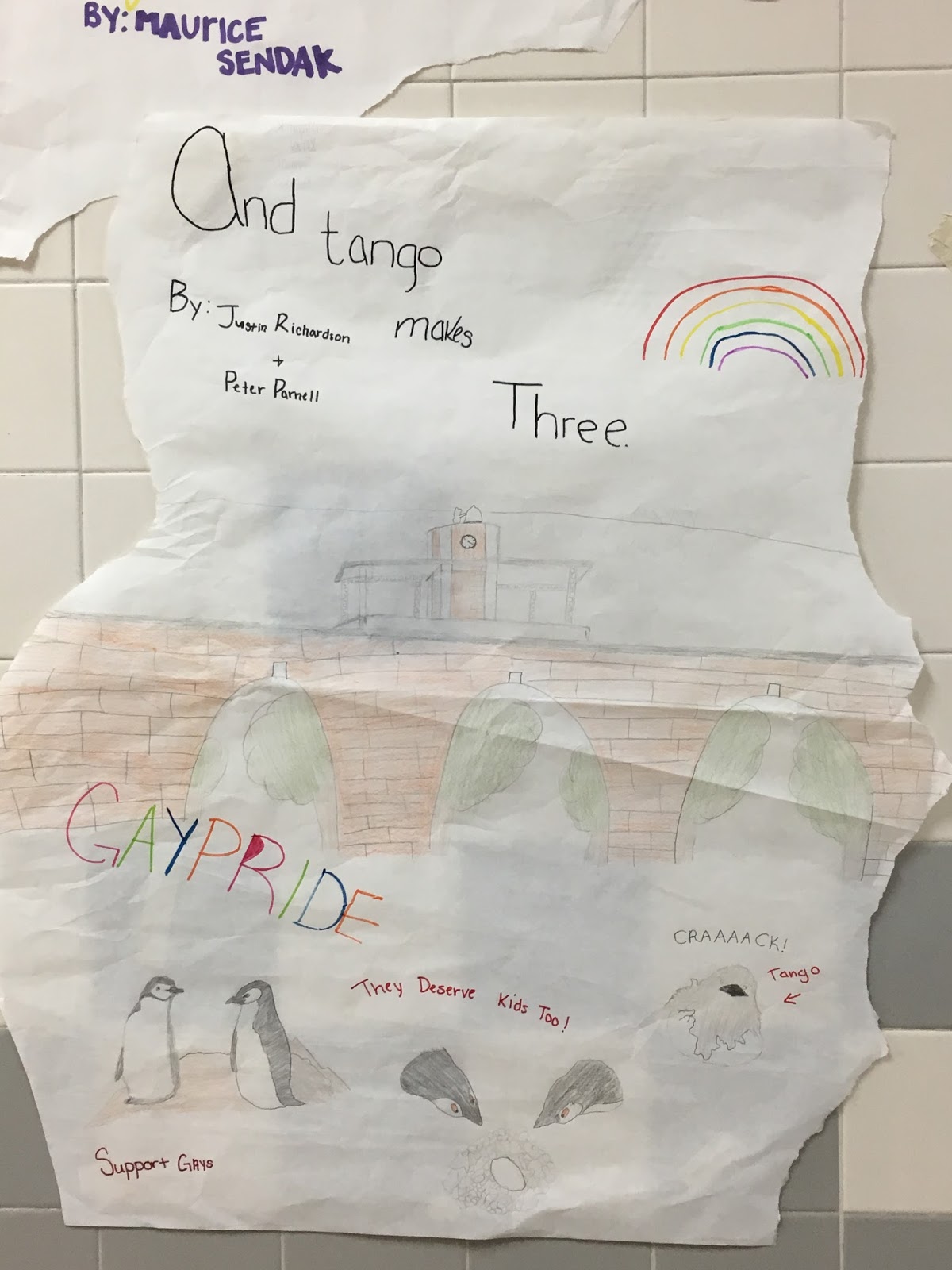
The culminating piece to our analysis was to create graffiti walls. This is a connection response activity from Kathy Short:
This was a little too much freedom for my students. With most creative assignments, I hear, "Do we have to color? Does it have to be neat?" With this assignment, I said, "Be as messy as you want. You do not have to color. It does not have to be neat. You can make a great big mess." I even ripped pieces of butcher paper in odd shapes to help exemplify that the work could be messy. My kids could not handle it. They asked if they could cut the paper. They asked if they could color. They asked for more time. I got some of the neatest and most creative work ever. The silly part of me wanted to tell the kids I was taking off points for not being messy, but I was afraid of scaring my kids for life.
Student Examples
Reflection This is one of my favorite lessons of the year. From an AVID perspective, all elements of WICOR were included - writing, inquiry, collaboration, organization, and reading. From a proud teacher perspective, I heard some amazing conversations taking place in my classroom, and those conversations included understanding, tolerance, and acceptance, regardless of personal beliefs. There was some disagreement about who should be reading the books and at what age, but my seventh and eighth grade students were incredibly mature in all aspects of the lesson.
It is important to me to have a culturally relevant classroom in which students learn to critically examine the world around them. A few weeks ago, my students engaged in an critical literacy/inquiry lesson* in which we analyzed song lyrics for stereotypes and underlying messages that we often overlook when singing the lyrics in front of our parents (well, not me). I started this lesson by sharing the song "Cater to you" by Destiny's Child. We listened to the song first, then discussed the lyrics. For the sake of argument, I took a strong feminist perspective, arguing against everything the ladies sing about, claiming it represented stereotypical view of woman. I feigned strong disgust (maybe I was a bit disgusted) toward lyrics such asmy life would be purposeless without you, let me help you take off your shoes, and I'll keep myself up.
But my kids are proved just how intelligent they are. They changed the perspective on me, explaining how it was acceptable for a woman to do nice things for her man when she wants to. And I had a few boys tout that this is the way it should be. All in good fun. After this, my students were allowed to choose individual songs to analyze for stereotypes. The assignment was to create a poster which included the song title, the artist, sample lyrics that exemplified stereotypes, and a brief explanation of how the song reinforces stereotypes (we quickly learned that country music is a gold mine for this activity). Now, not every poster was done perfectly, but my students rose to the occasion. I could not be prouder to share their work with you (and they are also proud to have it displayed on this site). Here are a few examples to get you started:
During our passing periods at school, we play music. Last week, our programmer had "I can't feel myself when I'm with you...and I love it..." blasting from our overhead system. I stood in the hallway giggling, and when class started, I asked my students who knew what that song is really about, connecting it back to this lesson. They knew. They are critically conscious young individuals. Do you know? *This lesson combines two activities from AVID's Culturally Relevant Teaching and consists of very little original thinking on my part.