Search This Blog

Showing posts with label again and again. Show all posts

Thursday, January 2, 2014

Flowers for Algernon - Part I

This is my third year teaching eighth grade (after eight years teaching every possible reading/writing variation of seventh grade we have had). When I left seventh grade, I was teaching writing, and eighth grade is predominantly focused upon reading. One of the biggest issues I have had has been pacing. After two years of trying to manage every listed reading assignment in our curriculum, I threw it all out the window and decided to simply teach - and it is paying off. Unfortunately, there are still requirements. 

One of the eighth grade required readings for eighth graders is the short story "Flowers for Algernon." When I say requirement, I mean requirement. Oops. Missed this for the first two years! Year three, I got this...I think. So here goes. 

Progress report for March 5

  • Although my students should pick up on the indirect characterization right away, I am going to start with direct characterization. This will be a short and sweet review to introduce us to Charlie. 
  • We will be working on computer annotation skills (Google Drive), starting with some basic underlining/highlighting skills. I am trying to get them away from highlighting everything on the paper. I have been teaching annotation all year, but that has not cut down on the highlighter abuse. 
  • Since we will be using Google Drive, we will also work on adding comments to take notes. I have created a sentence stem (slide 3) to guide their reflection of the direct characterization. 
  • I am also going to have the kids rewrite the first entry in proper English. Well, as proper as they can make it, I suppose. I haven't quite figured out how to grade this. It might simply be a participation grade for them, but I want them to get some editing practice. 
  • For the second entry, we are switching gears to indirect characterization. I want my students to start putting together what we are learning about Charlie through his writing. 
  • Since we have been working on Notice & Note signposts throughout the year, I am going to review Again & Again. With our Again & Again lenses (I am combining the N&N signpost with a text evidence strategy from Falling in Love with Close Reading), we will be looking for patterns in Charlie's thinking that help us understand his traits. 
  • Click for larger copy
  • The hard part here is getting them to focus on the text evidence. For example, what does the "rabits foot in my pockit because when I was a kid I always faled tests in school" tell us about  Charlie? (It was really hard to type all of that incorrectly.) Using a modified version of the frame provided in FILWCR, I am going to have the kids write a character traits statement about Charlie.

This is as far as I have gotten so far. Now I have to figure out where to chunk the rest of the text so it doesn't take me until the end of May to teach the entire story. 

________________________________________________________

Resources: 


Sunday, December 8, 2013

"Forgotten Language" by Shel Silverstein

My students took their first curriculum assessment of the year a few weeks ago. I intentionally set the test aside and saved it for our fall semester exam review. I am also hoping that the kids will have forgotten most of their thinking from before Thanksgiving, and we can look the reading passages with a fresh perspective..

Review for me is not just looking at answer choices. I will teach the passages from the test in an effort to model how they should be thinking about any reading, not just to answer test questions, but to gain something from the reading. Hefty goal on my part, I know. To them, it is simply a test with stuff to read.

The first passage we are going to look at is Shel Silverstein's "Forgotten Language." There were only three questions on the test regarding this poem, but my students struggle with poetry, and three questions failed are three questions failed. 


To teach this poem, I have incorporated a number of strategies:


  • From Notice and Note, I will be using the Again & Again signpost to focus on the meaning of Once and the significance of the repeated last line in connection to the rest of the poem. 
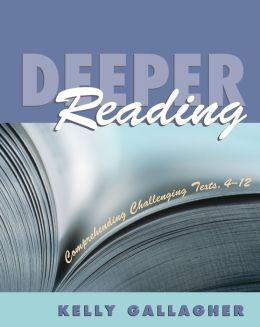
  • From Kelly Gallagher's Deeper Reading, I am using two strategies. For the second reading, we will focus on answering three questions: What does it say? What does it mean? What does it matter? I have also added the reflective question, What is the most valuable idea that you can take from this poem?
  • I am going to be using Nearpod for students to respond to all questions in the lesson. Because this review is also helping them prepare for their fall final exam, I need all students thinking and showing their thinking. I do not want them being passive and allowing others to answer questions for them. By being able to see their responses (thinking), I will be able to determine who is understanding or not understanding what. (Plus I just got Chromebooks and the kids are anxious to start using them.)
The only thing that makes this a test-related lesson is the incorporation of the test questions. I loathe multiple-choice questions, but such is the mandate of federal regulations; therefore, they must be taught at some point in time. More importantly, though, I hope they discover that Shel Silverstein is much more than a goofy poem writer. 

Tuesday, October 29, 2013

Notice and Note Reflections: "The Tell-Tale Heart"

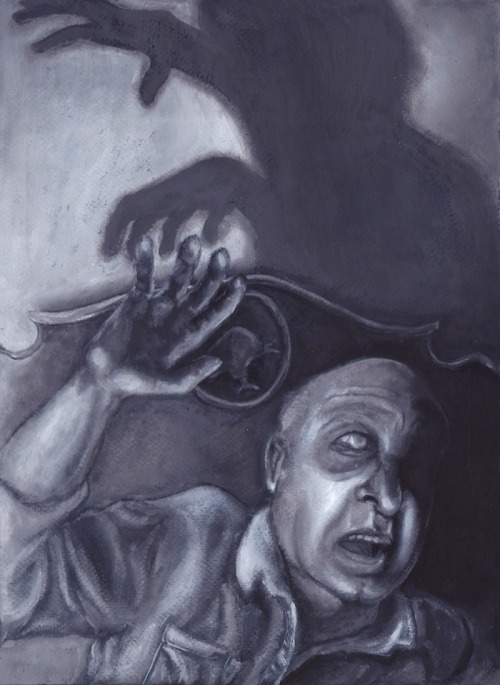
Today was day two of my lesson over "The Tell-Tale Heart." Yesterday was all about modeling and explicit teaching. I built upon our Contrasts & Contradictions and Sketch to Stretch lessons, then added in the new signpost, Again & Again. 

I am always concerned when I start a new text with close reading strategies. I went through the first three paragraphs one at a time, and I was afraid that it was going to take away from the overall suspense of the story. Wrong! It actually seems to have helped. By the end of class, there were a number of comments from the kids regarding what was going to happen next and how much they wanted to continue the story. 

The text itself also led to some confusion with Contrasts & Contradictions that I was not expecting. Because the narrator is already doing things that are contrary to our personal selves, some of the students were having difficulties identifying the CCs. My informal assessment of the situation is that they were overthinking it, but it was something to note for future reference. 

Today we started collaborative work on identify CCs and AAs. The students listened to a chunk of the text (through the murder), focused on identifying the elements we have been focused on. Right away, I knew there was an issue. As I walked about the classroom, I saw that the only thing being noted on the text was the vocabulary words. 

The first thing I did was address comprehension issues. We went through a simple who/what/when/where/why routine to make sure they understood the text to be able to identify the elements. No big issues. I did have to explain the difference in mattresses from the mid-1800s until now, but that certainly didn't impede their ability to locate information. 

In reflection, I think I need to allow them to listen/read first, then go back and listen/reread a second time. I believe I was asking them to do too much at the same time. Or maybe they were simply engrossed in the story. 

Their next step was to work with their groups to discuss what they had (had not) identified and add it to their reading log. As they worked together, I wandered the classroom, stopping to ask and answer questions. 

On the positive side, some of the students made Contrast & Contradiction connections that I had not even considered. For example, one student noted that despite the narrator's attempts to be stealthy, slow, and cautious, when it came to the actual murder, he leaped into the room. The student determined that this went against everything the character had done up until that time. (I <3 when I learn from my knuckleheads.)

I also noted that there were some great conversations taking place, even when the kids were not quite getting the particular skills. The groups were debating ideas and why they did or did not work. Oh my gosh! Students focused on the actual lesson! A group of my girls was very interested in the narrator's discovery of his own powers. 

Of course, we also had some negatives. I did an informal assessment on the work they did today to determine if they were understanding what I was asking them to do. These are some of the issues I saw:


  • The kids were easily able to recognize the Again & Again moments, since "TTH" is full of it. Explaining it, however, is not going well. The focus question for AA is, "Why does this keep showing up again and again?" Most of the responses stated that a word or phrase was repeated by did not address the why


  • There were also some issues regarding specificity and clarity. Take the following example. I discussed this with the group. They explained their idea in great detail. When it came to putting the thought on paper, some details were left out. 


The next step in my lesson is to have them create individual entries to show understanding. I do not think we are ready for that yet. When we pick back up with the lesson, we will need to return to their notes from today and work on elaboration and clarification, a skill we just used for our personal narrative. I will use some of their examples to model my expectations and allow them to make revisions to their work. The students who caught on quickly and completed exemplary work will become my back-up teachers (I do this frequently). 

Despite the negatives, I feel we are headed in the right direction. This was new for them, but it is also new for me. Today's work showed me where I can be more explicit in my own teaching to create an even better learning experience. 


Saturday, October 26, 2013

Close Reading Strategies with "The Tell-Tale Heart" (Planning)

It has taken hours, and my back is killing me, but I believe I have put together a quality close reading lesson for "The Tell-Tale Heart" using two of the signposts from Notice and Note: Contrasts & Contradictions and Again & Again. 

My goals for this lesson were to:

  • have students connect our Sketch and Stretch vocabulary lesson to the words within the text
  • connect our introductory lesson for Contrasts & Contradictions in "The Horror" to "The Tell-Tale Heart"
  • teach a second signpost, Again & Again
  • be EXPLICIT in all teaching
I began by reading "The Tell-Tale Heart," marking up my text, identifying the above elements and making some teaching notes:


As I was reading, I was making a sample CC/AA reading log. You can see that I do not always think in order. 


Using all of my notes, I created my presentation, adding my nerdy sense of humor throughout. I have an underlying goal to educate on all things 1980s. If I had to endure the torture, so should they!

I am definitely going to have to do some proofreading tomorrow. I am a bit delirious at this point (and not Eddie Murphy style), but I was determined to crank this baby out tonight. Any and all feedback is welcomed. 

As always, I will post feedback from the lesson as we progress through the next week.