Search This Blog

Showing posts with label texas literacy initiative. Show all posts

Saturday, August 6, 2016

Oh my goodness! I have never taught my kids to collaborate.


As a member of my school's AVID site team, I put a great deal of emphasis on the WICOR strategies in my classroom and lessons:


I can guarantee that I explicitly teach WICOR strategies. While reading Peter H.
Johnston's Choice Words, however, I realized that I am not doing a very good job at truly teaching my students how to collaborate. Johnston writes, "Even when they work in groups, [students] rarely work as a group, sharing ideas and working toward a common goal" (65). 

This really caught my attention. Do I really think my eighth graders know how to do this? We usually get there, but I am very aware that I have left out critical information regarding this process, and in order for my students to truly participate in group activities, I need to do a much better job if my students are going to "have some shared understanding of the situation and activity in which they are jointly engaged" (65). 

So time for a new approach to collaboration, especially with a new state teacher assessment beginning this year that focuses heavily on student-centered learning. From now on, when my students are going to be engaged in group activities, there will be a discussion ahead of time focused on the work to be done:


Classes do not start for two more weeks, so I do not know how this approach will work until I try it out. It is a small component, but I have a feeling it may pay off with huge dividends. More to come once we get started.

Thursday, October 15, 2015

Comprehension Processing Questions with videos

A few weeks ago, I wrote a short post about using Comprehension Processing Questions. I was asked for some follow-up information, so here is follow-up number one (yes, there is even more to come). 

I teach at an incredibly diverse school. Because we are in Texas, we tend to focus on our Spanish-speaking population, but we have students and families here from all over the world - Vietnam, Nigeria, Middle Eastern countries, South American countries. 

We are moving into a unit on expository text, and our first reading set is about immigrants and the challenges they face. Although some of my kids have a great deal of background knowledge in this area, some have none. So I searched for a video to help, and I ran across this: 


Although it had not come up in my summer training, I wanted to give my students something to focus on with this video. I created a Comprehension Processing Question to guide them: What do immigrant parents give up when moving to the United States? We discussed the question, and I clicked play. 

At first, my kids starting making notes in response to the CPQ, but I noticed that their pencils were being put down very quickly. I sat back and watched, wondering what was happening. As soon as some of my students started getting teary, I declared victory. I had, as the kids say, put my students all up in their feelings. That moment was worth so much more than their responses to the CPQ. 

We did, however, watch the video a second time in order to answer the question. My kids were able to discuss - in detail - what they had heard in the video. I do not show many videos in my class, but this certainly added value to what I was attempting to do with my lesson. 

Up next - CPQ with expository text. Stay tuned. 

Tuesday, October 28, 2014

I'm Ready for My Close Up...?

Today was the day. After days of anxiety and nervous tension, I was filmed presenting the vocabulary routine that is part of my campus Data Improvement Plan through the Texas Literacy Initiative. (If you look over there on the right, you will see my tag list. Vocabulary Routine is one of the bigger ones. I write about it a lot if you are interested in reading more.)

The overarching lesson for today focused on the elements of linear plot - exposition, rising action, conflict, climax, falling action, and resolution. For the most part, these words were review for my students. The bigger goal, however, based on our state standards, is to understand the connection between resolution and the conflict of the story. 

Because we are focusing so heavily on vocabulary, we use a lot of choral techniques and deepening comprehension activities - like the vocabulary routine. I built two routines into the lesson linear plot lesson - one for conflict and one for resolution

Under different circumstances, I probably would not have used the word conflict in a routine. My students know what a conflict is. I did, however, want them thoroughly focused on its meaning to understand its connection to resolution. The vocabulary routine focuses more on tier 2 words that students are unfamiliar with but are likely to encounter in multiple situations. 

One of my district curriculum specialists came in to observe and to film the vocabulary routines. At the same time, I had my student teacher film the entire lesson for me. Who doesn't love seeing themselves on film and thinking, "Do I really talk and move like that? I teach students AND teachers for goodness sake!"

So, for those of you who are wondering what exactly this routine looks like in action, I present...ME and my wonderful third period class (and before you look around and wonder where the rest of the class is, I am blessed to have one class that consists of only twelve students). 


Tuesday, October 21, 2014

Deepening Vocabulary Understanding

This year, I am getting much better about reusing lessons that work, rather than reinventing the wheel for everything I do. For the past two days, my students have been working on our vocabulary for "The Tell-Tale Heart." This has included a Texas Literacy Initiative vocabulary routine and a sketch-to-stretch assignment. 

Today I had a follow-up vocabulary booster training to last year's vocabulary routine training. Although I have been using the routine, I realized that I have not been moving through the entire process. I introduce the words, but I have not been working to deepen understanding as much as I should. I put the words on a word wall and often refer to them, but I have not really had my students doing much with them. 

So guess what's happening now.  With some guidance from Bringing Words to Life, I am creating daily review lessons for the rest of this week to deepen understanding of our vocabulary words. 

Deepening Understanding Lesson #1: Find the Missing Word 

This strategy is essentially a fill-in-the-blank. Since I have been out for a day and a half, this will help show me how much my students have learned without my presence. In order to ensure feedback from all students, I am creating the review as a Kahoot lesson. Kahoot creates high engagement, and my students often ask if we are ever going to use it in class. This will be the first time in my class this year. 

Deepening Understanding Lesson #2: Making Choices 

For this strategy, students will be given examples and non-examples for each word. If the information given is correct example, the students will say the word. If it is not, they will not say anything at all. 

For example: If I say something you think is truly hideous (and not just your personal opinion), say hideous. If you do not think it is hideous, do not say anything at all. 

  • Adam Levine
  • Freddy Krueger
  • a puppy dog
  • maggots on rotting food

Deepening Understanding Lesson #3: Putting the Words to Use

On Friday, I am going to have my students complete a timed writing with the words. In an effort to get them to apply our vocabulary words to other disciplines, they will have to write about what they are doing in another class, using at least four of the nine words. This week I introduced Seven-Up Sentences, writing with a minimum of seven words per sentence, to make their writing more powerful. They will need to incorporate this into their work (to the best of their ability under timed writing circumstances). 

I am looking forward to seeing how things go this week. The district goal is to focus on 4-5 words per week. I have more for this week because I am using a district-created lesson. Once I see how things go for the next week days, I will determine if I continue using this set for another week, and if not, I have to figure out what to next. 

Stay tuned. 

Tuesday, September 2, 2014

Kismet?

Today I started teaching my first Texas Literacy Initiative vocabulary routine of the year. Earlier this summer, I was skimming through Habits of Mind (yes, I really do own all these books). I decided that the first thing I needed to focus on was persistence. I see kids give up on school in the first few weeks every year. This is my attempt to be a bit proactive. 

In the vocabulary routine, students have opportunities to participate in analyzing graphics, choral and partner speaking, and writing. Especially this early in the year, students respond well to choral speaking, as they are able to talk in a safe environment. And I get goofy with it - just the boys, just the girls, just the boys sounding like the girls, just the girls sounding like the boys. I tried to get them to rap today, but they just laughed at me. 

So far this year, and I know it has only been six days, my lessons have had a meant-to-be quality. We were using on online interactive presentation to respond to the lesson. I included a video clip, something I have never done before, but I knew the kids would respond well to it: 


Not only do my students love Finding Nemo, they often compare me to Ellen DeGeneres - and that is a compliment I will gladly take. 

After the comparisons, my often-used online site kept stalling and crashing. It was an ideal moment to teach persistence, to discuss how I was so determined to teach them this lesson that I had a backup plan. They groaned; I pretended I heard squeals of joy. 

Although I think "teachable moment" is an overused expression, I will happily make connections from any lessons to the world around us. The more I can do it, the more my students will understand. I am looking forward to picking this lesson back up tomorrow and seeing where it leads next. 


_____________________________

Side note: This is one of the images my students analyzed to determine if it showed persistence. 


When I asked how it showed persistence, one girl made a comment about the "big ball," causing massive laughter from this class. It is silliness like this that makes me absolutely love teaching middle school. (Tee-hee-hee! She said "big ball.")

Monday, April 14, 2014

Preparing for a visit from TLI

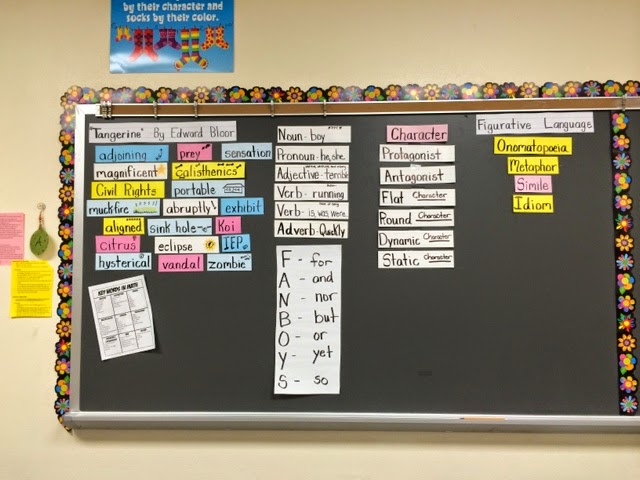
This Thursday, representatives from the Texas Literacy Initiative in Austin and within the district are coming to observe classes to see vocabulary use in action. I am the contact person for this program at our school. Last week, a colleague stopped me to show all that she has done to prepare for the visit. I am so impressed that I have to share. 


Monday, February 17, 2014

Vocabulary Collectors

Once again, Corbett Harrison has inspired me. This time, he suckered me in with his Vocabulary Collectors ideas and examples

I have modified this for the needs of my students. My school is working hard on promoting academic vocabulary, so I have designed my lesson to include words from the four core classes. I have also focused on products that should be review activities for my students. 

In my presentation, I have used a variation of our last vocabulary routine word, regress. I also created an example of each of the products that I will post on our student webpage for their access. I am looking forward to having their work to use as examples in the future. 

Testing season is creeping up. I am hoping that this activity might help them digest some needed vocabulary over the next couple of months. I will need to display these, and I am going to try out some activities (TBD from my recent word wall training) using the words that are posted. 

Here ya go:

Tuesday, February 4, 2014

Acknowledgement feels so goooood

When I got to school yesterday, I had an email from a friend who works at another school in the district:


I had not idea what she was talking about. 

It turns out that my not-so-little-anymore blog was mentioned in the Texas Literacy Initiative newsletter for January for my reflections on the vocabulary routine that has been this year's focus. 


Go me!


You can read the full newsletter here

Monday, January 27, 2014

Fun Friday: Playing with our new Ipads

As part of the Texas Literacy Initiative, my school received two carts of brand new Ipads. The carts had been in my room for a few days, but my students did not notice. They were a bit surprised when I said we were going to be getting them out. Then they were a bit disappointed when I said we were going to be playing word games. 

Despite their initial thinking, the word games were a hit. I gave them a list of apps to choose from, and each class seemed to have its own favorite. I expected groans, and lots of this is boring. Instead, I saw students working together to figure things out. They asked questions when they were stuck. They told me they learned things. I was really impressed, and I am excited to do this again. 

The choices (we used the free versions of all apps):
  • RhymieStymie - determine a set of synonyms that rhyme together
  • This is to That - solve analogies
  • Get+Together - figure out compound words based on clues and pictures (this one was really good for my ELLS)
  • Grading Game - find all of the errors in a paper or be fired
  • Idiom Stories - What does the idiom mean? (another good one for my ELLs)
  • Word Stack - put together words by association


Thursday, December 26, 2013

"Stolen Ideas" - Definitions and Photography

I have mentioned before that my school is part of a state grant, the Texas Literacy Initiative, and the focus this year is on vocabulary. I stumbled upon this in my Twitter feed today, and my brain has been twitching with ideas ever since. I said I would wait until Saturday before I started doing anything school related, but my brain does not agree with that decision after 6 /2 days of little educational stimulation. 

Today's Daily Create (@ds106dc) assignment: Using Dictionary.com's word of the day, take and share a photographic representation of the meaning. 

How easy and wonderful is that. Not only can I use this with a word of the day to expose my students to more vocabulary, I can also assign words from our readings for them to do this with. We are a Bring Your Own Technology school, and most of my students have some sort of camera. For those who do not, they can always draw something. They can also use photo editing apps to add some creativity. 

Of course, what is a great idea without some practice? 

Today's Dictionary.com word:  


As a former daytime soap opera addict (I am only a nighttime soap opera addict now), I know this meaning. The second definition, however, caught me off guard. I decided to go with that one because it is new to me and because I cooked a turkey Christmas Eve. 

So without further ado, here is my photographic representation of schmaltz:

Yum!

Now I need someone to teach me how to use Flickr because I have not logged into the site in years. 

Sunday, December 1, 2013

Vocabulary Routine for Milkweed: Ghetto

Now that turkey break is coming to a close, it is time to get back to the daily grind. That means Sunday lesson planning! 

My Pre-AP class is reading Milkweed. This is not a difficult read, and I have not pulled out any vocabulary so far. But we are now traveling to the ghetto in the story, and this is definitely a word I feel needs to be taught explicitly. 
I admit it. I'm guilty of using this as a slang term, then turning around with my old lady voice and saying,"Do you have any idea what that word really means?"

Although some of my Pre-AP students will understand the word in context, some will not. I am sure some have been doing their reading over the break with an image such as this in mind:

My apologies if this is a picture of
any of my readers and/or family/friends/
acquaintances of my readers.
Blame Google Images. 

I have worked at the same school for 10 1/2 years now. I know my students. This kind of image, or one similar, is going to come to mind when reading the World War II story as soon as they see the word ghetto

So, I have put together their vocabulary routine lesson, complete with various images from 1940s Warsaw, to ensure that they never forget what ghetto really means. I did add an end piece asking them to briefly write about how they think the 1940s definition used in the book has turned into the slang definition we use today. I am curious to see what they come up with. 

Sunday, November 17, 2013

The Giver: Chapter 1

While my Pre-AP students are reading Milkweed, my academic students will be reading The Giver. Last year, I will honestly admit that I did some of my worst teaching with The Giver. I was frustrated with my students. They refused to read outside of class, impeding the lessons I was trying to cover in class. For the most part, we listened to the book and did very little with it. Of course, when I was doing this, my newly-promoted secondary superintendent was brought to my classroom to view some of the finest teaching our school has to offer. (sigh) Not my best moment, but I refuse to let it happen again. 

Prior to beginning the novel, we will be going through our Texas Literacy Initiative vocabulary routine with the word release. Although I know my kids know this word, I want to put focus on it since it is such an important concept in the novel. We will be viewing the presentation with Nearpod so that I may assess understanding of the term. I am not expecting any issues here. We will come back to discuss this more after reading the first chapter of the book. 

Last year, I began by having my students create their own perfect societies, but it become more of a distraction and never truly connected to the novel the way I had initially intended. This year, I'm throwing that out the window. For chapter 1, we will focus on Contrasts & Contradictions from Notice and NoteThey are already familiar with Contrasts & Contradictions, but now we are going to shift away from characters and focus on the setting. I want them delving deeply into the differences between Jonas' world versus our own to see what this "perfect" world is like. 

In preparing the Contrasts & Contradictions lesson, I incorporated Christopher Lehmans' Close Reading Ritual from Falling in Love with Close Reading. The lenses will be focused on the setting of the story. The patterns will be the Contrasts & Contradictions. We will then use this information to create a picture of Jonas' society. 

As with some of my previous lessons, I am going to have my students respond to the presentation questions using Nearpod. By using Nearpod, I ensure that every student submits a response, rather than letting another student answer on his/her behalf. I can skim through their responses and see who is understanding the text and the strategy, as well as who is not. This information is also saved in a report that I can use as needed.

This is definitely a better start from last year's teaching. Ain't nobody comin' back this year to say I ain't doin' my J-O-B!

Friday, November 15, 2013

Darn you, learning logs!


Next week, we go school wide with the weekly learning logs. Since I made the assignment, I decided to do a trial run today. Of course, I expected it to be an easy day. I was trying not to talk much due to a sore throat, but the best made plans...

I discussed the learning log with the students. I explained how this is going to be used throughout the school, that they will see it in all classes, that I will make them the experts, blah, blah, blah. I discussed how they do not have to address the four questions directly but are to use them as a guide for their response, as the response will depend on what they have learned in a class for the week. I waxed eloquent on the need to write in specific detail and not just make a list, using complete sentences, capitalization, and punctuation. 

I feel like all I did all day was waste my time and breath repeating myself. Days like this make me wonder if I am really doing any proficient teaching at all. 


Is this a complete sentence? Did this happen in the story?
I do not remember blood.

No, dear. This is not specfic. Nor did you know all of this.
You told me so in class. And you do not read outside of class.
Oh, thank goodness. We are at least headed in the correct direction.

Thank you. Someone listened in class and read the directions.


All right, all right. Maybe I do not have to quit after all.


So what have I learned from this?
  • My students need explicit teaching on how to write about what they have been taught during the week. 
  • My students need a review of what they have learned during the week before writing about what they have learned during the week. 
  • The non-English teachers are about to feel some English teacher pain when it comes to reading student writing. Wahahahahahahahahaha!

Thursday, October 24, 2013

TLI Vocabulary Routine: Round 2 (Reflection)

I love this strategy. I love love love love love this strategy. Did I mention that I love this strategy? I do. I love it. I loved it the first time. I loved it this second time

The Texas Literacy Initiative vocabulary strategy engages students. The kids are actively involved in learning the material. 

1. They repeat the word. I have them do this in different ways for my own enjoyment - say the word, say it like a cat, say it like a dog, say it like a boss. I definitely see some future actors and actresses coming from my classroom. 

2. They are analyzing usage and providing informal assessment information with a thumbs up/thumbs down response. I can scan the room and visually see who is understanding within a matter of seconds. Both times I have conducted the routine, when a student provides an incorrect answer, he/she will go back to the sentence and process again until he/she figures it out. Watching a student take the initiative to actually correct himself is pretty impressive. 

3. I learn a great deal about my students through my examples and non-examples. Case in point: Today, one of my sentences said that parents are vexed when kids take the initiative to wash dishes on their own. One boy told me that he is not allowed to wash dishes because his parents think he is does not clean them well enough. I think this is one smart child!

4. The kids are speaking to one another in complete sentences with the Seven-Up Sentences. I did not complete this part of the activity last time. This time, I added it, and the practice was magical. I am one of two eighth-grade ELA ESL teachers, and getting my ELLs to speak in front of others can be a struggle sometimes. This was a no pressure partner conversation, and everyone was talking, in addition to working with the given word. 

5. They are learning. It has been a few weeks since we went through our first vocabulary routine. When I referred back to our gripes lesson, I was immediately barraged with a chorus of "to complain." Sure, a few kids forgot, but after a few seconds, the first lesson seemed to pop right back into their brains. 

6. They made connections between two lessons and were able to write about it using the words

I have not yet taught this strategy to my campus colleagues, but the training is coming up soon. I cannot wait to share and model how this works with them. 

Vocabulary Strategy: Sketch to Stretch is a hit!

A few days, I posted my vocabulary lesson  for "The Tell-Tale Heart." I truly felt I had something good, but as always, the children have surpassed my expectations. 


You know it's a good strategy when the kids start drawing you for the assignment. Of course, this student thought he was the first and only child to ever come up with an idea like this.

I used this as my example for the rest of the day, telling them I have never lied about being a model. This is the proof! The lips are too big, however. No Botox for me, thank you very much. 

Here are some other examples:


This was fun and engaging for the students and for me. 


Sunday, October 20, 2013

Vocabulary Strategies for "The Tell-Tale Heart"

I will begin teaching "The Tell-Tale Heart" later this week. I am working on two vocabulary strategies for this lesson to mix things up: the Texas Literacy Initiative vocabulary routine and another strategy called Sketch to Stretch. 

I will start the vocabulary work with the vocabulary routine for the word vex. I chose this word because it ties in well with our last vocabulary routine for the word gripe. I want my students to be able to view words in connection to one another, rather than isolated pieces from different readings. I have heard my students using the word gripe - correctly - in conversation with one another, so I will be curious to see if they pick up on vex the same way. 

The second strategy, Sketch to Stretch, comes from Vocabulary Strategies that Work, a book provided by the Texas Literacy Initiative as part of our vocabulary focus. Sketch to Stretch was originally created as a reading comprehension strategy for visualization (I am going to use that as a connection piece at the end of the reading). In this process, students read a section of text, then create a reaction drawing. By the end of the reading, they have a series of drawings to help them recall information. [If you search this strategy online, you will find a great deal of information.]

Wilfong has adapted this strategy for vocabulary study. Students read a chunk of text, then they choose a word from that section that they feel is vital to the meaning of the selection. They then draw what they think the word means in the given context. 

Since this is the first time I will be using this strategy, and because "TTH" tends to be complicated enough for my students to understand, I have modified Wilfong's strategy to suit my own needs. Rather than use Poe's text, I am giving my students modern-language sentences with selected words from the story. They will create their drawings and definitions based on this information to help them apply it to "TTH".

Follow-up to come after I teach this Thursday or Friday. Stay tuned.

Tuesday, October 15, 2013

Speed Drafts

Before I move on to today's topic, let me follow-up on my Power Writing post:

  • This was a continued success with my academic students. The best response I heard all day was a whispered, "This is aaaaaawesome." In addition, I heard requests for more rounds. 
  • One of my science colleagues (anonymous shoutout) used Power Writing with her students today as a review of academic terms. We are both part of our Texas Literacy Initiative Campus Based Leadership Team, and we are working on reading and writing skills in all classrooms. The teacher provided this feedback: "They LOVE this. I was afraid they wouldn't buy in to writing in science but they did and then some!! Thank you" 

The power rounds were used in anticipation of a personal narrative writing assignment. Traditionally, in assigning a personal narrative, I would model brainstorming and Thinking Maps planning before approaching a rough draft. This time I decided to try something different based on informal observations. The  biggest issue the kids have is getting started, and the more time they are given, the more time they will take. Well, I am not into wasting time (at least not too much; we all need our moments). 

Extending on my Power Writing lesson, today I added Speed Drafts. After presenting the topic and giving the kids a few minutes to discuss their ideas with one another, I provided them with a very limited amount of time to write as much as they could about their topic - 5 minutes for Pre-AP; 7 minutes for academic. By no means did I expect them to have a completed draft. Working with a time limit, however, ensured that they had something written with which we can work on skills such as elaboration, clarification, complex sentences, and basic editing. 

I did expect some grumbling, but what I did hear was about hand cramps. I have never seen my students write so much in one day, nor have I seen them exhibit such pride in accomplishing a small feat for the day. One student came up to me with a huge smile and said, "Miss. I wrote 260 words. Can you believe it?"

I would not have believed any of it had I not seen it with my own eyes. I set a personal goal to challenge my students more this year, and this small victory ensures me that I am doing the right thing for them and for me. 

Tomorrow, rewriting without looking!

Saturday, October 5, 2013

Texas Literacy Initiative: Vocabulary Routine

This year, my school has become part of the Texas Literacy Initiative. This is a grant that helps support literacy efforts from ages 0 -18. The focus for 2013-2014 is vocabulary instruction. Our at-risk students come to school with a significantly lower vocabulary knowledge-base than students from other family backgrounds. If we want out students to make it to college (or simply get by in a future workplace), it is imperative that we find effective ways to provide vocabulary instruction. 

I am serving as a pseudo-instructional coach for my school regarding this grant. I have already had the opportunity to attend professional development with state representatives that I am bringing back to my campus for my students and colleagues.

This week, I incorporated the TLI vocabulary routine into my classroom instruction. In the professional development sessions, the routine seemed extremely time-consuming and very dorky. Boy, was I wrong on both counts. The entire routine took no more than ten minutes, and it only lasted that long because the students were so engrossed in what we were doing. 

I conducted the vocabulary routine with the word gripes to accompany a news article. The first group I completed the lesson with was my Pre-AP students. I thought for sure that my group of 29 was going to hate this activity. Wrong! By the time we finished, one of my girls called me over and said, "Are we going to do more words this way? This was fun!" Out of all my students, she was one of the last I expected to hear this from. 

My favorite experience was with my co-teach class, a combination of special education and academic students. My co-teacher and I struggled to pull in the reigns with this group. Not only were they fully engaged with the routine, but they managed to turn it into a song. My classroom was full of singing, dancing, and clapping. How is that for vocabulary instruction?

I honestly thought most kids would know this word, but a quick show of hands throughout all my classes showed the contradictory. I think it is incredibly important to point that out because we often assume that our students know more than they actually do. I am working hard to break that mindset, and this vocabulary routine has provided me with an entertaining avenue to break through to my students.