Search This Blog

Showing posts with label contrasts and contradictions. Show all posts

Saturday, November 23, 2013

Weekly Learning Logs: Take 2

The children are not understanding the point of the learning log. 

  1. There is a great deal of confusion about which class they are supposed to be writing about. I cannot figure this one out. You are in English class; write about English class. When you are in science, write about science. 
  2. I keep hearing, "But we didn't learn anything this week." Are you kidding me? I am the hardest working teacher I know, and we didn't learn anything? This week, we worked on vocabulary strategies, identifying Contrasts & Contradictions, making predictions, and explaining what we have learned using complete sentences. Yep, nothing. 
  3. The kids want a sentence limit. I keep telling them to write enough to tell me what they learned. Next time, I am going to say, with an echo, "One hundred sentences sentences sentences." 
If you are a regular reader of this blog, you know that I am willing to learn from my knuckleheads, even if they think they are learning nothing from me. So I am going to make some changes for week three. 

I talked to a couple of science teachers about how they are using the learning log. I was told that they are giving the students a specific question about the material covered during the week, then they follow the same rubric that I established. (One teacher did ask why I had not added spelling. I responded that there is only so much we can focus on at one time, and I had to pick and choose my battles on this one.)

The next time we do the learning log, I am going to give some more structure. As I am writing this, I realized that I actually gave my students to focused questions regarding what they had learned from our reading of The Giver, then I asked them to complete the learning log a day later. I really gave the same assignment twice. Since their answers to the following questions were more specific, I will use this format as the learning log the next time we complete this assignment. In addition to the one hundred sentences sentences sentences, of course. 

This assignment focused on the Contrasts & Contradictions that we had
discussed throughout chapter 1.


This one focused on our vocabulary routine for the week.


Thursday, November 21, 2013

Identifying Contrasts & Contradictions in The Giver (Chapter 1)

Before beginning The Giver, I explained to my students that we would be going through the first chapter slowly, as we often do not give enough thought to all the information being presented in this introductory piece. Since I have read the story, of course I know that there are certain things I want them to catch, so this was very much a baby-step assignment. 

I established the purpose of our reading of chapter 1: focus on identifying Contrasts & Contradictions, a skill we have been working on for weeks now. I liked them before, but I now believe I am head-over-heels in love with Contrasts & Contradictions. Adam Levine may be People's sexiest man alive, but he ain't got nothin' on 25 students asking some deep questions.

Before I present the list, let me preface by saying this: I helped point out some of the CCs, but any discussion afterward was left to my students. There was oohing, aaahing, and oh-my-goshing from them and a lot of shoulder shrugging and playing stupid from me. 

So here is what "we" uncovered in chapter 1:

  • Jets flying overhead is not frightening to us, especially since we live in proximity to the DFW airport, but this is not the same for the people in the community. 
  • We do not have speaker systems set up in our neighborhoods with unknown voices telling us what to do. We have a speaker system at school, but students often to not even pay attention when an administrator comes on because they deem it unimportant. In the community, these not only exist, but any directions are followed immediately. 
  • Being released from class is a good thing, but being released in the community does not appear to be a good thing at all. The kids did discuss what the possibilities might be. They suggested everything from death to banishment to the desert.
  • Jonas is concerned about word choice, but we say whatever they think whenever they think it. 
  • We do not tend to recognize when apologies are necessary, but in the community, they are required. (The kids also noted that the repetition of the apology was an Again & Again signpost.)
  • We don't share feelings with our parents. Eeeew! Jonas and family have to discuss feelings because it is a rule. 
  • Jonas and Lily do not know what animals are. (Although they identified this one, many of my students were quite confused about how this could possibly be. I am curious to see how they react when they learn why.)
  • Job roles are reversed in the story based on our stereotypical views (nurses are women; law enforcement workers are men). 
  • In our culture, we are not given spouses. (This did lead to some discussion of different cultures and religions around the world. I also started giving them classmates and spouses, and they were not happy.)
  • In our culture, there is not a limit on the number of kids or specified genders. (Some of the classes discussed that the babies must be given like the spouses because that's the only way this arrangement could happen. As they talked about this, they began to realize that the babies must be made in some unnatural way.)
I am proud of myself for a much better start to teaching this novel than I had last year, and I am proud of my students for showing that their brains do work right before a holiday. 

Tuesday, October 29, 2013

Notice and Note Reflections: "The Tell-Tale Heart"

Today was day two of my lesson over "The Tell-Tale Heart." Yesterday was all about modeling and explicit teaching. I built upon our Contrasts & Contradictions and Sketch to Stretch lessons, then added in the new signpost, Again & Again. 

I am always concerned when I start a new text with close reading strategies. I went through the first three paragraphs one at a time, and I was afraid that it was going to take away from the overall suspense of the story. Wrong! It actually seems to have helped. By the end of class, there were a number of comments from the kids regarding what was going to happen next and how much they wanted to continue the story. 

The text itself also led to some confusion with Contrasts & Contradictions that I was not expecting. Because the narrator is already doing things that are contrary to our personal selves, some of the students were having difficulties identifying the CCs. My informal assessment of the situation is that they were overthinking it, but it was something to note for future reference. 

Today we started collaborative work on identify CCs and AAs. The students listened to a chunk of the text (through the murder), focused on identifying the elements we have been focused on. Right away, I knew there was an issue. As I walked about the classroom, I saw that the only thing being noted on the text was the vocabulary words. 

The first thing I did was address comprehension issues. We went through a simple who/what/when/where/why routine to make sure they understood the text to be able to identify the elements. No big issues. I did have to explain the difference in mattresses from the mid-1800s until now, but that certainly didn't impede their ability to locate information. 

In reflection, I think I need to allow them to listen/read first, then go back and listen/reread a second time. I believe I was asking them to do too much at the same time. Or maybe they were simply engrossed in the story. 

Their next step was to work with their groups to discuss what they had (had not) identified and add it to their reading log. As they worked together, I wandered the classroom, stopping to ask and answer questions. 

On the positive side, some of the students made Contrast & Contradiction connections that I had not even considered. For example, one student noted that despite the narrator's attempts to be stealthy, slow, and cautious, when it came to the actual murder, he leaped into the room. The student determined that this went against everything the character had done up until that time. (I <3 when I learn from my knuckleheads.)

I also noted that there were some great conversations taking place, even when the kids were not quite getting the particular skills. The groups were debating ideas and why they did or did not work. Oh my gosh! Students focused on the actual lesson! A group of my girls was very interested in the narrator's discovery of his own powers. 

Of course, we also had some negatives. I did an informal assessment on the work they did today to determine if they were understanding what I was asking them to do. These are some of the issues I saw:


  • The kids were easily able to recognize the Again & Again moments, since "TTH" is full of it. Explaining it, however, is not going well. The focus question for AA is, "Why does this keep showing up again and again?" Most of the responses stated that a word or phrase was repeated by did not address the why


  • There were also some issues regarding specificity and clarity. Take the following example. I discussed this with the group. They explained their idea in great detail. When it came to putting the thought on paper, some details were left out. 


The next step in my lesson is to have them create individual entries to show understanding. I do not think we are ready for that yet. When we pick back up with the lesson, we will need to return to their notes from today and work on elaboration and clarification, a skill we just used for our personal narrative. I will use some of their examples to model my expectations and allow them to make revisions to their work. The students who caught on quickly and completed exemplary work will become my back-up teachers (I do this frequently). 

Despite the negatives, I feel we are headed in the right direction. This was new for them, but it is also new for me. Today's work showed me where I can be more explicit in my own teaching to create an even better learning experience. 


Saturday, October 26, 2013

Close Reading Strategies with "The Tell-Tale Heart" (Planning)

It has taken hours, and my back is killing me, but I believe I have put together a quality close reading lesson for "The Tell-Tale Heart" using two of the signposts from Notice and Note: Contrasts & Contradictions and Again & Again. 

My goals for this lesson were to:

  • have students connect our Sketch and Stretch vocabulary lesson to the words within the text
  • connect our introductory lesson for Contrasts & Contradictions in "The Horror" to "The Tell-Tale Heart"
  • teach a second signpost, Again & Again
  • be EXPLICIT in all teaching
I began by reading "The Tell-Tale Heart," marking up my text, identifying the above elements and making some teaching notes:


As I was reading, I was making a sample CC/AA reading log. You can see that I do not always think in order. 


Using all of my notes, I created my presentation, adding my nerdy sense of humor throughout. I have an underlying goal to educate on all things 1980s. If I had to endure the torture, so should they!

I am definitely going to have to do some proofreading tomorrow. I am a bit delirious at this point (and not Eddie Murphy style), but I was determined to crank this baby out tonight. Any and all feedback is welcomed. 

As always, I will post feedback from the lesson as we progress through the next week. 

Wednesday, October 23, 2013

Midnight Lesson Planning: Close Reading with Contrasts & Contradictions

I tend to do my greatest lesson planning in the middle of the night. For some of you, midnight might be bedtime, but for me, it is usually hours into sleep. Unfortunately, I'm a light sleeper, and most everything wakes me up, including my constantly working brain. 

A few days ago, I posted about a passage I found to connect to "The Tell-Tale Heart." I was excited about the prospect of the piece, but in my rush to incorporate it into class, I had not thoroughly processed the potential - at least not until waking up in the wee hours of the morning. 


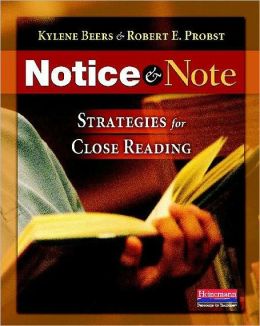
My new favorite book (Don't I say that about every book?) for reading comprehension strategies is Notice & Note by Kylene Beers and Bob Probst. The strategies are almost so simple, one wonders why one didn't think of it on her own (her being me). 

With my midnight genius, I realized that "The Horror" is a perfect piece to introduce the signpost Contrast & Contradictions, especially as a contrast piece itself to "The Tell-Tale Heart." I already had my presentation for this strategy created, and a first period conference time allowed me to do some quick editing and revising to teach this concept today. 

The idea behind the strategy (and the others in the book) is for students to look for repetitive patterns to help understand text. With Contrasts & Contradictions, the kids look for (notice) character actions that are the opposite of what we expect. 


We began the lesson by discussing the concepts in the slide - everything from the stop sign, what notice and note mean, and examples of contrasts and contradictions. Now, as an edutainer, I have no problem making fun of myself, so coming up with real-life examples to teach this was easy:

  • If Ms. Foti came to school in a dress, you would be asking... (this is where they all chime in with, "Why?"). 
  • If Ms. Foti was mean to you for a day, you would be asking...
  • If Ms. Foti got married this weekend, you would be asking...
Hook, line, and sinker, all in one. 

Before reading the piece, I set the mood. I turned the lights off (I have a big window). I got everyone quiet. I reminded them that we were focused on identifying contrasts and contradictions within the reading. Then I read "The Horror" as if it was the scariest, most frightening, terrifying work ever written. 

I didn't even have to teach after that. Each class period, the kids were already commenting about everything that was "not right" with the passage. The contrasts and contradictions stood out like me in a dress (for those readers who do not know me personally, I am a bit of a tomboy and do not even own a dress). Of course, we did discuss afterward, identifying and labeling (noting) the CCs. But I would not call what I had to do at that point work. It certainly helps to have middle school students who are horror movie connoisseurs. 

I have to give a genius student credit for pointing out an obvious CC that I completely overlooked. At the beginning of the text, Eggers sets up Sandra as fearful, yet by age thirty, she is ready to write a horror novel. Can Ms. Foti say contradiction?

It always feels fantastic when students grasp a concept (and quickly), but the best reward is watching them enjoy education. Today ranks as one of the best learning days of the year.