Search This Blog

Showing posts with label poetry. Show all posts

Saturday, November 30, 2019

Building seventh grade poets

I need to tell the truth, the whole truth, and nothing but the truth: I took the easy way out on an assignment. I needed my students to write poetry, and I was in a time crunch. Some of my students were finished with a previous writing assignment, and I needed to help others without holding my finishers up. I could not see how I was going to teach a poetry writing assignment like I wanted. So I didn't! And I have to admit that sometimes the laziest lesson planning creates the most amazing results.

"Miss, what's a syllable?"
In order to continue addressing the previous writing assignment, I resorted to creating two poetry writing assignments in Google classroom: a nonet and a Japanese lantern poem. Both poems have specific rules for lines and syllables. I assumed these would not require much explanation and/or support from me, allowing me to work with some students who needed more help.

Despite some initial struggles with syllable counting, some of my students produced the best writing I have had from them all year. I was blown away, and my shock at the work they produced led them to ask if I would share their work. I am working on building internal motivation in my students, and we are all about braggin' rights. So please allow me to brag on my kids.

Many students chose to write the nonet. I am providing the structure of the poem as well as some of my favorite examples.


Wednesday, June 28, 2017

Poetry. Yuck!

This post is a response to "Chapter 4: Poetry for Children" in Sylvia Vardell's Children's Literature in Action that I am reading for a graduate children's and young adult literature course.

___________________________________________________________________________

Poetry. Yuck! That’s my first reaction when I think about poetry, but I honestly do not know where that comes from. As I was reading this chapter, I was a bit flabbergasted by how much of a role poetry has played in my life and my teaching. 

As I was reading about Mother Goose, something clicked in my brain. I have a closet in my house that is used solely for book storage (it’s one of many places). I had to stop reading the chapter about poetr and go hunting to find something I thought was there:


These three books are all from my childhood (I’m almost 44, so they have been around a long time). All were read more times than I can remember. All are attached to some very positive memories of my mother and maternal grandparents, and just finding them and seeing my grandmother’s handwriting brought me to tears, so much so that I had to stop reading about poetry and contact my mother and sister. That is the power of literature right there. 

When I did get back to the chapter, as I read J. Patrick Lewis’ interview, I remembered that my fifth grade writing project was all poetry. I can recall sitting in class, writing limericks and haikus, editing and revising over and over again in an attempt to create the best possible work. There were two other girls in class who were also writers, and we were very competitive. For as long as I can remember, it was my intention to be the best writer. 

I continued to write a great deal of poetry throughout my childhood. I have literary magazines from high school in which my poetry is published. I also filled personal journals with teen angst-filled poetry.


I have never simply shared poetry with my classes. In teaching STAAR-tested poetry, the goal has always been to make sure students understand it enough to answer questions to be able to pass the test and move on to ninth grade. Now that I am not in a STAAR-tested class, I do have the ability to actually share poetry. 

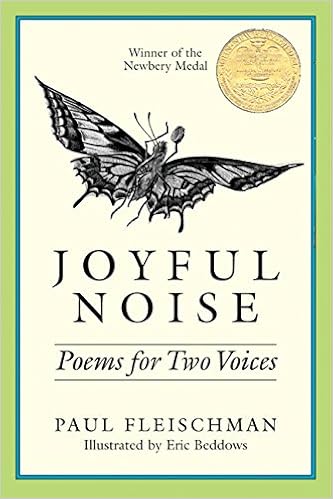
I don’t like to teach poetry for reading, but I like to teach writing poetry. When I was at the AVID conference last week, one of the writing strategies presented was a two-voice poem (page 139). This is not new information to me. I have taught this format before, but I have not used it in quite some time. I have already added it to my list of beginning lessons for August. My eighth grade classes will be a half-and-half mix of students I taught last year in seventh grade and students who are new to AVID for eighth grade. I am going to use the two-voice poem as a get-to-know you activity between my former students and my new students. 

I have also taught other types of poems in my class, such as diamante and acrostic, but one of my favorite poems to teach is a “Where I’m From” poem that I first learned about through AVID. The poem is based on a piece by George Ella Lyon. In the classroom, it provides an opportunity for students to explore their family backgrounds. I have also used the “I Am” poem that I first learned about through AVID. 
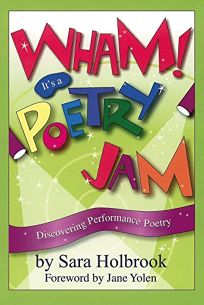
Ironically, despite thinking I do not like poetry at all, I have been a big proponent of spoken-word poetry. I purchased Wham! It’s a Poetry Jam in an attempt to try to build a poetry slam on my campus, but it never found it’s footing. I used a few of the poems with my students, but I was discouraged and gave up. It might be time to pull that book back out. 

This chapter also made me wonder what poetry is available in my school library. Silverstein and Prelutsky are staples, and I know exactly where they are on the bookshelf. I pulled up our online library catalog to see what other poets we have available for checkout. There are 228 titles categorized under poetry, including The Poetry Friday Anthology by Sylvia Vardell (I have debated about buying that book for years; I had no idea we had a copy at school). We also have titles from Paul Janeczko, Lee Bennett Hopkins (I didn’t know he was a big deal until reading this chapter), Carl Sandburg, and Pat Moon, to name a few. I honestly do not think I have ever seen a student walking around with a book of poems, however, unless it has been a requirement for an English class project. 

Based on my very informal analysis of titles, it does not look like our collection addressed the diversity of our school campus. Many of the books are about holidays or are compilations of silly poems. My campus has a new librarian coming in this year, and this is probably something I can discuss with her. 

This class continues to surprise me as I continue to discover how different genres of literature have shaped me. When I say I cannot remember not reading, I really know why. When you look back on the role of literature in your own life, what role did/does poetry play?
              

Monday, February 29, 2016

Where is poetry hidden in your life?

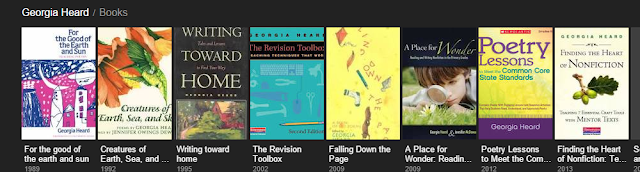
This weekend, I had the honor of being able to attend the Rose F. Spicola Forum in Reading at Texas Woman's University in Denton, Texas (the perks of being enrolled in a cohort program). The two keynote speakers were Georgia Heard and Naomi Shihab Nye. 


Google Search

Google Search

I have no shame in admitting that I am not a big poetry fan. Sure, I filled journals with teen angst-filled poems about boys and friends and loneliness when I was younger, but I have never considered myself a poet. Sure, I get a kick out of Shel Silverstein and "Sarah Cynthia Silvia Stout", but I do not consider myself a strong poetry teacher. But listening to Heard and Shihab Nye inspired me to find my poetic side. 

In Heard's speech, she discussed finding hidden poetry in our lives. She began by asking the audience to make a list of places where we might find hidden poetry:
  • my workouts
  • my classroom
  • my students
  • my pets
Heard then asked us to take one of our ideas and make a poem out of it. The assignment was not about writing at the level of a professional poet but of expressing ourselves through poetry. If I cannot write my own and be comfortable with whatever I can produce, how can I expect my students to do so? 


Both Heard and Shihab Nye suggested carrying around a small notebook in which to track observations about the world. After leaving the forum, I headed straight to Walmart to buy myself a little notebook and some cute new pens (may as well indulge). 


Being in a poetry mindset, I found myself aware and taking notice of the world around me - at Walmart. And there is so much to observe and write about at Walmart!


From this list, I heeded Shihab Nye's advice. I chose some of the items on my list and created a new poem. 


From here, I am already planning ahead in my brain, determining how to use this in my class this year and next year (I am always thinking ahead). I am not worried about my talent - or lack thereof. I want to be able to go through the process in order to be a better teacher. Maybe I can ignite a passion in a student and end up watching them become the keynote speaker at a future conference. 


Thursday, February 5, 2015

"You can't write a poem about McDonald's"

"You can't write a poem about McDonald's" has been one of my favorite poems for years now. I have been teaching it annually because I want my kids to understand that poetry can be different than what they expect. Most kids hear the word poem or poetry and 
shut down immediately. Honestly, I am not a big poetry fan myself, so it is far from being my favorite thing to teach. For the benefit of my students and for me, I do my best to find off-the-wall poems. 


The focus for this lesson was making inferences from sensory details. To get them thinking about this, I had my students complete a pre-reading writing assignment, describing their favorite meal in as much sensory detail as possible. 


I then introduced three vocabulary words from the poem: fanatic, salvation, and cannibalism. To confuse them, I threw in the phrase "hip huggers and halter tops", showing them a picture from the 1970s. We focused on their meanings, and tried to figure out how they could possibly be connected and used them to make a prediction about the poem. Most of the kids focused completely on 

The next day, we worked on a sorting game. On one set of index cards, I glued images for the five senses. On a second set, I glued phrases from the poem. In groups, my students decided the sense being used to create each description. Adding the words and phrases to the vocabulary from the day before, the kids wrote a new prediction. Again, they seemed fixated on the cannibalism, and I began to question them about the type of teacher they think I am. 


At this point, they were completely suckered in, and I gave them the title of the poem. Many of the kids did not believe me (probably because I am known for pranking them). After a bit of convincing, the resigned their suspicions, and the lightbulbs above their heads began sparking as they made connections between the title and the phrases I had given them: crisp as a pickle, brown as a bun, greasy air, fingers thin like french fries

Once I let them read the poem, there were some realizations that out of the original words I taught them, they should have focused on fanatic rather than cannibalism. I think a few kids were disappointed that the poem was not about a savage murderer ("You did teach us that story about the guy who cut up the body and buried the heart, Miss."). But the more we discussed the sensory details, the more the poem came to life for them. 

As a culminating activity, we are drawing visual representations of the poem. Some kids are creating scenes while others are working on collages of images throughout the poem. So far, I have seen everything from the crazy fanatic to very interesting renditions of a hamburger cashier. Images to come!


Friday, March 14, 2014

I really hope this takes a week: A poetry lesson

We are just about two weeks away from our eighth grade state reading test. As much as I hate standardized testing, it is currently part of the job, and it is still my responsibility to prepare my students for the exam. Before spring break, my department met to analyze data, and we discovered that the only real need to have for the test is more poetry. So, the next two weeks will be poetry. 

But I have an issue. One, I am writing lessons for a long-term sub in another class. Two, I am out of my classroom for three days next week for the ESL state reading exam. So I am essentially writing a test-prep lesson for two (very reliable and hardworking) subs to teach over the course of a week. 

I know my own pacing. I know how I would teach this in the classroom. I know the conversations I would have. How do I write all of that into lesson plans for other people? Why, a PowerPoint presentation, of course!

I have been studying for the high school certification exam and have been doing a lot of reading. Fortunately, there is a great deal of information in these texts regarding poetry, particularly regarding reader response,  and I am trying to incorporate as much of it as possible into the lesson. There is even more I would like to add, but I am trying to balance what the subs can handle without completely overdoing it. 


So here is the breakdown:

  • For the lesson, I am using the poem "Midnight" by Sara Holbrook. This poem was on last year's state exam. By using the poem and state questions, I am hoping to give my students a bit of familiarity with the exam format (our district assessments are honestly much harder). 
  • I am starting with a Quick Write simply to get the kids thinking prior to the reading, especially since this lesson is coming directly after spring break. 
  • The kids will be reading the poem on their own first. I do not expect them to understand
    everything about the poem, but they need the independent practice. During this reading, they will identify any words for which they need clarification. 
  • I (or the subs) will read the poem out loud. The kids need to hear fluent reading, particularly when it comes to poetry. In eleven years of teaching middle school, this has always been an issue. 
  • We will then break into a Think-Pair-Share activity. Based on the above readings, I am going to have the students write their thoughts about what they have read, whether it be questions, personal connections, or understanding. I want them to get the thoughts on their papers before we discuss. Not all students will speak up in a large group setting, and they all need a chance to express themselves. This also helps to meet the needs of my ESL students by giving them an opportunity to write and to speak. Hopefully, the subs can guide this discussion for a few minutes without too much pressure. 
  • The next step is to take Cornell notes over terms associated with the poem - speaker, stanza, simile, metaphor, personification. Based on previous test results, my students do not have too many issues with figurative language. I am more concerned with making sure that they understand that the speaker is not the poet. 
  • Although this is not necessarily what I would do if I was in class with the kids, I have added a section on paraphrasing. My own observations tell me that my students often get distracted by the format of a poem and lose focus of the meaning. I have written in a section with guiding questions to help them interpret the poem, then they will work collaboratively on the rest. 
  • As part of the reader response focus of this lesson, I am going to have them do a short writing assignment from the Teaching Reading book above. They will identify what they deem to be the most important word, phrase, and element, explaining why. This is an opportunity for them to reflect upon the meaning in a personal manner. 
  • At this point, the students will be answering the questions from last year's state test (blah). I rarely test in this manner in my classroom. Most of my assessments are much more holistic in nature and usually involve writing. But, this is the first exposure that they are going to have to questions from the state itself. 
  • The last part of the lesson involves test-taking strategies - breaking down the answer choices to determine why three answers are wrong and one is correct. The students tend to look for the right answer and do not take the time to effectively eliminate the wrong answers. I have done this since I started teaching, and it seems to help. I have added everything to the PPT that I think I would discuss in class. It's like me in clip art format!

If I was in the classroom, and it was not testing time, I would be doing this much differently. Sometimes, however, my hand is forced. Here's to hoping that this actually takes a week.